Calculus I final exam study sheet
The Calculus I final is cumulative, but the integration unit at the end of the term usually carries the most new points: Riemann sums, both parts of the Fundamental Theorem, u-substitution, and area between curves. Limits and derivative rules come back mostly as steps inside bigger problems rather than as stand-alone questions. At many universities the final is a common exam written by the department, so it can look different from your instructor's midterms.
Whether your course calls it a formula sheet, a crib sheet, an aid sheet or just your revision notes, the job is the same: one page that holds a whole semester of calculus.
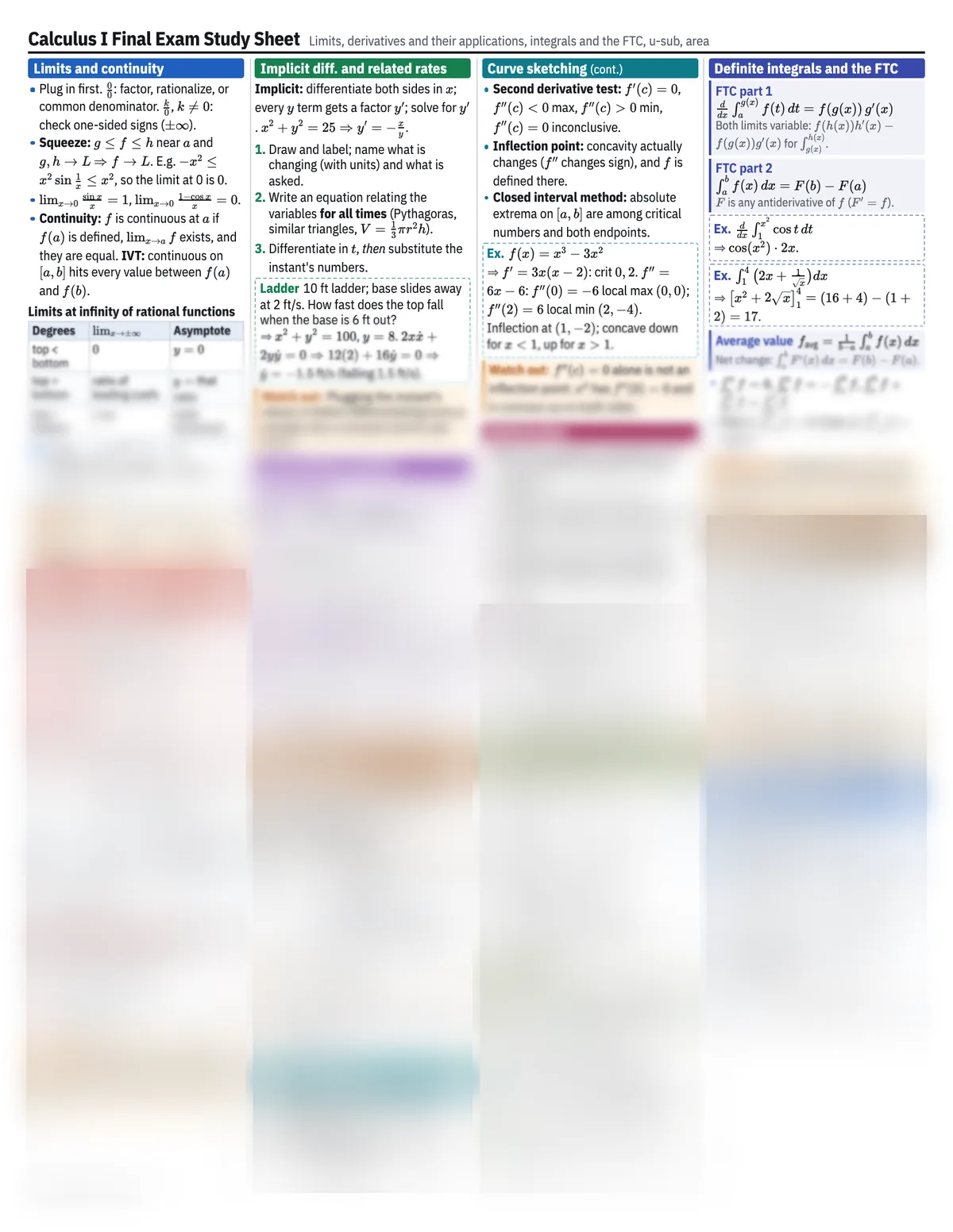 Cheat sheet locked
The scope
What this exam usually covers
Expect one or two problems from each block below, with the integration material weighted most heavily. Check each against the review sheet your course posts.
- Limits that need a technique Rationalizing, the squeeze theorem, and limits at infinity of rational or radical functions. The sign of the square root as x goes to negative infinity is a classic lost point.
- Derivatives, including logarithmic Chain rule nested two deep, implicit differentiation, and log differentiation for a variable base and exponent such as x to the x. Inverse trig derivatives are often included.
- Related rates and linearization Usually one word problem: relate the quantities first, differentiate in t, substitute last. A linear approximation of a root or a trig value is a common short question.
- MVT and L'Hôpital Find the c the Mean Value Theorem promises, or check its hypotheses. L'Hôpital with a rewrite first: a product, a difference, or an exponential form like 1 to the infinity.
- Curve sketching and optimization Sign charts for f' and f'', the first and second derivative tests, and one applied max or min problem where the domain and the endpoint check carry points.
- Riemann sums and antiderivatives Left, right, or midpoint sums from a table or a formula, the limit-of-sums definition, and an initial value problem that solves for the constant C.
- FTC, both parts Differentiate an integral with a variable upper limit (chain rule included), and evaluate definite integrals with an antiderivative. Average value and net change ride along.
- u-substitution and area Definite integrals where the limits must change with u, and the area between two curves, found from the intersection points, sometimes easier in y.
Usually later
Integration by parts, trig substitution, volumes of revolution, and work belong to Calculus II at most schools, though some Calculus I courses end with a short volumes section; check whether the review sheet lists it. Epsilon-delta proofs and Newton's method are on some finals and skipped by others, so let the posted topic list decide.
The rules
What a note sheet is usually allowed to include
check your exam header — it wins
Calculus I final rules depend on whether the exam is a department-wide common final or your own instructor's paper. Common finals more often allow no notes, or print a short list of trig identities and derivative formulas on the cover. Instructor-written finals sometimes allow one handwritten page, front and back, or an index card. Canadian courses may call this an aid sheet and state its exact size; UK and Australian courses that permit a crib sheet usually specify it in the module handbook. Calculators are a separate rule and are often banned. Build this page as a study sheet either way, and bring it only if your syllabus says a note sheet is allowed.
The sheet
The matching library sheet
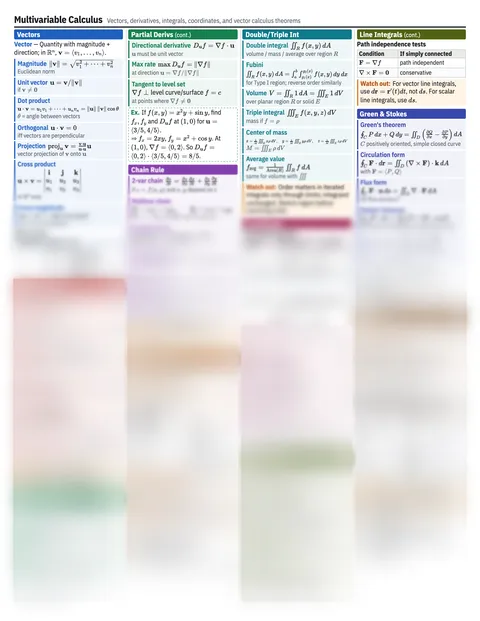
A one-page reference for the whole topic, fact-checked, with the first part free to read. This exam page does not repeat it. Use it to see the material, then make a shorter study sheet from the notes your section actually used.
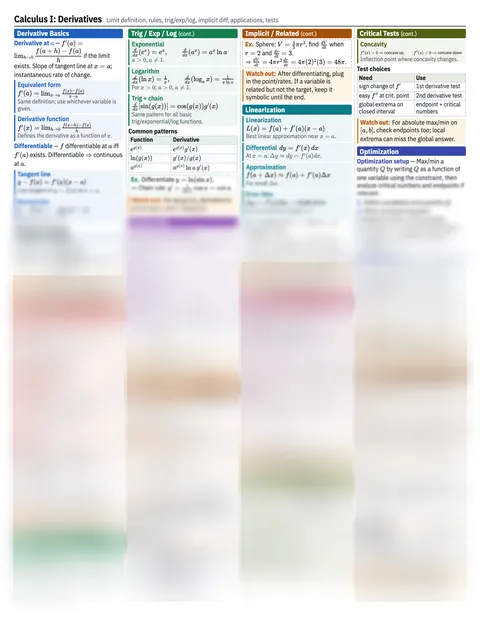
Calculus I: Derivatives reference sheet — the free part in text.
Unlock the full reference sheet to edit, print or save it as a PDF.
Unlock the full Final exam sheet, written for this exam's scope. The free part is in the preview above.
Make your own for this exam
Upload the slides or problem sets from the whole term, with extra weight on the integration weeks, and say in the focus step which topics the review session stressed. Choose one page or front and back to match the final's rule.
FAQ
Questions
- What should go on a Calculus I final formula sheet?
- The derivative and antiderivative tables, product, quotient, and chain rules, both parts of the FTC, the Riemann sum setup, the L'Hôpital forms, and a short procedure for related rates and optimization. Worked examples of the problem types you miss most are worth more than a second copy of rules you already know.
- Is the Calculus I final mostly integrals?
- It is cumulative, so every unit appears, but the integration unit is usually the largest single block because it has not been tested as heavily yet. Limits and derivatives tend to show up inside larger problems.
- Can I bring a crib sheet to a Calculus I final?
- Only if the exam rules say so. Department-wide finals often allow nothing or provide a formula list; some instructor-written finals allow a handwritten page or card. Check the syllabus or the exam instructions, not last year's rules.
- Do I need epsilon-delta proofs for the final?
- Some courses test the formal limit definition and many do not. If it was on a homework set and the review sheet lists it, put one worked template on your sheet; otherwise spend the space on integration.
- How is this different from the Midterm 1 page?
- Midterm 1 covers the derivative rules. This page covers the whole course and adds what comes after: applications of derivatives, Riemann sums, the Fundamental Theorem, and substitution.
Keep going
More study pages
All of these sit in the sheet library. Every exam study page.