Organic Chemistry Cheat Sheet — 1-page PDF
Functional groups, naming, resonance, acid-base, stereochemistry, mechanisms, alkenes, alcohols. The whole course on one dense, printable page for your midterm or final, with every formula typeset and worked examples where they help.
The first part is free below. See pricing →
For a specific exam: Organic Chemistry I Midterm 1 study sheet, Organic Chemistry I Final exam study sheet.
- 1 pageUS Letter
- 10 sections11 topics
- Free previewfull sheet with Unlimited
 Cheat sheet locked
On the sheet
What’s on it
The topics a typical Organic Chemistry I exam tests, all on the one page.
- Functional groups
- Nomenclature basics
- Resonance and formal charge
- Acid-base and pKa trends
- Stereochemistry: chirality, R/S, E/Z
- Conformations
- SN1 vs SN2
- E1 vs E2
- Alkene addition reactions
- Markovnikov vs anti-Markovnikov
- Alcohol reactions
Free preview
The free part, as text
The free part of the sheet, section by section. Unlock the full sheet to read the rest, edit any block, and print it or save it as a PDF.
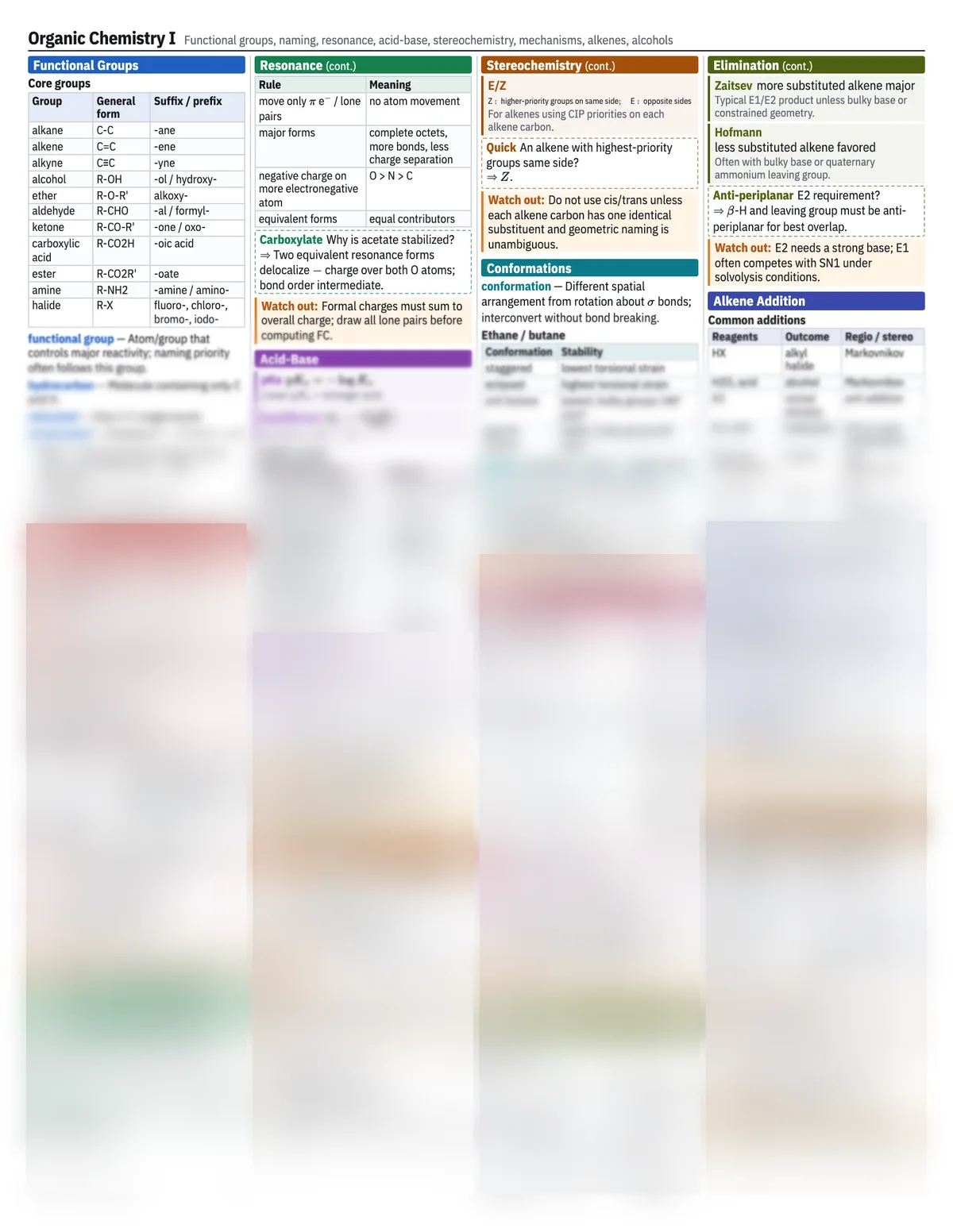
01Functional Groups
Core groups
| Group | General form | Suffix / prefix |
|---|---|---|
| alkane | C-C | -ane |
| alkene | C=C | -ene |
| alkyne | C≡C | -yne |
| alcohol | R-OH | -ol / hydroxy- |
| ether | R-O-R' | alkoxy- |
| aldehyde | R-CHO | -al / formyl- |
| ketone | R-CO-R' | -one / oxo- |
| carboxylic acid | R-CO2H | -oic acid |
| ester | R-CO2R' | -oate |
| amine | R-NH2 | -amine / amino- |
| halide | R-X | fluoro-, chloro-, bromo-, iodo- |
- functional group
- Atom/group that controls major reactivity; naming priority often follows this group.
- hydrocarbon
- Molecule containing only C and H.
- saturated
- Only C-C single bonds.
- unsaturated
- Contains or .
- Alkyl = substituent from alkane minus one H, e.g. methyl , ethyl .
- Aromatic ring: phenyl .
- Alkene/alkyne reactions occur at bond.
02Resonance
Resonance rules
| Rule | Meaning |
|---|---|
| move only e / lone pairs | no atom movement |
| major forms | complete octets, more bonds, less charge separation |
| negative charge on more electronegative atom | O > N > C |
| equivalent forms | equal contributors |
CarboxylateWhy is acetate stabilized?
Two equivalent resonance forms delocalize charge over both O atoms; bond order intermediate.
Watch out:Formal charges must sum to overall charge; draw all lone pairs before computing FC.
03Acid-Base
pKa
Lower = stronger acid.
Equilibrium
For .
Acidity trends
| More acidic when... | Reason |
|---|---|
| more electronegative atom bears charge | stabilizes charge |
| larger atom bears charge down a group | charge more diffuse |
| more resonance stabilization | delocalization |
| greater -character in conjugate base | sp > sp2 > sp3 |
| electron-withdrawing groups nearby | inductive stabilization |
04Stereochemistry
E/Z
Z: higher-priority groups on same side E: opposite sides
For alkenes using CIP priorities on each alkene carbon.
QuickAn alkene with highest-priority groups same side?
.
Watch out:Do not use cis/trans unless each alkene carbon has one identical substituent and geometric naming is unambiguous.
05Conformations
- conformation
- Different spatial arrangement from rotation about bonds; interconvert without bond breaking.
Ethane / butane
| Conformation | Stability |
|---|---|
| staggered | lowest torsional strain |
| eclipsed | highest torsional strain |
| anti butane | lowest; bulky groups apart |
| gauche butane | higher; bulky groups apart |
Strain
torsional + steric + angle strain
Contributes to conformational energy.
ChairCyclohexane substituent most stable position?
Equatorial usually preferred; axial has 1,3-diaxial interactions.
06Elimination
Zaitsev
more substituted alkene major
Typical E1/E2 product unless bulky base or constrained geometry.
Hofmann
less substituted alkene favored
Often with bulky base or quaternary ammonium leaving group.
Anti-periplanarE2 requirement?
-H and leaving group must be anti-periplanar for best overlap.
Watch out:E2 needs a strong base; E1 often competes with SN1 under solvolysis conditions.
07Alkene Addition
Common additions
| Reagents | Outcome | Regio / stereo |
|---|---|---|
| HX | alkyl halide | Markovnikov |
| H2O, acid | alcohol | Markovnikov |
| X2 | vicinal dihalide | anti addition |
| X2, H2O | halohydrin | OH on more substituted C |
| BH3 then H2O2/NaOH | alcohol | anti-Markovnikov, syn |
| H2, Pd/C | alkane | syn hydrogenation |
Cheat sheet locked
Also on the full Organic Chemistry I sheet
9 more sections, with every definition, formula and worked example. Unlimited unlocks every full sheet in the library to edit, print or save as a PDF, and makes unlimited sheets from your own notes.
Naming
- Parent chain
- Order
- Common suffix priority
Resonance
- resonance structures
- Formal charge
Acid-Base
- Hybridization acidity
Stereochemistry
- chirality
- enantiomers
- diastereomers
- CIP priority
Conformations
SN1/SN2
- Key comparison
- SN1
- SN2
Elimination
- E1 vs E2
Alkene Addition
- Markovnikov
- Anti-Markovnikov
Alcohols
- Major reactions
- Alcohol substitution
FAQ
Questions
About the Organic Chemistry I sheet and making your own.
- What does this Organic Chemistry I cheat sheet cover?
- It has 10 sections: Functional Groups, Naming, Resonance, Acid-Base, Stereochemistry, Conformations, SN1/SN2, Elimination, Alkene Addition and Alcohols. Together they cover the topics a typical Organic Chemistry I exam tests, including functional groups, nomenclature basics, resonance and formal charge and acid-base and pKa trends.
- Is the organic chemistry cheat sheet free?
- The first part is free to read on this page, with no account needed. The full sheet opens in the app with Unlimited ($4.99 a month or $19 for a semester), where you can edit it, print it or save it as a PDF. It is one US Letter page and prints cleanly in black and white or colour.
- Can I bring this Organic Chemistry I cheat sheet to my exam?
- Only if your course allows a note sheet, so check the syllabus. This one is a single US Letter page. If your exam allows a different size, such as a 3x5 or 4x6 index card or one page front and back, Cheat Sheet AI makes one at exactly that size from your own lecture notes.
- How accurate is it?
- The sheet was written by our engine from a standard course outline, then a second model fact-checked every formula and statement against it; it corrected 3 statements before publishing. Notation and emphasis vary between courses, so check it against your own lecture notes.
- Can I make a Organic Chemistry I sheet from my own notes?
- Yes. Upload your lecture slides, notes or study guide and Cheat Sheet AI writes a sheet in your course's notation, sized to exactly the space your exam allows. Your first sheets are free.
Your course, your notes, one page.
Upload your own Organic Chemistry I slides or notes and get a study sheet in your course’s notation. Your first sheet needs no account, and a free account adds one more. See pricing