Organic Chemistry I final exam study sheet
The Organic Chemistry I final is cumulative, and the structure topics from the first midterm come back inside the mechanism questions: you cannot predict SN1 versus SN2 without carbocation stability, or E2 products without stereochemistry. The heaviest weight usually falls on substitution and elimination, alkene addition reactions, and alcohols, along with short synthesis problems that chain two or three steps together.
Students in the UK call this kind of page revision notes or a crib sheet, Canadian courses an aid sheet, and US students a cheat sheet or reaction sheet: one page of mechanisms, trends, and stereochemical rules in your own drawings.
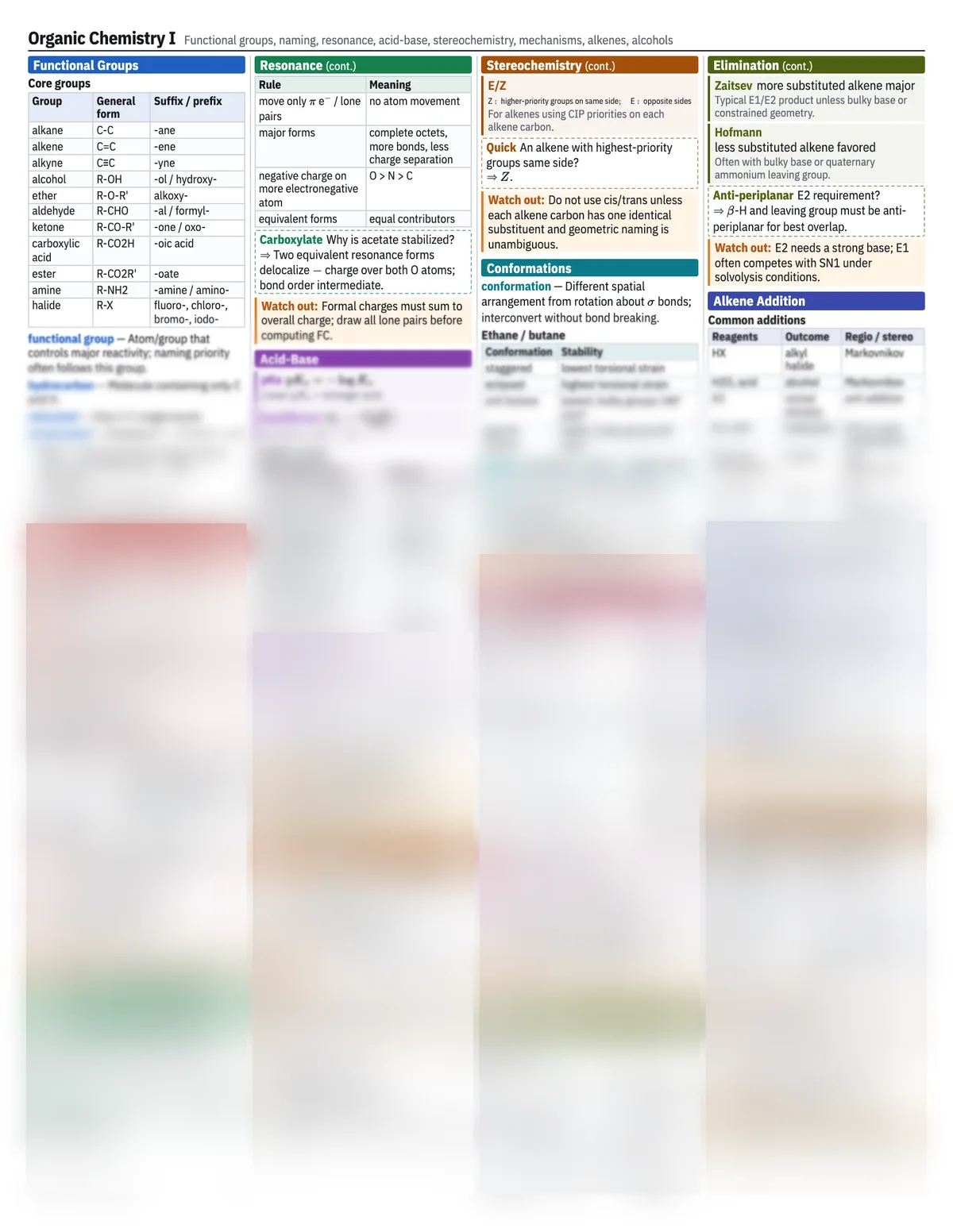 Cheat sheet locked
The scope
What this exam usually covers
These are the problem types an Organic Chemistry I final usually grades. Drawings and arrows earn the points, so practise them rather than memorizing lists.
- Structure, resonance, and acidity Formal charge, legal resonance arrows, and ranking acids by the stability of the conjugate base. These reappear inside mechanism questions on the final, not just as standalone items.
- Stereochemistry R/S, E/Z, enantiomers, diastereomers, and meso compounds, now applied to products: which reactions give racemic mixtures, inversion, or syn versus anti addition.
- Conformations Chair conformations with axial and equatorial substituents. On the final the main use is E2 on cyclohexanes, which needs the leaving group and the hydrogen trans-diaxial.
- SN1 versus SN2 Substrate, nucleophile, leaving group, and solvent decide the pathway. SN2 inverts the stereocenter; SN1 racemizes and can rearrange through a more stable carbocation.
- E1 versus E2 and product choice Strong bulky bases favour E2 and the Hofmann product; small strong bases give Zaitsev. E2 requires anti-periplanar geometry, which fixes the alkene geometry.
- Alkene addition reactions HX, hydration, halogenation, hydroboration-oxidation, and others your course covered, with Markovnikov versus anti-Markovnikov regiochemistry and syn or anti stereochemistry.
- Alcohols Conversion to alkyl halides and sulfonates, acid-catalysed dehydration, and oxidation states where taught. Converting OH into a good leaving group is the step students forget.
- Short synthesis Two or three steps from a starting material to a target using the reactions above. Work backward from the product and check regiochemistry and stereochemistry at each step.
Usually later
Spectroscopy (IR, NMR, mass spectrometry), radical halogenation, alkynes, conjugated dienes and Diels-Alder, and ethers and epoxides are each taught in Organic Chemistry I at some schools and Organic Chemistry II at others. Aromatic and carbonyl chemistry are Organic Chemistry II. The review sheet tells you which units this final includes.
The rules
What a note sheet is usually allowed to include
check your exam header — it wins
Organic Chemistry I finals rarely allow a sheet of reactions, because recalling reagents is part of what is graded. Many departments supply a pKa table and a periodic table and allow nothing else; some use a standardized final under the same rule. Molecular model kits are allowed by some instructors and banned by others. A minority of courses permit one handwritten index card. Canadian exam covers state whether an aid sheet is allowed, and UK modules that permit a crib sheet say so in the module handbook. Follow the syllabus; this page is a study sheet for practising at your desk either way.
The sheet
The matching library sheet
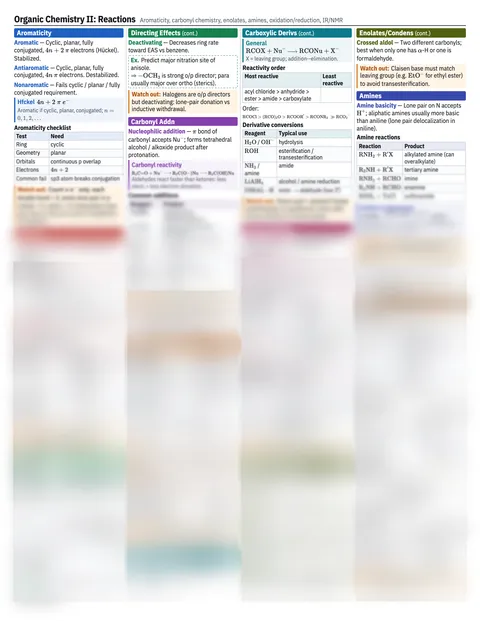
A one-page reference for the whole topic, fact-checked, with the first part free to read. This exam page does not repeat it. Use it to see the material, then make a shorter study sheet from the notes your section actually used.
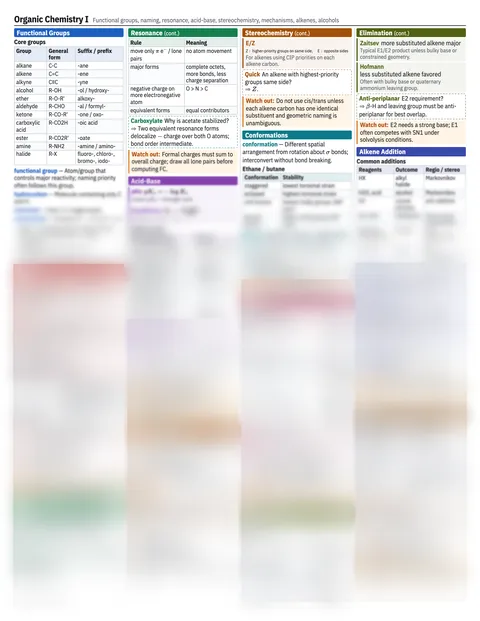
Organic Chemistry I reference sheet — the free part in text.
Unlock the full reference sheet to edit, print or save it as a PDF.
Make your own for this exam
Upload the lecture notes and problem sets from the whole term, and in the focus step name the mechanisms and reactions the review session stressed, such as E2 on cyclohexanes or hydroboration. Pick one page or front and back, and ask for reagent-to-product summaries with stereochemistry rather than paragraphs.
FAQ
Questions
- Is the Organic Chemistry I final cumulative?
- Usually yes. Structure, acidity, and stereochemistry from the first exam appear inside the mechanism and synthesis questions, so they are tested twice even when no question asks for them directly.
- Can I bring a crib sheet to an Organic Chemistry I final?
- Usually not. Most courses provide a pKa table and a periodic table and allow no notes, because knowing the reagents is the point of the exam. A few allow one index card. Check the syllabus or the exam announcement.
- How do I decide between SN1, SN2, E1, and E2 on the final?
- Classify the substrate as methyl, primary, secondary, or tertiary, then the reagent as a strong nucleophile, strong base, both, or weak. Add solvent and temperature. Secondary substrates are the cases where the reagent decides.
- Should my study sheet include spectroscopy?
- Only if your course taught IR or NMR before this final. Many schools leave spectroscopy to Organic Chemistry II, and the review sheet will say.
Keep going
More study pages
All of these sit in the sheet library. Every exam study page.