Organic Chemistry II final exam study sheet
The Organic Chemistry II final is usually cumulative across both semesters in practice, because synthesis problems reuse Organic Chemistry I reactions. The new weight is on the later units: enolates and the aldol and Claisen condensations, amines, and multistep synthesis that combines aromatic substitution with carbonyl chemistry. Spectroscopy often returns as a structure-determination problem that ties the course together.
Call it a crib sheet, revision notes, an aid sheet as Canadian courses do, or a reaction summary: one page that maps reagents to products for the chapters this final covers.
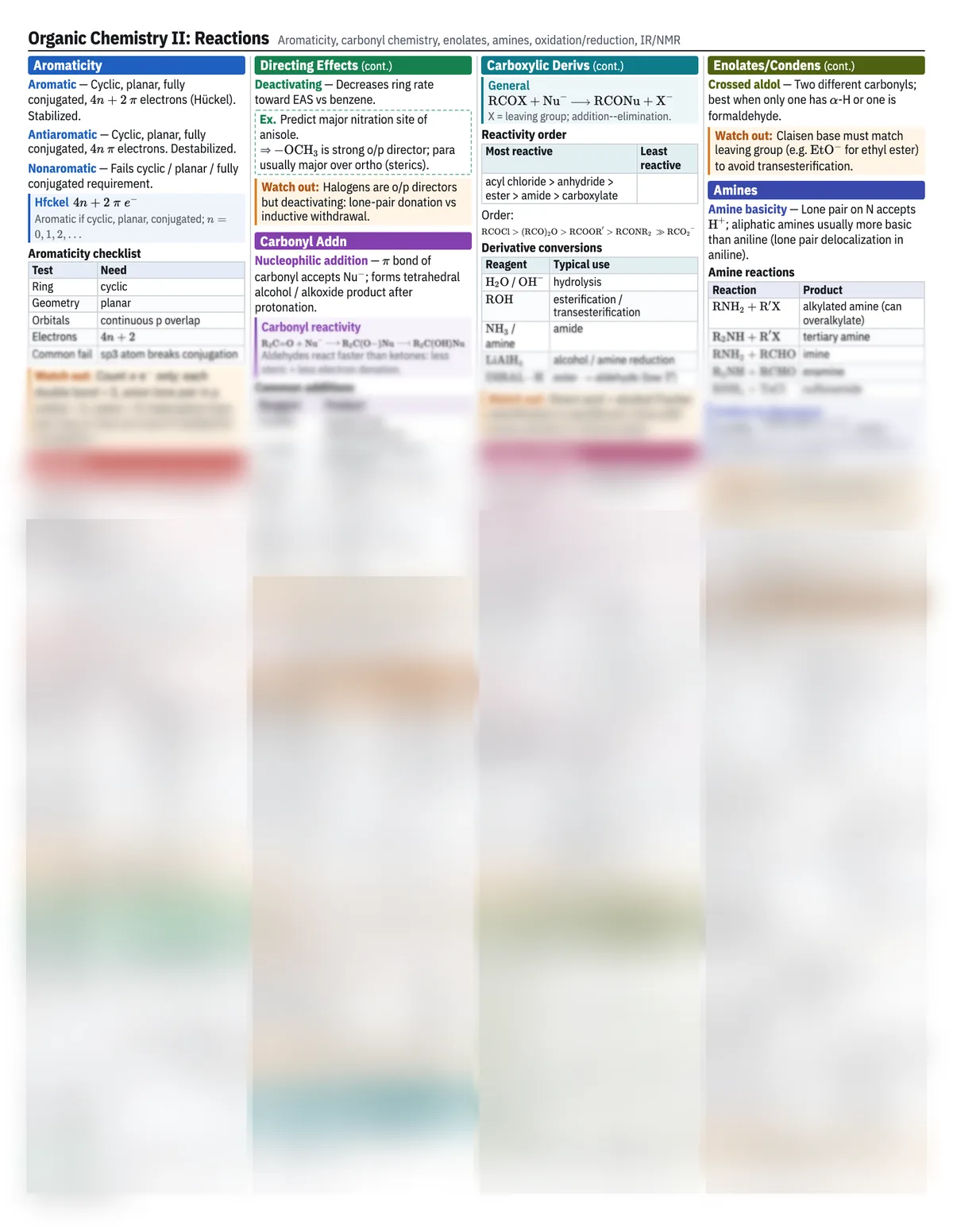 Cheat sheet locked
The scope
What this exam usually covers
These are the problem types an Organic Chemistry II final commonly grades. Multistep synthesis and spectroscopy carry the most points at many schools.
- Aromaticity Hückel's rule with 4n+2 pi electrons in a planar, fully conjugated ring. Heterocycles such as pyrrole and pyridine test whether you count the nitrogen lone pair correctly.
- Electrophilic aromatic substitution and directing effects Nitration, halogenation, sulfonation, and Friedel-Crafts with their limits. Order of steps in a disubstituted benzene synthesis is a standard final question.
- Nucleophilic addition to aldehydes and ketones Hydrides, Grignard reagents, acetals as protecting groups, imines and enamines, and Wittig where taught. Grignard reagents are destroyed by any acidic hydrogen in the molecule.
- Carboxylic acid derivatives Reactivity order from acid chlorides to amides, nucleophilic acyl substitution, hydrolysis, and reduction with LiAlH4. Esters plus excess Grignard give tertiary alcohols, not ketones.
- Enolates and condensations Kinetic versus thermodynamic enolates, alpha-alkylation, aldol and Claisen condensations, and often conjugate addition. Spotting the aldol or Claisen bond in a target is the key synthesis skill.
- Amines Basicity trends, aniline versus alkylamines, reductive amination, and diazonium salts for substitution on benzene where your course taught them.
- IR and NMR structure determination Diagnostic IR bands for C=O, O-H, and N-H, then NMR shifts, integration, and splitting to assemble a structure from a formula. Degree of unsaturation is the quick first step.
- Multistep synthesis Plan backward from the target, keep track of which functional groups survive each reagent, and protect when needed. Partial credit usually depends on writing reagents for every step.
Usually later
Carbohydrates, amino acids and peptides, lipids, pericyclic reactions beyond Diels-Alder, and polymers often close out Organic Chemistry II and carry less weight, or appear only in some courses. Conjugated dienes and Diels-Alder are taught in either semester depending on the textbook. Check the review sheet for the last chapter included.
The rules
What a note sheet is usually allowed to include
check your exam header — it wins
Organic Chemistry II finals rarely permit a reaction sheet, since mapping reagents to products is what the exam tests. The usual materials are a periodic table, a pKa table, and sometimes IR and NMR correlation charts printed on the exam. Some departments give a standardized end-of-year organic exam with no notes at all. A few instructors allow a single handwritten index card, and model kits are allowed in some sections. In Canada, check the exam cover for the aid-sheet rule; in the UK, crib sheets are uncommon for organic papers. The syllabus decides; this page is a study sheet either way.
The sheet
The matching library sheet
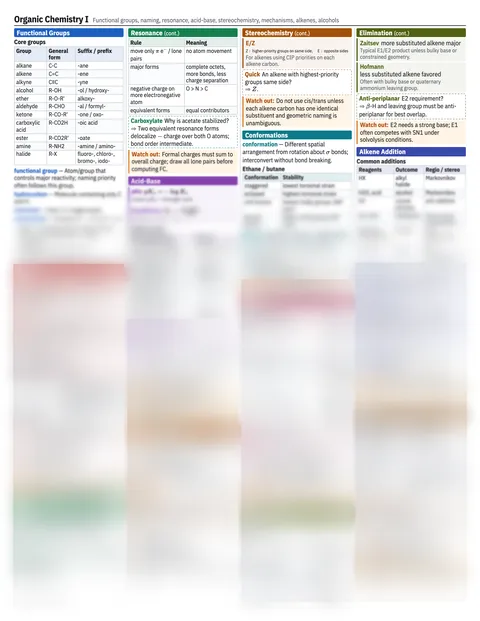
A one-page reference for the whole topic, fact-checked, with the first part free to read. This exam page does not repeat it. Use it to see the material, then make a shorter study sheet from the notes your section actually used.
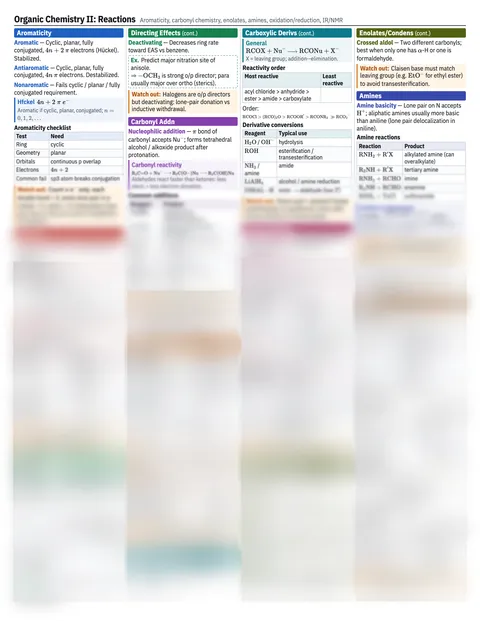
Organic Chemistry II: Reactions reference sheet — the free part in text.
Unlock the full reference sheet to edit, print or save it as a PDF.
Make your own for this exam
Upload the lecture notes and problem sets from the whole term, and in the focus step name what the review session stressed, such as aldol retrosynthesis or NMR splitting. Pick one page or front and back, and ask for a reagent table with conditions and products rather than prose.
FAQ
Questions
- Is the Organic Chemistry II final cumulative?
- Often explicitly, and almost always in practice, because synthesis problems need Organic Chemistry I reactions such as substitution, elimination, and alkene additions. The new material still gets most of the points.
- Can I bring a crib sheet to an Organic Chemistry II exam?
- Usually not. Most courses provide a pKa table and sometimes spectroscopy charts, and allow no other notes. A few allow one index card. Read the syllabus or the exam announcement before planning around one.
- What should an Organic Chemistry II study sheet focus on for the final?
- A reagent-to-product map for EAS and carbonyl reactions, the derivative reactivity order, aldol and Claisen disconnections, amine reactions your course covered, and a short IR and NMR shift table if one is not printed on the exam.
- How do I approach a multistep synthesis question?
- Work backward from the target: find the bond a known reaction makes, such as an aldol or Grignard bond, and repeat until you reach the starting material. Then check each forward step for groups the reagent would destroy.
- Will NMR be on the final?
- At many schools, yes, often as a structure-determination problem with an IR spectrum and a molecular formula. Some courses examine spectroscopy separately, so check the review list.
Keep going
More study pages
All of these sit in the sheet library. Every exam study page.