General Chemistry Cheat Sheet — 1-page PDF
Core quantitative rules, structure, bonding, gas, solution, and thermochem. The whole course on one dense, printable page for your midterm or final, with every formula typeset and worked examples where they help.
The first part is free below. See pricing →
For a specific exam: General Chemistry I Midterm 1 study sheet, General Chemistry I Final exam study sheet.
- 1 pageUS Letter
- 11 sections10 topics
- Free previewfull sheet with Unlimited
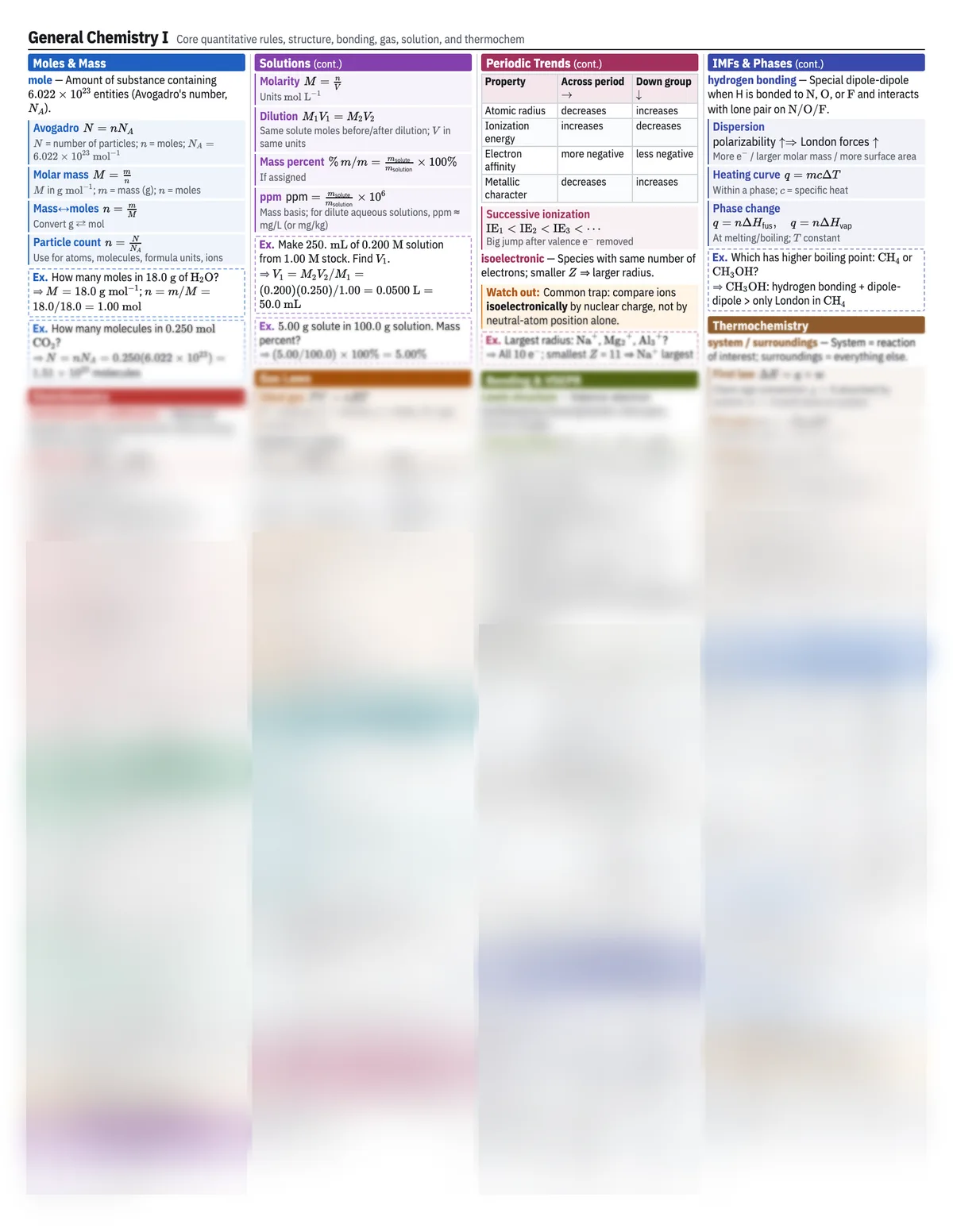 Cheat sheet locked
On the sheet
What’s on it
The topics a typical General Chemistry I exam tests, all on the one page.
- Moles, molar mass, stoichiometry
- Limiting reagent and percent yield
- Solution concentration and dilution
- Gas laws
- Atomic structure and electron configuration
- Periodic trends
- Lewis structures and VSEPR
- Intermolecular forces
- Thermochemistry and Hess's law
- Reaction types
Free preview
The free part, as text
The free part of the sheet, section by section. Unlock the full sheet to read the rest, edit any block, and print it or save it as a PDF.
01Moles & Mass
- mole
- Amount of substance containing entities (Avogadro's number, ).
Avogadro
= number of particles; = moles;
Molar mass
in ; = mass (g); = moles
Mass↔moles
Convert g ⇄ mol
Particle count
Use for atoms, molecules, formula units, ions
Ex.How many moles in of ?
;
Ex.How many molecules in ?
molecules
02Stoichiometry
- stoichiometric coefficients
- Balanced equation numbers giving mole ratios among reactants/products.
Mole ratio
From balanced equation only
- Balance equation.
- Convert given quantity to mol.
- Use mole ratio to find mol desired.
- Convert mol to requested unit.
03Solutions
Molarity
Units
Dilution
Same solute moles before/after dilution; in same units
Mass percent
If assigned
ppm
Mass basis; for dilute aqueous solutions, ppm ≈ mg/L (or mg/kg)
Ex.Make of solution from stock. Find .
Ex. solute in solution. Mass percent?
04Gas Laws
Ideal gas
= pressure, = volume, = moles, = gas constant, = K
Common values
| Units | Use | |
|---|---|---|
| when in atm, in L | ||
| thermo | ||
| when in torr |
05Periodic Trends
Trend directions
| Property | Across period | Down group |
|---|---|---|
| Atomic radius | decreases | increases |
| Ionization energy | increases | decreases |
| Electron affinity | more negative | less negative |
| Metallic character | decreases | increases |
Successive ionization
Big jump after valence e removed
- isoelectronic
- Species with same number of electrons; smaller ⇒ larger radius.
Watch out:Common trap: compare ions isoelectronically by nuclear charge, not by neutral-atom position alone.
Ex.Largest radius: , , ?
All e; smallest = ⇒ largest
06Bonding & VSEPR
- Lewis structure
- Valence-electron bookkeeping showing bonds, lone pairs, formal charges.
Formal charge
valence e; nonbonding e; bonding e
- Count total valence e (add for anions, subtract for cations).
- Choose central atom (usually least electronegative; never H).
- Make single bonds, complete octets on terminal atoms.
- Place leftover e on central atom; form multiple bonds if needed.
- Check formal charges; minimize magnitude, place negative FC on more electronegative atom.
07IMFs & Phases
- hydrogen bonding
- Special dipole-dipole when H is bonded to , , or and interacts with lone pair on .
Dispersion
polarizability London forces
More e / larger molar mass / more surface area
Heating curve
Within a phase; = specific heat
Phase change
At melting/boiling; constant
Ex.Which has higher boiling point: or ?
: hydrogen bonding + dipole-dipole > only London in
08Thermochemistry
- system / surroundings
- System = reaction of interest; surroundings = everything else.
First law
Chem sign convention: absorbed by system; work done on system
PV work
Expansion:
Enthalpy
At constant pressure,
Calorimetry
= heat capacity; sign from
Cheat sheet locked
Also on the full General Chemistry I sheet
10 more sections, with every definition, formula and worked example. Unlimited unlocks every full sheet in the library to edit, print or save as a PDF, and makes unlimited sheets from your own notes.
Stoichiometry
- Mass-mass
- Percent yield
- Percent error
Limiting Reagent
- limiting reagent
- excess reagent
- Leftover
- Reaction completion
Solutions
- molarity
Gas Laws
- Combined gas law
- Boyle
- Charles
- Dalton
- Density
Atomic Structure
- atomic number
- mass number
- Charge
- Photon energy
- de Broglie
Periodic Trends
- effective nuclear charge
Bonding & VSEPR
- VSEPR shapes
- Molecular shapes from lone pairs
IMFs & Phases
- intermolecular forces
- Strength order
Thermochemistry
- Hess
Reaction Types
- Core patterns
- precipitation reaction
- acid-base neutralization
- redox
- Oxidation numbers
FAQ
Questions
About the General Chemistry I sheet and making your own.
- What does this General Chemistry I cheat sheet cover?
- It has 11 sections: Moles & Mass, Stoichiometry, Limiting Reagent, Solutions, Gas Laws, Atomic Structure, Periodic Trends, Bonding & VSEPR, IMFs & Phases, Thermochemistry and Reaction Types. Together they cover the topics a typical General Chemistry I exam tests, including moles, molar mass, stoichiometry, limiting reagent and percent yield, solution concentration and dilution and gas laws.
- Is the general chemistry cheat sheet free?
- The first part is free to read on this page, with no account needed. The full sheet opens in the app with Unlimited ($4.99 a month or $19 for a semester), where you can edit it, print it or save it as a PDF. It is one US Letter page and prints cleanly in black and white or colour.
- Can I bring this General Chemistry I cheat sheet to my exam?
- Only if your course allows a note sheet, so check the syllabus. This one is a single US Letter page. If your exam allows a different size, such as a 3x5 or 4x6 index card or one page front and back, Cheat Sheet AI makes one at exactly that size from your own lecture notes.
- How accurate is it?
- The sheet was written by our engine from a standard course outline, then a second model fact-checked every formula and statement against it; it corrected 2 statements before publishing. Notation and emphasis vary between courses, so check it against your own lecture notes.
- Can I make a General Chemistry I sheet from my own notes?
- Yes. Upload your lecture slides, notes or study guide and Cheat Sheet AI writes a sheet in your course's notation, sized to exactly the space your exam allows. Your first sheets are free.
Your course, your notes, one page.
Upload your own General Chemistry I slides or notes and get a study sheet in your course’s notation. Your first sheet needs no account, and a free account adds one more. See pricing