Chemical Equilibrium Cheat Sheet — 1-page PDF
Rates, equilibrium, acids/bases, solubility, thermodynamics, electrochemistry. The whole course on one dense, printable page for your midterm or final, with every formula typeset and worked examples where they help.
The first part is free below. See pricing →
For a specific exam: General Chemistry II Final exam study sheet.
- 1 pageUS Letter
- 10 sections11 topics
- Free previewfull sheet with Unlimited
 Cheat sheet locked
On the sheet
What’s on it
The topics a typical General Chemistry II exam tests, all on the one page.
- Reaction rates and rate laws
- Integrated rate laws and half-life
- Arrhenius equation
- Equilibrium constants K
- Le Chatelier's principle
- Acids and bases, pH, pKa
- Buffers and Henderson-Hasselbalch
- Titrations
- Solubility Ksp
- Thermodynamics: ΔG, ΔH, ΔS
- Electrochemistry and Nernst equation
Free preview
The free part, as text
The free part of the sheet, section by section. Unlock the full sheet to read the rest, edit any block, and print it or save it as a PDF.
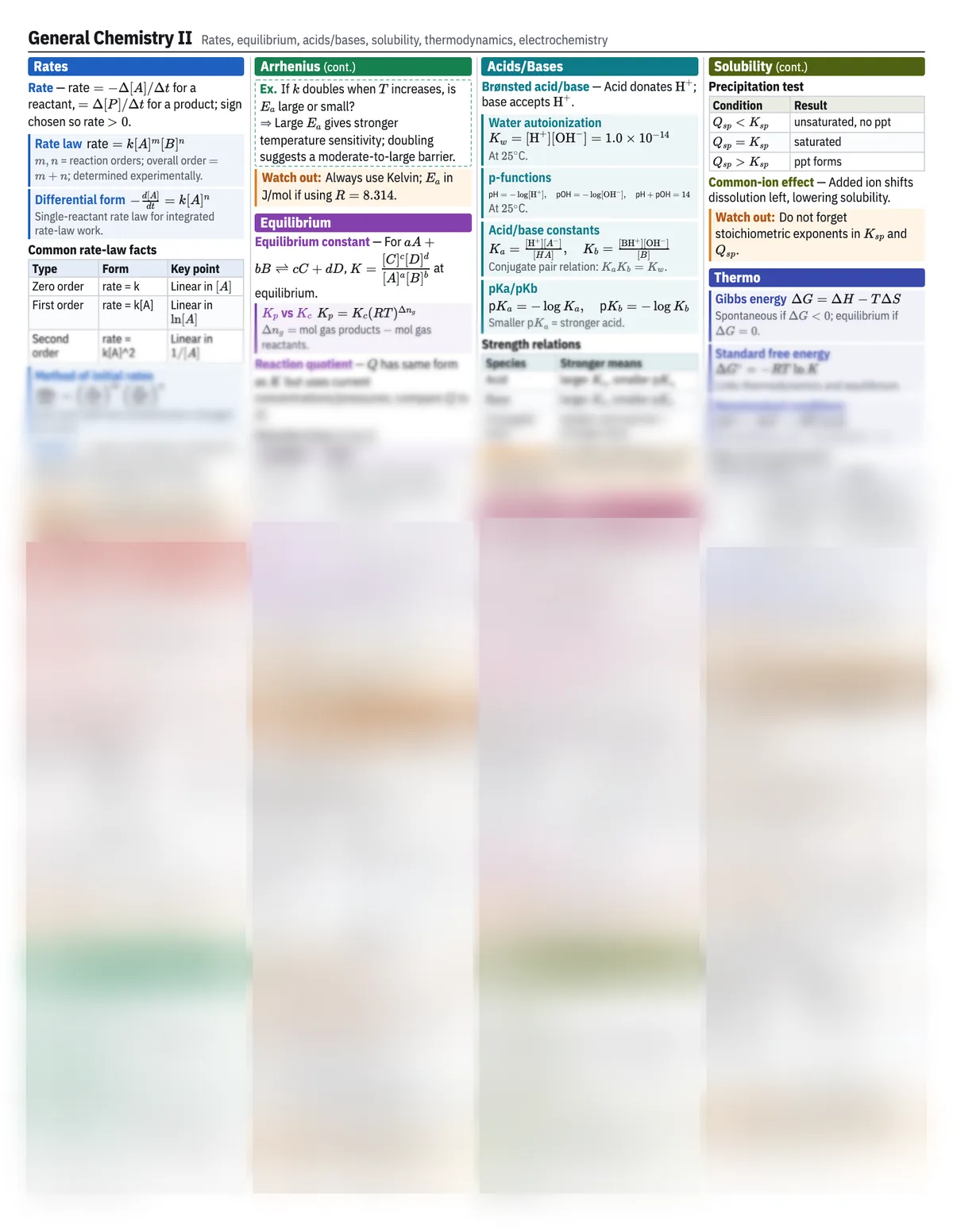
01Rates
- Rate
- for a reactant, for a product; sign chosen so rate .
Rate law
= reaction orders; overall order ; determined experimentally.
Differential form
Single-reactant rate law for integrated rate-law work.
Common rate-law facts
| Type | Form | Key point |
|---|---|---|
| Zero order | rate = k | Linear in |
| First order | rate = k[A] | Linear in |
| Second order | rate = k[A]^2 | Linear in |
Method of initial rates
Use trials with one concentration changed at a time.
- Catalyst
- Lowers activation energy ; speeds both forward and reverse reactions; no change to or .
Watch out:Do not infer order from balanced equation unless explicitly elementary.
02Arrhenius
Ex.If doubles when increases, is large or small?
Large gives stronger temperature sensitivity; doubling suggests a moderate-to-large barrier.
Watch out:Always use Kelvin; in J/mol if using .
03Equilibrium
- Equilibrium constant
- For , at equilibrium.
vs
mol gas products mol gas reactants.
- Reaction quotient
- has same form as but uses current concentrations/pressures; compare to .
Direction from vs
| Condition | Shift |
|---|---|
| forward, make products | |
| reverse, make reactants | |
| at equilibrium |
04Acids/Bases
- Brønsted acid/base
- Acid donates ; base accepts .
Water autoionization
At .
p-functions
At .
Acid/base constants
Conjugate pair relation: .
pKa/pKb
Smaller = stronger acid.
Strength relations
| Species | Stronger means |
|---|---|
| Acid | larger , smaller |
| Base | larger , smaller |
| Conjugate base | weaker acid partner = stronger base |
Watch out:For weak acids/bases, use equilibrium; do not assume complete dissociation.
05Solubility
Precipitation test
| Condition | Result |
|---|---|
| unsaturated, no ppt | |
| saturated | |
| ppt forms |
- Common-ion effect
- Added ion shifts dissolution left, lowering solubility.
Watch out:Do not forget stoichiometric exponents in and .
06Thermo
Gibbs energy
Spontaneous if ; equilibrium if .
Standard free energy
Links thermodynamics and equilibrium.
Nonstandard conditions
At equilibrium, and .
Signs and spontaneity
| Low | High | ||
|---|---|---|---|
| + | + | nonspontaneous | spontaneous |
| + | - | nonspontaneous | nonspontaneous |
| - | + | spontaneous | spontaneous |
| - | - | spontaneous | nonspontaneous |
Cheat sheet locked
Also on the full General Chemistry II sheet
8 more sections, with every definition, formula and worked example. Unlimited unlocks every full sheet in the library to edit, print or save as a PDF, and makes unlimited sheets from your own notes.
Integrated Laws
- Zero order
- First order
- Second order
- First-order shortcuts
- Order identification
Arrhenius
- Arrhenius equation
- Linear form
- Two-point form
- Activation energy
Equilibrium
- Manipulating K
- Heterogeneous equilibria
Le Chatelier
- Le Chatelier's principle
- Stress responses
- Temperature and K
- Endothermic/exothermic
Buffers & Titration
- Buffer
- Henderson-Hasselbalch
- Buffer at half-equivalence
- Equivalence point
- Titration landmarks
- Moles method
Solubility
- Solubility product
- Molar solubility
- Common Ksp setup
- Ion product
Thermo
- Entropy
- Enthalpy at constant P
Electrochem
- Oxidation/reduction
- Cell potential
- Free energy and voltage
- Nernst equation
- Anode/cathode
- Electrochem shortcuts
FAQ
Questions
About the General Chemistry II sheet and making your own.
- What does this General Chemistry II cheat sheet cover?
- It has 10 sections: Rates, Integrated Laws, Arrhenius, Equilibrium, Le Chatelier, Acids/Bases, Buffers & Titration, Solubility, Thermo and Electrochem. Together they cover the topics a typical General Chemistry II exam tests, including reaction rates and rate laws, integrated rate laws and half-life, Arrhenius equation and equilibrium constants K.
- Is the chemical equilibrium cheat sheet free?
- The first part is free to read on this page, with no account needed. The full sheet opens in the app with Unlimited ($4.99 a month or $19 for a semester), where you can edit it, print it or save it as a PDF. It is one US Letter page and prints cleanly in black and white or colour.
- Can I bring this General Chemistry II cheat sheet to my exam?
- Only if your course allows a note sheet, so check the syllabus. This one is a single US Letter page. If your exam allows a different size, such as a 3x5 or 4x6 index card or one page front and back, Cheat Sheet AI makes one at exactly that size from your own lecture notes.
- How accurate is it?
- The sheet was written by our engine from a standard course outline, then a second model fact-checked every formula and statement against it; it corrected 1 statement before publishing. Notation and emphasis vary between courses, so check it against your own lecture notes.
- Can I make a General Chemistry II sheet from my own notes?
- Yes. Upload your lecture slides, notes or study guide and Cheat Sheet AI writes a sheet in your course's notation, sized to exactly the space your exam allows. Your first sheets are free.
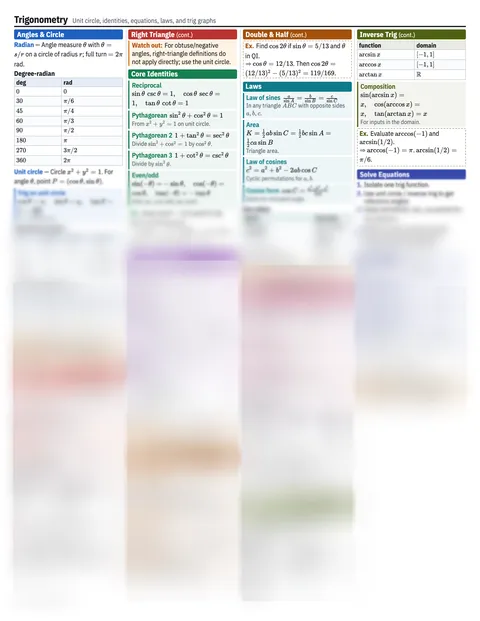
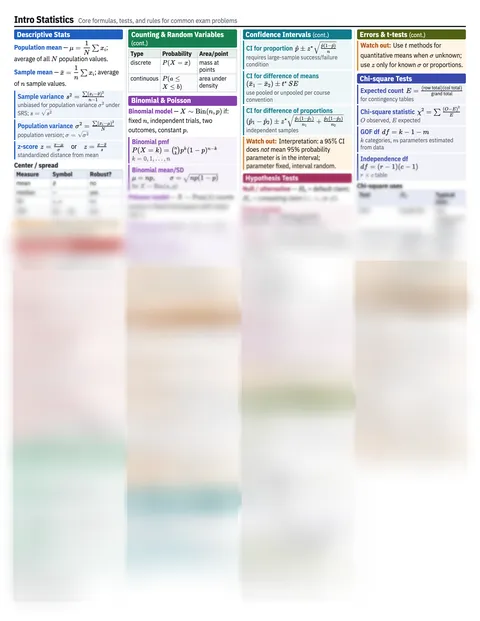
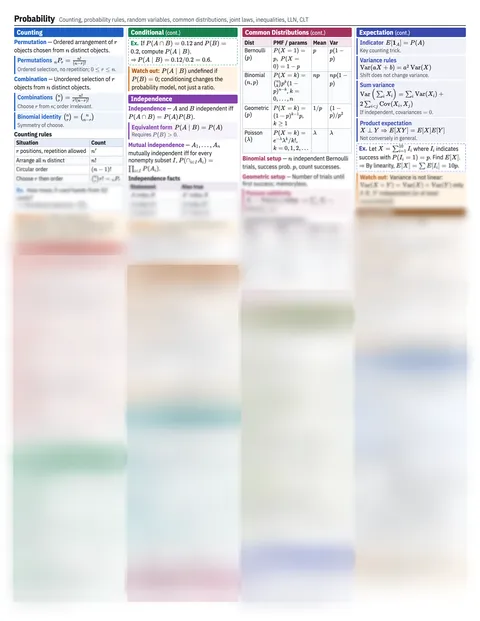
Your course, your notes, one page.
Upload your own General Chemistry II slides or notes and get a study sheet in your course’s notation. Your first sheet needs no account, and a free account adds one more. See pricing