Probability Cheat Sheet — 1-page PDF
Counting, probability rules, random variables, common distributions, joint laws, inequalities, LLN, CLT. The whole course on one dense, printable page for your midterm or final, with every formula typeset and worked examples where they help.
The first part is free below. See pricing →
For a specific exam: Probability Final exam study sheet.
- 1 pageUS Letter
- 11 sections11 topics
- Free previewfull sheet with Unlimited
 Cheat sheet locked
On the sheet
What’s on it
The topics a typical Probability exam tests, all on the one page.
- Counting: permutations and combinations
- Axioms and conditional probability
- Independence
- Bayes' theorem
- Discrete random variables, expectation, variance
- Common discrete distributions
- Common continuous distributions
- Joint distributions, covariance
- Linearity of expectation
- Markov and Chebyshev inequalities
- Law of large numbers, CLT
Free preview
The free part, as text
The free part of the sheet, section by section. Unlock the full sheet to read the rest, edit any block, and print it or save it as a PDF.
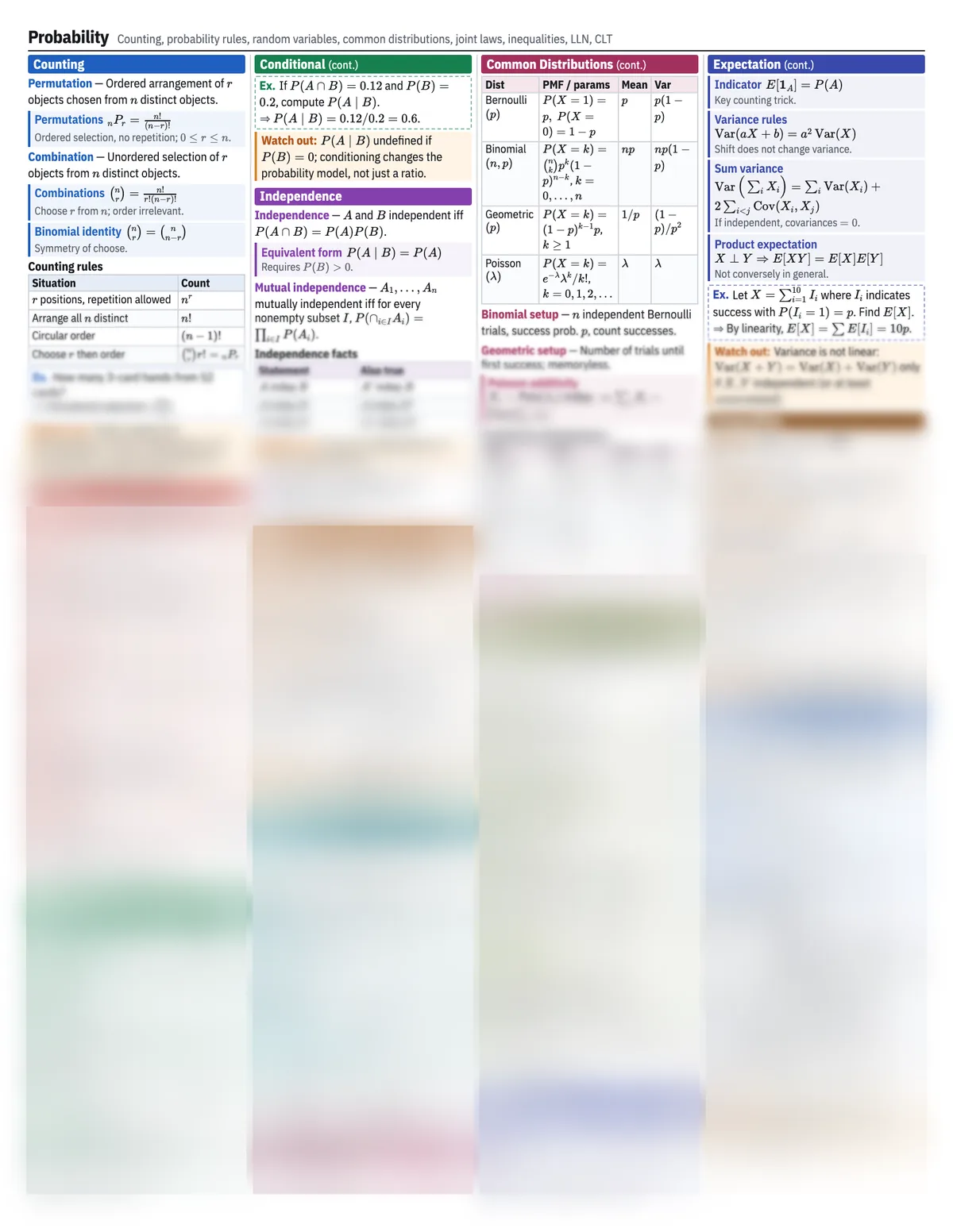
01Counting
- Permutation
- Ordered arrangement of objects chosen from distinct objects.
Permutations
Ordered selection, no repetition; .
- Combination
- Unordered selection of objects from distinct objects.
Combinations
Choose from ; order irrelevant.
Binomial identity
Symmetry of choose.
Counting rules
| Situation | Count |
|---|---|
| positions, repetition allowed | |
| Arrange all distinct | |
| Circular order | |
| Choose then order |
Ex.How many 3-card hands from 52 cards?
Unordered selection: .
Watch out:Order matters for permutations, not for combinations; do not divide by unless all orderings of each set are equally counted.
02Conditional
Ex.If and , compute .
.
Watch out: undefined if ; conditioning changes the probability model, not just a ratio.
03Independence
- Independence
- and independent iff .
Equivalent form
Requires .
- Mutual independence
- mutually independent iff for every nonempty subset , .
Independence facts
| Statement | Also true |
|---|---|
| indep | indep |
| indep | indep |
| indep | indep |
Watch out:Pairwise independence mutual independence.
Ex.If , , independent, find .
.
04Common Distributions
Discrete distributions
| Dist | PMF / params | Mean | Var |
|---|---|---|---|
| Bernoulli | |||
| Binomial | , | ||
| Geometric | , | ||
| Poisson | , |
- Binomial setup
- independent Bernoulli trials, success prob. , count successes.
- Geometric setup
- Number of trials until first success; memoryless.
Poisson additivity
Continuous distributions
| Dist | Mean | Var | |
|---|---|---|---|
| Uniform | on | ||
| Exponential | , , | ||
| Normal |
05Expectation
Indicator
Key counting trick.
Variance rules
Shift does not change variance.
Sum variance
If independent, covariances .
Product expectation
Not conversely in general.
Ex.Let where indicates success with . Find .
By linearity, .
Watch out:Variance is not linear: only if independent (or at least uncorrelated).
06Inequalities
Markov
For , .
Chebyshev
, , .
General Chebyshev
Equivalent form.
Cheat sheet locked
Also on the full Probability sheet
9 more sections, with every definition, formula and worked example. Unlimited unlocks every full sheet in the library to edit, print or save as a PDF, and makes unlimited sheets from your own notes.
Axioms
- Sample space
- Event
- Axioms
- Complement
- Union
- Difference
- De Morgan
Conditional
- Conditional prob
- Multiplication
- Chain rule
- Partition
- Total probability
Bayes
- Bayes
- Two-event Bayes
- Prior / posterior
Discrete RVs
- Random variable
- PMF
- CDF
- Expectation
- Variance
- Std dev
- Moment generating fn
Common Distributions
- Normal pdf
Joint Laws
- Joint pmf/pdf
- Marginals
- Conditional pmf/pdf
- Covariance
- Correlation
- Independence
Expectation
- Linearity
Inequalities
- Union bound
Limit Laws
- LLN
- WLLN
- CLT
- Sum form
- Use theorems when
FAQ
Questions
About the Probability sheet and making your own.
- What does this Probability cheat sheet cover?
- It has 11 sections: Counting, Axioms, Conditional, Independence, Bayes, Discrete RVs, Common Distributions, Joint Laws, Expectation, Inequalities and Limit Laws. Together they cover the topics a typical Probability exam tests, including counting: permutations and combinations, axioms and conditional probability, independence and Bayes' theorem.
- Is the probability cheat sheet free?
- The first part is free to read on this page, with no account needed. The full sheet opens in the app with Unlimited ($4.99 a month or $19 for a semester), where you can edit it, print it or save it as a PDF. It is one US Letter page and prints cleanly in black and white or colour.
- Can I bring this Probability cheat sheet to my exam?
- Only if your course allows a note sheet, so check the syllabus. This one is a single US Letter page. If your exam allows a different size, such as a 3x5 or 4x6 index card or one page front and back, Cheat Sheet AI makes one at exactly that size from your own lecture notes.
- How accurate is it?
- The sheet was written by our engine from a standard course outline, then a second model fact-checked every formula and statement against it; it corrected 3 statements before publishing. Notation and emphasis vary between courses, so check it against your own lecture notes.
- Can I make a Probability sheet from my own notes?
- Yes. Upload your lecture slides, notes or study guide and Cheat Sheet AI writes a sheet in your course's notation, sized to exactly the space your exam allows. Your first sheets are free.
Your course, your notes, one page.
Upload your own Probability slides or notes and get a study sheet in your course’s notation. Your first sheet needs no account, and a free account adds one more. See pricing