APUSH Cheat Sheet — 1-page PDF
1-page cheat sheet: colonial era → civil rights movement. The whole course on one dense, printable page for your midterm or final, with every formula typeset and worked examples where they help.
The first part is free below. See pricing →
For a specific exam: AP US History Exam study sheet.
- 1 pageUS Letter
- 12 sections11 topics
- Free previewfull sheet with Unlimited
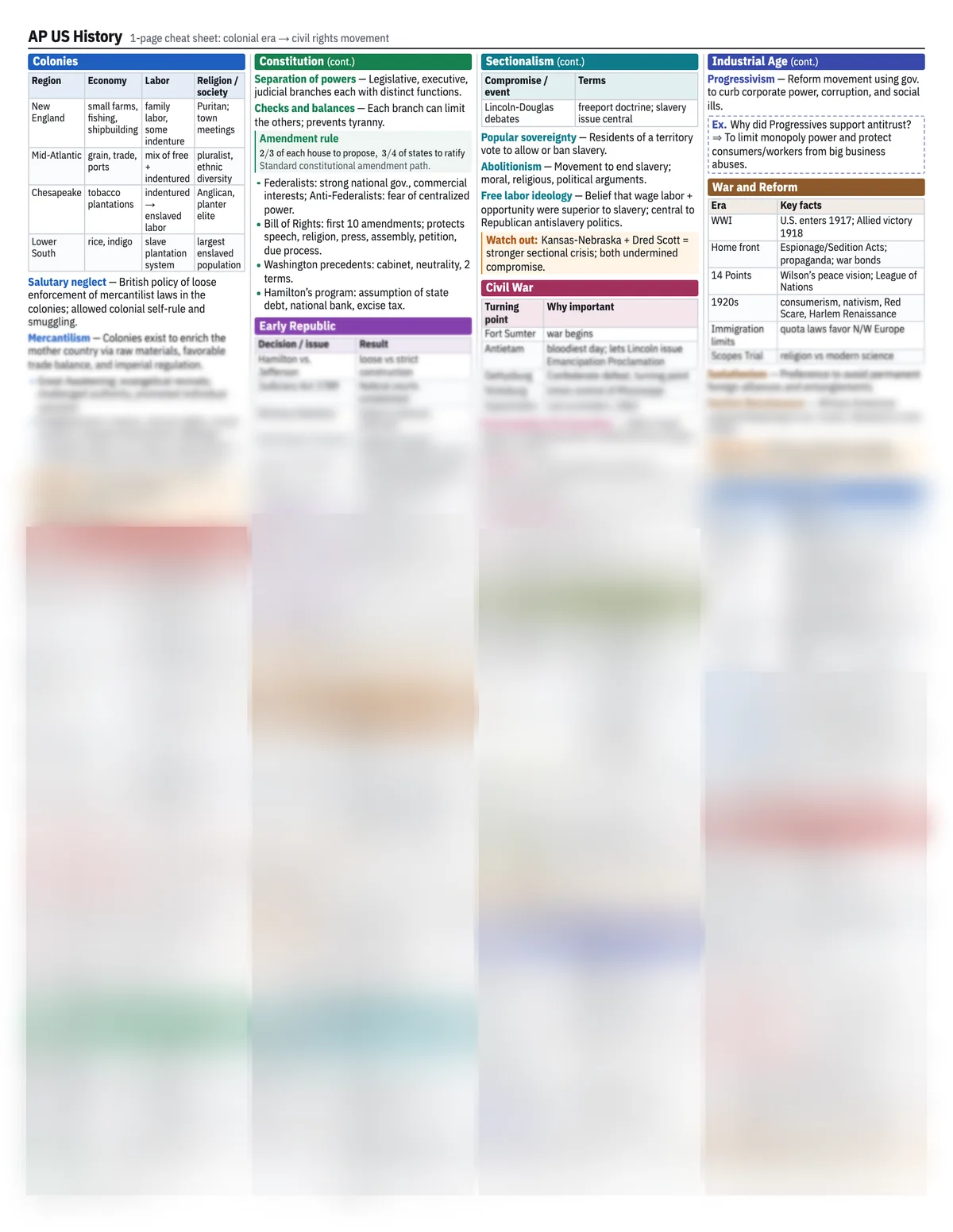 Cheat sheet locked
On the sheet
What’s on it
The topics a typical AP US History exam tests, all on the one page.
- Colonial era
- American Revolution
- Constitution and early republic
- Jacksonian era
- Sectionalism and Civil War
- Reconstruction
- Gilded Age and Progressive Era
- WWI and the 1920s
- Great Depression and New Deal
- WWII and Cold War
- Civil rights movement
Free preview
The free part, as text
The free part of the sheet, section by section. Unlock the full sheet to read the rest, edit any block, and print it or save it as a PDF.
01Colonies
| Region | Economy | Labor | Religion / society |
|---|---|---|---|
| New England | small farms, fishing, shipbuilding | family labor, some indenture | Puritan; town meetings |
| Mid-Atlantic | grain, trade, ports | mix of free + indentured | pluralist, ethnic diversity |
| Chesapeake | tobacco plantations | indentured → enslaved labor | Anglican, planter elite |
| Lower South | rice, indigo | slave plantation system | largest enslaved population |
- Salutary neglect
- British policy of loose enforcement of mercantilist laws in the colonies; allowed colonial self-rule and smuggling.
- Mercantilism
- Colonies exist to enrich the mother country via raw materials, favorable trade balance, and imperial regulation.
- Great Awakening: evangelical revivals; challenged authority, promoted individual salvation.
- Enlightenment: reason, natural rights, social contract; shaped revolutionary ideology.
- Triangular trade: rum, slaves, sugar; Atlantic economy linked Europe, Africa, Americas.
Watch out:Not all colonies same: New England = commerce/religion; Chesapeake/Lower South = plantation/slavery.
02Constitution
- Separation of powers
- Legislative, executive, judicial branches each with distinct functions.
- Checks and balances
- Each branch can limit the others; prevents tyranny.
Amendment rule
,\ 3/4$ of states to ratify
Standard constitutional amendment path.
- Federalists: strong national gov., commercial interests; Anti-Federalists: fear of centralized power.
- Bill of Rights: first 10 amendments; protects speech, religion, press, assembly, petition, due process.
- Washington precedents: cabinet, neutrality, 2 terms.
- Hamilton’s program: assumption of state debt, national bank, excise tax.
03Early Republic
| Decision / issue | Result |
|---|---|
| Hamilton vs. Jefferson | loose vs strict construction |
| Judiciary Act 1789 | federal courts established |
| Whiskey Rebellion | federal authority enforced |
| Washington Farewell | avoid permanent alliances, political parties |
| Alien and Sedition Acts | expanded federal power; civil-liberties backlash |
| Kentucky/Virginia Resolutions | state nullification doctrine |
04Sectionalism
| Compromise / event | Terms |
|---|---|
| Missouri Compromise | Maine free, Missouri slave; 36°30' line |
| Compromise of 1850 | California free; stronger Fugitive Slave Act |
| Kansas-Nebraska Act | popular sovereignty; repeals 36°30' line |
| Dred Scott | Black people not citizens; Congress cannot ban slavery in territories |
| Lincoln-Douglas debates | freeport doctrine; slavery issue central |
- Popular sovereignty
- Residents of a territory vote to allow or ban slavery.
- Abolitionism
- Movement to end slavery; moral, religious, political arguments.
- Free labor ideology
- Belief that wage labor + opportunity were superior to slavery; central to Republican antislavery politics.
Watch out:Kansas-Nebraska + Dred Scott = stronger sectional crisis; both undermined compromise.
05Civil War
| Turning point | Why important |
|---|---|
| Fort Sumter | war begins |
| Antietam | bloodiest day; lets Lincoln issue Emancipation Proclamation |
| Gettysburg | Confederate defeat; turning point |
| Vicksburg | Union control of Mississippi |
| Appomattox | Lee surrenders, 1865 |
- Emancipation Proclamation
- 1863; freed slaves in rebelling areas; redefined war as fight against slavery.
- Total war
- War targeting Confederate economic and civilian infrastructure; Sherman’s March exemplifies.
- 13th Amendment
- Abolishes slavery except as punishment for crime.
06Industrial Age
- Progressivism
- Reform movement using gov. to curb corporate power, corruption, and social ills.
Ex.Why did Progressives support antitrust?
To limit monopoly power and protect consumers/workers from big business abuses.
07War and Reform
| Era | Key facts |
|---|---|
| WWI | U.S. enters 1917; Allied victory 1918 |
| Home front | Espionage/Sedition Acts; propaganda; war bonds |
| 14 Points | Wilson’s peace vision; League of Nations |
| 1920s | consumerism, nativism, Red Scare, Harlem Renaissance |
| Immigration limits | quota laws favor N/W Europe |
| Scopes Trial | religion vs modern science |
- Isolationism
- Preference to avoid permanent foreign alliances and entanglements.
- Harlem Renaissance
- African American cultural flowering in art, music, literature in the 1920s.
Watch out:WWI civil-liberties testable: Schenck v. U.S. upheld “clear and present danger” limits on speech.
08Depression to Cold War
| Topic | Key facts |
|---|---|
| Great Depression | 1929 crash; unemployment; bank failures |
| New Deal | relief, recovery, reform |
| WWII | Pearl Harbor 1941; U.S. mobilization; D-Day 1944; atomic bombs 1945 |
| Cold War | containment, Truman Doctrine, Marshall Plan, NATO |
| Korea/Vietnam | containment wars; limited war in Asia |
| Red Scare | loyalty fears; McCarthyism |
Cheat sheet locked
Also on the full AP US History sheet
9 more sections, with every definition, formula and worked example. Unlimited unlocks every full sheet in the library to edit, print or save as a PDF, and makes unlimited sheets from your own notes.
Revolution
- Declaration logic
- Republican motherhood
Constitution
- Federalism
Early Republic
- Louisiana Purchase
- Marbury v. Madison
- Manifest Destiny
Jacksonian Era
- Jacksonian democracy
- Nullification
- Spoils system
Civil War
Reconstruction
- Freedmen’s Bureau
- Black Codes
- Sharecropping
Industrial Age
- Gilded Age
- Populism
Depression to Cold War
- New Deal
- Containment
- Truman Doctrine
- GI Bill
Civil Rights
- Nonviolent protest
- De jure segregation
- De facto segregation
FAQ
Questions
About the AP US History sheet and making your own.
- What does this AP US History cheat sheet cover?
- It has 12 sections: Colonies, Revolution, Constitution, Early Republic, Jacksonian Era, Sectionalism, Civil War, Reconstruction, Industrial Age, War and Reform, Depression to Cold War and Civil Rights. Together they cover the topics a typical AP US History exam tests, including colonial era, American Revolution, Constitution and early republic and Jacksonian era.
- Is the APUSH cheat sheet free?
- The first part is free to read on this page, with no account needed. The full sheet opens in the app with Unlimited ($4.99 a month or $19 for a semester), where you can edit it, print it or save it as a PDF. It is one US Letter page and prints cleanly in black and white or colour.
- Can I bring this AP US History cheat sheet to my exam?
- Only if your course allows a note sheet, so check the syllabus. This one is a single US Letter page. If your exam allows a different size, such as a 3x5 or 4x6 index card or one page front and back, Cheat Sheet AI makes one at exactly that size from your own lecture notes.
- How accurate is it?
- The sheet was written by our engine from a standard course outline, then a second model fact-checked every formula and statement against it; it corrected 2 statements before publishing. Notation and emphasis vary between courses, so check it against your own lecture notes.
- Can I make a AP US History sheet from my own notes?
- Yes. Upload your lecture slides, notes or study guide and Cheat Sheet AI writes a sheet in your course's notation, sized to exactly the space your exam allows. Your first sheets are free.
Keep going
More sheets

All 40 sheets are in the sheet library.
Your course, your notes, one page.
Upload your own AP US History slides or notes and get a study sheet in your course’s notation. Your first sheet needs no account, and a free account adds one more. See pricing