World War 2 Cheat Sheet — 1-page PDF
Causes, major campaigns, Holocaust, home fronts, conferences, ending, consequences. The whole course on one dense, printable page for your midterm or final, with every formula typeset and worked examples where they help.
The first part is free below. See pricing →
- 1 pageUS Letter
- 10 sections9 topics
- Free previewfull sheet with Unlimited
 Cheat sheet locked
On the sheet
What’s on it
The topics a typical World War II exam tests, all on the one page.
- Causes of WWII
- Key leaders
- Major European theater battles
- Pacific theater
- The Holocaust
- Home fronts
- Key conferences: Tehran, Yalta, Potsdam
- End of the war
- Consequences and Cold War origins
Free preview
The free part, as text
The free part of the sheet, section by section. Unlock the full sheet to read the rest, edit any block, and print it or save it as a PDF.
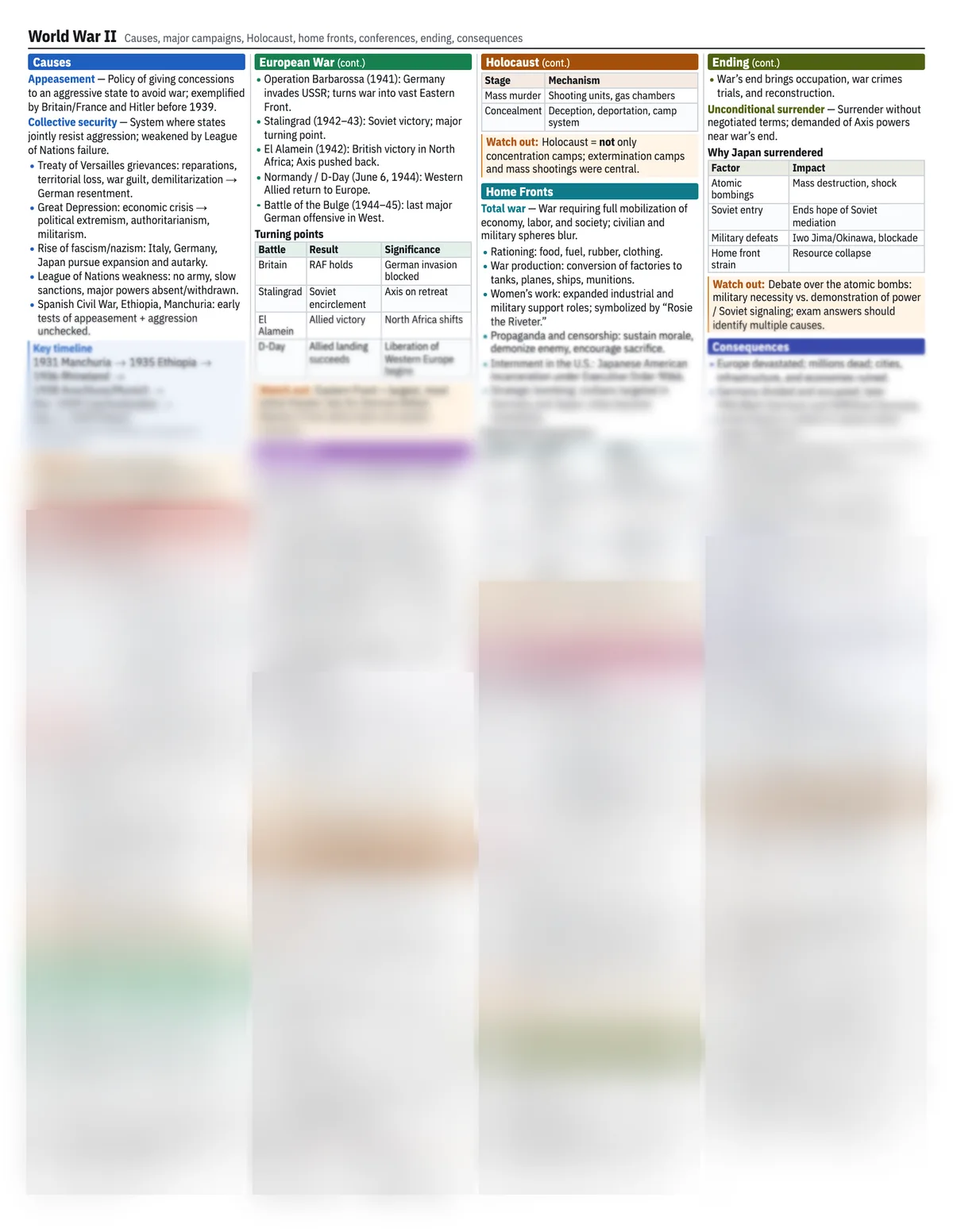
01Causes
- Appeasement
- Policy of giving concessions to an aggressive state to avoid war; exemplified by Britain/France and Hitler before 1939.
- Collective security
- System where states jointly resist aggression; weakened by League of Nations failure.
- Treaty of Versailles grievances: reparations, territorial loss, war guilt, demilitarization → German resentment.
- Great Depression: economic crisis → political extremism, authoritarianism, militarism.
- Rise of fascism/nazism: Italy, Germany, Japan pursue expansion and autarky.
- League of Nations weakness: no army, slow sanctions, major powers absent/withdrawn.
- Spanish Civil War, Ethiopia, Manchuria: early tests of appeasement + aggression unchecked.
Key timeline
1931 Manchuria 1935 Ethiopia 1936 Rhineland 1938 Anschluss/Munich Mar. 1939 Czechoslovakia Sep. 1, 1939 Poland
Common prewar escalation sequence in Europe/Asia.
Watch out:Munich Agreement = Sudetenland to Germany; not peace. It exposed the failure of appeasement and encouraged further expansion.
02European War
- Poland (1939): Germany + USSR divide Poland after invasion; Britain/France declare war.
- France (1940): fall after Germany goes through the Ardennes; Dunkirk evacuation.
- Battle of Britain (1940): RAF prevents invasion; air defense decisive.
- Operation Barbarossa (1941): Germany invades USSR; turns war into vast Eastern Front.
- Stalingrad (1942–43): Soviet victory; major turning point.
- El Alamein (1942): British victory in North Africa; Axis pushed back.
- Normandy / D-Day (June 6, 1944): Western Allied return to Europe.
- Battle of the Bulge (1944–45): last major German offensive in West.
Turning points
| Battle | Result | Significance |
|---|---|---|
| Britain | RAF holds | German invasion blocked |
| Stalingrad | Soviet encirclement | Axis on retreat |
| El Alamein | Allied victory | North Africa shifts |
| D-Day | Allied landing succeeds | Liberation of Western Europe begins |
Watch out:Eastern Front = largest, most lethal theater; key for German defeat. Western Front alone does not explain outcome.
03Pacific War
- Island hopping
- U.S. strategy of capturing selected islands, bypassing others, to move closer to Japan.
- Pearl Harbor (Dec. 7, 1941): Japanese surprise attack brings U.S. into war.
- Philippines, Singapore, Dutch East Indies: rapid Japanese advances in 1941–42.
- Midway (June 1942): U.S. naval victory; Japanese carrier losses; major turning point.
- Guadalcanal (1942–43): first major Allied offensive in the Pacific.
- Iwo Jima, Okinawa (1945): costly final island battles near Japan.
- Atomic bombs on Hiroshima and Nagasaki (Aug. 1945): Japan surrenders.
04Holocaust
Persecution to genocide
| Stage | Mechanism |
|---|---|
| Legal exclusion | Laws, propaganda |
| Physical isolation | Ghettos, forced labor |
| Mass murder | Shooting units, gas chambers |
| Concealment | Deception, deportation, camp system |
Watch out:Holocaust = not only concentration camps; extermination camps and mass shootings were central.
05Home Fronts
- Total war
- War requiring full mobilization of economy, labor, and society; civilian and military spheres blur.
- Rationing: food, fuel, rubber, clothing.
- War production: conversion of factories to tanks, planes, ships, munitions.
- Women’s work: expanded industrial and military support roles; symbolized by “Rosie the Riveter.”
- Propaganda and censorship: sustain morale, demonize enemy, encourage sacrifice.
- Internment in the U.S.: Japanese American incarceration under Executive Order 9066.
- Strategic bombing: civilians targeted in Germany and Japan; cities become battlefields.
Home front comparison
| Country | Feature | Effect |
|---|---|---|
| U.S. | Mass production | Arsenal of Democracy |
| Britain | Blitz + rationing | Civilian endurance |
| USSR | Evacuation eastward | Industry preserved |
| Germany | Forced labor | War economy intensified |
| Japan | Resource shortage | Overextension |
06Ending
- Germany surrenders: May 7–8, 1945 (VE Day in Europe).
- Hitler dies by suicide in April 1945; Berlin falls to the Soviets.
- Japan continues after Germany’s defeat; Soviet entry into war and atomic bombings accelerate surrender.
- Japan surrenders Aug. 15, 1945; formal signing Sept. 2, 1945 (VJ Day).
- War’s end brings occupation, war crimes trials, and reconstruction.
- Unconditional surrender
- Surrender without negotiated terms; demanded of Axis powers near war’s end.
Why Japan surrendered
| Factor | Impact |
|---|---|
| Atomic bombings | Mass destruction, shock |
| Soviet entry | Ends hope of Soviet mediation |
| Military defeats | Iwo Jima/Okinawa, blockade |
| Home front strain | Resource collapse |
Watch out:Debate over the atomic bombs: military necessity vs. demonstration of power / Soviet signaling; exam answers should identify multiple causes.
07Consequences
- Europe devastated; millions dead; cities, infrastructure, and economies ruined.
- Germany divided and occupied; later FRG/West Germany and GDR/East Germany.
- United Nations created to replace failed League of Nations.
- Decolonization accelerates in Asia and Africa as European empires weaken.
- U.S. and USSR emerge as superpowers; bipolar world order.
- Nuremberg and Tokyo trials establish precedents for war crimes and crimes against humanity.
Cheat sheet locked
Also on the full World War II sheet
8 more sections, with every definition, formula and worked example. Unlimited unlocks every full sheet in the library to edit, print or save as a PDF, and makes unlimited sheets from your own notes.
Key Leaders
- Major leaders and roles
- Axis Powers
- Allied Powers
European War
- Blitzkrieg
Pacific War
- Pacific methods
Holocaust
- Holocaust
- Final Solution
Home Fronts
Conferences
- Big Three conferences
- Second front
Consequences
- Cold War origins
- Cold War roots
- Wartime alliance breaks
Fast Review
FAQ
Questions
About the World War II sheet and making your own.
- What does this World War II cheat sheet cover?
- It has 10 sections: Causes, Key Leaders, European War, Pacific War, Holocaust, Home Fronts, Conferences, Ending, Consequences and Fast Review. Together they cover the topics a typical World War II exam tests, including causes of WWII, key leaders, major European theater battles and Pacific theater.
- Is the world war 2 cheat sheet free?
- The first part is free to read on this page, with no account needed. The full sheet opens in the app with Unlimited ($4.99 a month or $19 for a semester), where you can edit it, print it or save it as a PDF. It is one US Letter page and prints cleanly in black and white or colour.
- Can I bring this World War II cheat sheet to my exam?
- Only if your course allows a note sheet, so check the syllabus. This one is a single US Letter page. If your exam allows a different size, such as a 3x5 or 4x6 index card or one page front and back, Cheat Sheet AI makes one at exactly that size from your own lecture notes.
- How accurate is it?
- The sheet was written by our engine from a standard course outline, then a second model fact-checked every formula and statement against it; it corrected 4 statements before publishing. Notation and emphasis vary between courses, so check it against your own lecture notes.
- Can I make a World War II sheet from my own notes?
- Yes. Upload your lecture slides, notes or study guide and Cheat Sheet AI writes a sheet in your course's notation, sized to exactly the space your exam allows. Your first sheets are free.
Keep going
More sheets
All 40 sheets are in the sheet library.
Your course, your notes, one page.
Upload your own World War II slides or notes and get a study sheet in your course’s notation. Your first sheet needs no account, and a free account adds one more. See pricing