AP US History exam study sheet
The AP US History exam does not let you bring a note sheet, a formula card, or an outline. This page is a study aid for the weeks before the exam, not something to carry into the testing room. The exam is periods 1 through 9, with multiple choice, short answers, a document-based question, and a long essay. A useful study sheet is a timeline plus the reasoning skill each essay asks for, not a fact for every year.
Some students call it revision notes, others a crib sheet: one page of periods, turning points and themes to study from before the AP exam.
 Cheat sheet locked
The scope
What this exam usually covers
College Board’s periodization is the spine. Local course calendars sometimes linger on one era; the exam does not.
- Periods, not isolated events One turning point and one continuity for each period you are weak on. The exam rewards change-over-time sentences more than a single date with no context.
- Multiple choice Stimulus first: an excerpt, map, or image, then the question. Practice the skill of naming the period from the source before you look at the choices.
- Short answers Three parts, labeled, each a claim plus a specific piece of evidence. A study sheet can hold a bank of evidence you can actually remember, grouped by period.
- Document-based question Thesis, use of most of the documents, one piece of outside evidence, and sourcing for a few documents. The formula is the skill. The documents are new on exam day.
- Long essay A defensible claim, a line of reasoning, and specific evidence. Practice one comparison and one causation prompt from different periods rather than outlining every possible prompt.
- Reasoning skills Causation, comparison, and continuity and change. Name which one the prompt asks for in the first sentence so the rest of the essay answers it.
Usually later
There is no later unit on exam day. What students over-study is a favorite era (the Civil War, or the New Deal) at the expense of periods 1 to 3 and 7 to 9. A study sheet that is half the 1930s will not help a prompt on the early republic or the late twentieth century. Spread the evidence bank.
The rules
What a note sheet is usually allowed to include
check your exam header — it wins
Nothing you wrote may come into the AP testing room. The College Board rules for AP US History prohibit notes, books, and formula sheets; you get the exam booklet and the documents printed in it. Scratch paper, if any, is controlled by the proctor. Building a one-page study sheet is still useful the night before, because writing the timeline is the review. Leave it at home or in a locker. A teacher’s in-class midterm may have a different rule; the AP exam does not inherit that rule.
The sheet
The matching library sheet
A one-page reference for the whole topic, fact-checked, with the first part free to read. This exam page does not repeat it. Use it to see the material, then make a shorter study sheet from the notes your section actually used.
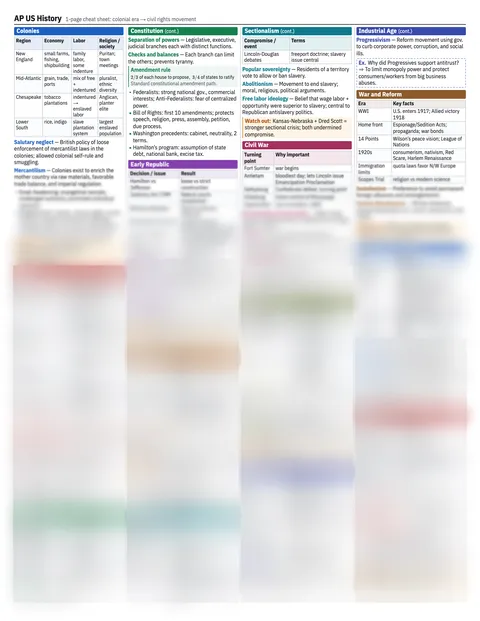
AP US History reference sheet — the free part in text.
Unlock the full reference sheet to edit, print or save it as a PDF.
Make your own for this exam
Upload your period packets or a review outline you already trust, and say which periods feel thin. Ask for a timeline and a short evidence bank, not a narrative of each presidency. The sheet you generate is for studying. It is not an exam aid you are allowed to use on the AP test.
FAQ
Questions
- Can I bring this study sheet into the AP US History exam?
- No. AP US History does not allow notes, books, or a self-made sheet in the testing room. Use the page to review, then leave it outside.
- What should an APUSH study sheet contain if it is only one page?
- A period timeline with one turning point each, a handful of evidence examples you can remember under pressure, and the three essay moves: thesis, evidence, and the reasoning skill the prompt named.
- Does the exam favor one era?
- No. Prompts and stimuli can come from any period. A sheet that only covers the Civil War and the New Deal will miss early-republic and late-twentieth-century questions.
Keep going
More study pages
All of these sit in the sheet library. Every exam study page.