Linear Algebra final exam study sheet
The linear algebra final is cumulative, but in most courses the weight sits on what came after the midterm: eigenvalues and eigenvectors, diagonalization, orthogonality, Gram-Schmidt and least squares. Row reduction does not go away; it is the tool inside almost every one of those problems, from an eigenspace basis to the normal equations. Expect true-or-false questions that test the invertible matrix theorem across the whole course.
Call it a formula sheet, a crib sheet, an aid sheet or revision notes; in linear algebra it is a page of theorems and the procedures that apply them.
 Cheat sheet locked
The scope
What this exam usually covers
This is the second-half material the final usually stresses, plus the early tools it still depends on.
- Eigenvalues and eigenvectors Solve det(A − λI) = 0, then find each eigenspace as the null space of A − λI. Check your eigenvalues against the trace and determinant before moving on.
- Diagonalization A = PDP⁻¹ with eigenvectors as the columns of P, in the same order as the eigenvalues in D. An n by n matrix needs n independent eigenvectors; repeated eigenvalues are where that can fail.
- Orthogonality and projections Dot products, orthogonal complements, and the projection onto a subspace. The sum-of-projections formula needs an orthogonal basis; using it with any other basis gives a wrong answer that looks fine.
- Gram-Schmidt Turn a basis into an orthogonal one by subtracting projections onto every earlier vector, then normalize if asked. Errors compound, so check orthogonality at each step.
- Least squares Solve the normal equations AᵀA x̂ = Aᵀb, often to fit a line to data. The residual b − A x̂ is orthogonal to the column space, which makes a quick check.
- The invertible matrix theorem, full version By the final it includes zero not being an eigenvalue, full rank, a trivial null space and a nonzero determinant. True-or-false questions test moving between the equivalent statements.
- Row reduction and determinants, revisited Still on the final as standalone problems and inside the eigenvalue and least-squares work. A row-operation slip early wrecks the eigenspace you find later.
- Subspaces and rank Bases and dimensions of the column and null spaces, rank-nullity, and coordinates. These return as short questions and as parts of longer ones.
Usually later
Symmetric matrices and the spectral theorem, the singular value decomposition, quadratic forms, complex eigenvalues, and Markov chains are on some finals and not others, depending on how far your course got. Abstract vector spaces such as polynomial spaces, and change of basis, are also uneven. Check the review sheet, and do not let them crowd out eigenvalues and least squares.
The rules
What a note sheet is usually allowed to include
check your exam header — it wins
Linear algebra finals often follow the midterm’s rule, but check, because some courses that allowed nothing earlier allow a sheet on the final since it covers twice the material. Typical rules are one handwritten page or index card, or no notes at all. Calculators that row-reduce or compute eigenvalues are commonly banned. A Canadian engineering section may permit an aid sheet, while UK and Australian modules rarely allow a crib sheet. Whichever applies, this page is a study sheet: the theorems written in your own words are what you need to know anyway.
The sheet
The matching library sheet
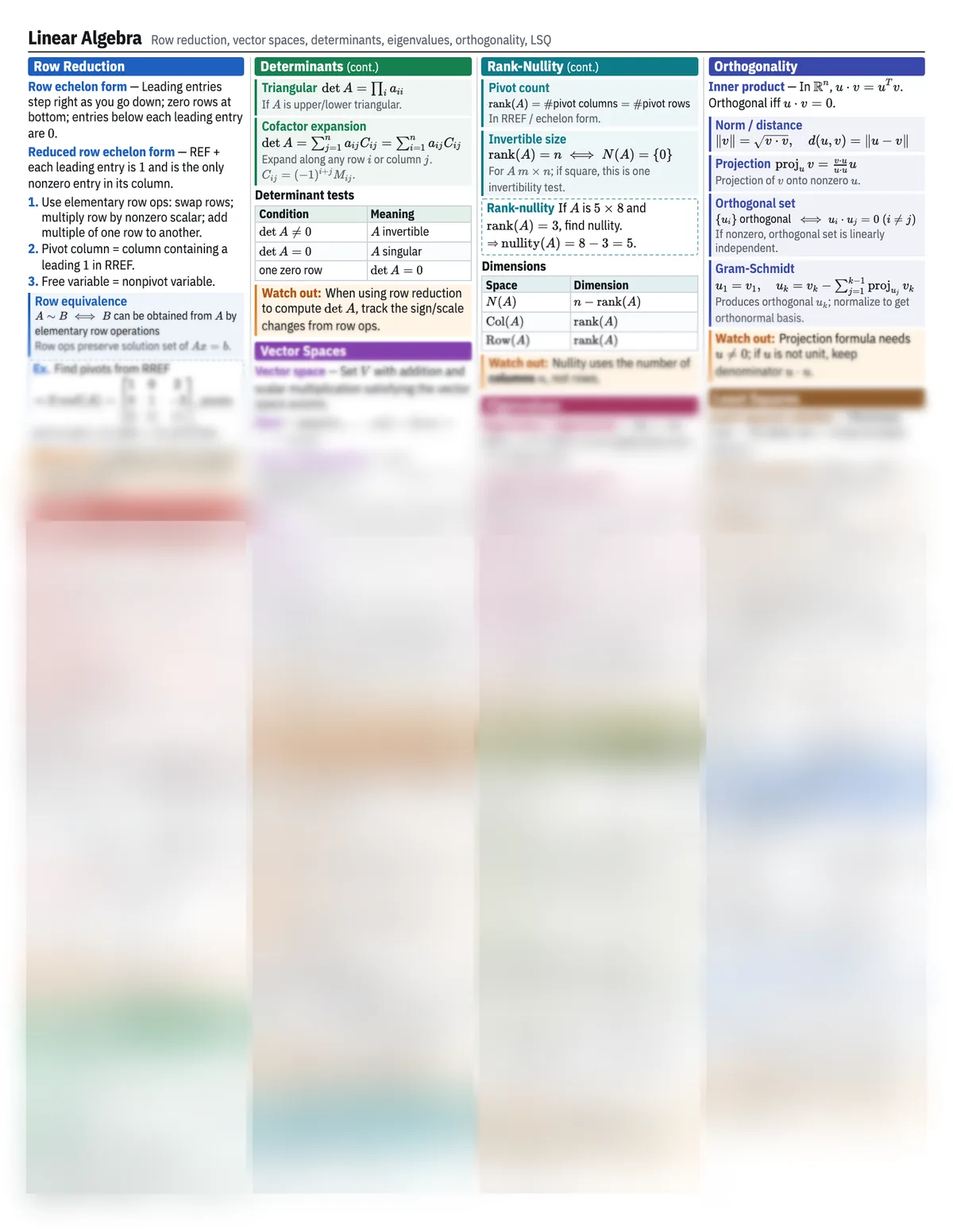
A one-page reference for the whole topic, fact-checked, with the first part free to read. This exam page does not repeat it. Use it to see the material, then make a shorter study sheet from the notes your section actually used.
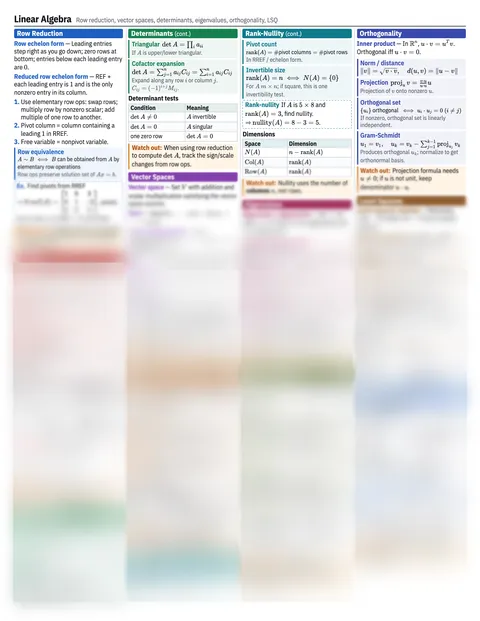
Linear Algebra reference sheet — the free part in text.
Unlock the full reference sheet to edit, print or save it as a PDF.
Make your own for this exam
Upload the post-midterm lectures and problem sets on eigenvalues, orthogonality and least squares, plus the early notes if the final is fully cumulative. In the focus step, name what the review stressed, such as diagonalizability or Gram-Schmidt. Pick one page or an index card to match the rule.
FAQ
Questions
- Is the linear algebra final cumulative?
- Usually yes, with most weight on eigenvalues, diagonalization, orthogonality and least squares. Row reduction and determinants appear both as their own problems and inside those later ones.
- What goes on a linear algebra crib sheet for the final?
- The full invertible matrix theorem, the diagonalization conditions, the projection and Gram-Schmidt formulas, the normal equations, and rank-nullity. Procedures as numbered steps take less room than worked examples.
- When is a matrix not diagonalizable?
- When it has fewer than n linearly independent eigenvectors, which happens only with a repeated eigenvalue whose eigenspace is smaller than its multiplicity. An n by n matrix with n distinct eigenvalues is always diagonalizable.
- How is this different from the linear algebra midterm page?
- The midterm page covers row reduction, inverses, determinants and the first vector-space ideas. This page is for the final, which adds the eigenvalue and orthogonality half of the course.
Keep going
More study pages
All of these sit in the sheet library. Every exam study page.