Financial Accounting final exam study sheet
The Financial Accounting final is cumulative by nature, because every later chapter still needs journal entries, adjustments and the statements. What it adds is the asset and financing chapters: inventory costing, receivables and bad debts, depreciation methods, bonds, stock transactions, and in many courses the statement of cash flows and ratio analysis. The newer chapters usually carry more of the points, while the cycle shows up inside every problem.
A final-exam formula sheet, a crib sheet, an aid sheet or a set of revision notes all mean the same thing here: one page of the entries, methods and formulas from the whole term.
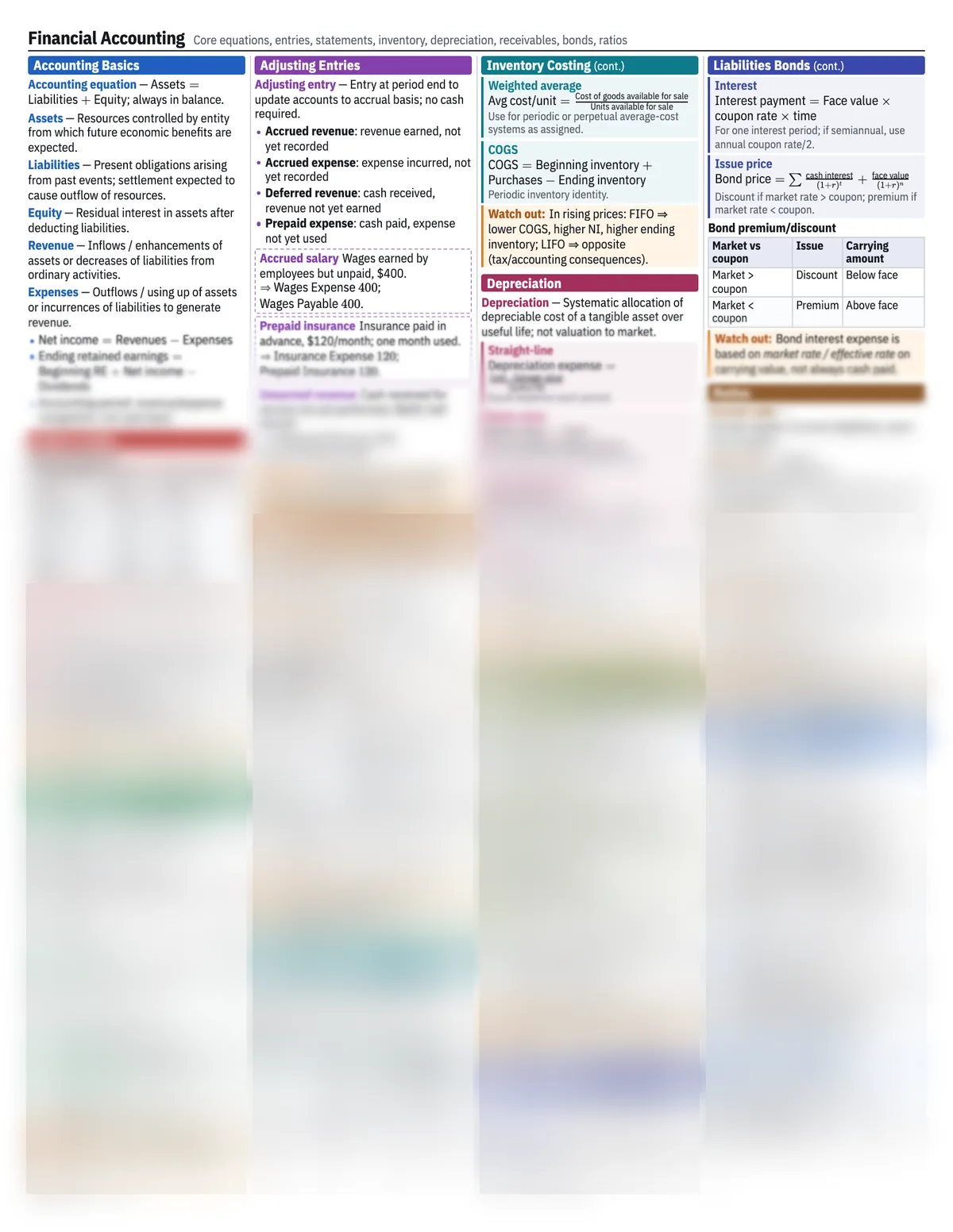 Cheat sheet locked
The scope
What this exam usually covers
These are the topics a typical cumulative accounting final grades. Use the review sheet to weight them; the order matches a standard intro text.
- Inventory costing FIFO, LIFO and weighted average under periodic and perpetual systems, the effect of rising prices on COGS and net income, and lower of cost and net realizable value.
- Receivables and bad debts Allowance method by percentage of sales or an aging schedule, write-offs and recoveries, and why a write-off leaves net receivables unchanged. Direct write-off for contrast.
- Long-lived assets What gets capitalized, straight-line, declining-balance and units-of-activity depreciation, partial years, revising an estimate, and the gain or loss on disposal.
- Liabilities and bonds Notes and accrued interest, bonds issued at par, a discount or a premium, and effective-interest amortization tables. Interest expense versus cash paid is where marks go.
- Stockholders' equity Issuing common and preferred stock, treasury stock, cash and stock dividends, splits, and preferred dividend preferences in arrears. Some courses keep this chapter light.
- Statement of cash flows Indirect-method operating section from net income, depreciation and working-capital changes, then investing and financing. Classifying interest and dividends is a common short question.
- Ratio analysis Liquidity, solvency and profitability ratios such as the current ratio, debt to assets, inventory turnover and return on assets, with a sentence of interpretation.
- The cycle, again Adjusting and closing entries and statement preparation reappear in comprehensive problems, often as the first question. Do not let the earlier material rust.
Usually later
Final exams in intro financial accounting usually skip consolidations, leases in detail, deferred taxes and investments in other companies, which belong to intermediate courses. Whether the statement of cash flows and the equity chapter are tested depends on how far your class got; the final review sheet is the reliable list.
The rules
What a note sheet is usually allowed to include
check your exam header — it wins
Accounting finals are usually closed-book, with a calculator and sometimes present value tables printed in the exam for the bonds chapter. A minority of instructors allow a one-page handwritten sheet or an index card for the final even when midterms allowed none, and a few Canadian courses use an instructor-approved aid sheet with stated dimensions. UK and Australian modules list permitted materials in the handbook, and most do not permit a crib sheet. Read the rule for this exam, not last term's. Either way, condensing the term into one page of revision notes is how you find what you still do not know.
The sheet
The matching library sheet
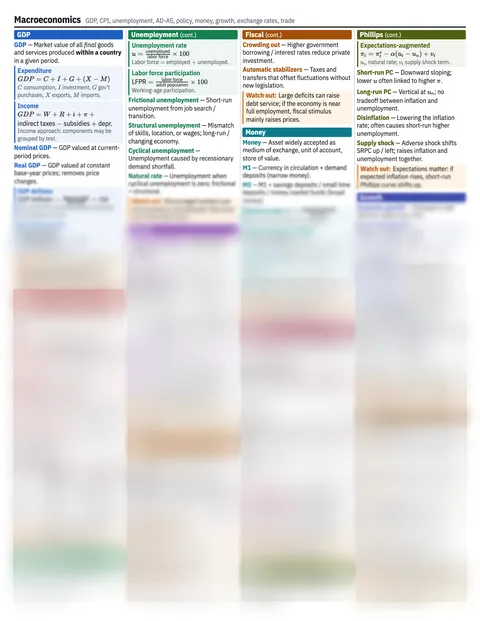
A one-page reference for the whole topic, fact-checked, with the first part free to read. This exam page does not repeat it. Use it to see the material, then make a shorter study sheet from the notes your section actually used.
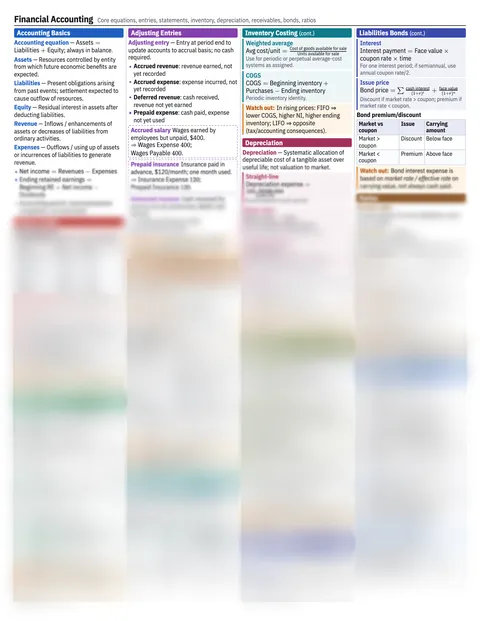
Financial Accounting reference sheet — the free part in text.
Unlock the full reference sheet to edit, print or save it as a PDF.
Make your own for this exam
Upload the slides or problem sets for the whole term, or just the post-midterm chapters if you already have a midterm sheet. In the focus step, list what the review session named, such as bond amortization tables or the indirect cash-flow method. Choose one page, front and back, or an index card to match what the final allows.
FAQ
Questions
- Is the Financial Accounting final cumulative?
- Almost always in practice, because adjusting entries, closing and the statements are part of every later topic. Many instructors weight the newer chapters more heavily, but a comprehensive problem on the cycle is common. Check the review sheet for the split.
- What goes on an accounting final formula sheet or crib sheet?
- The entries you are most likely to reverse: bond discount and premium amortization, the allowance write-off, treasury stock, the depreciation formulas, the indirect-method adjustments, and the ratios your course uses. Skip definitions you already know.
- How should I study inventory costing for the final?
- Work one data set under FIFO, LIFO and average cost side by side and check that cost of goods available for sale equals COGS plus ending inventory every time. That single check catches most errors.
- Are present value tables provided for bonds?
- Often, either as tables in the exam or as permission for a financial calculator. Some courses ask you to work from an amortization table you build. Ask which, because it changes what you need to memorize.
Keep going
More study pages
All of these sit in the sheet library. Every exam study page.