Psychology Cheat Sheet — 1-page PDF
Core exam facts: methods, bio, learning, memory, cognition, dev, motivation, personality, disorders, social. The whole course on one dense, printable page for your midterm or final, with every formula typeset and worked examples where they help.
The first part is free below. See pricing →
For a specific exam: Introduction to Psychology Final exam study sheet.
- 1 pageUS Letter
- 10 sections11 topics
- Free previewfull sheet with Unlimited
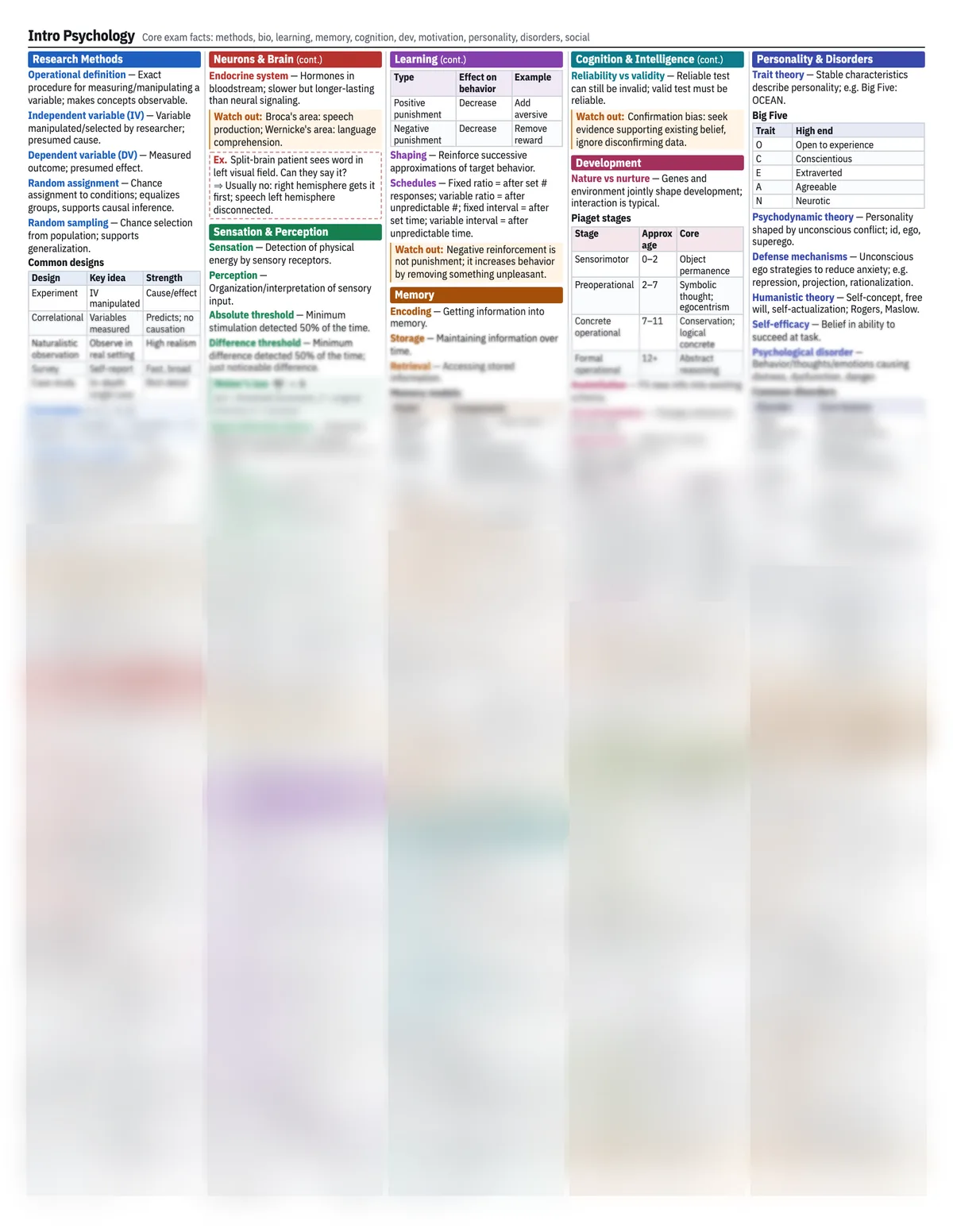 Cheat sheet locked
On the sheet
What’s on it
The topics a typical Intro Psychology exam tests, all on the one page.
- Research methods
- Neurons and brain structures
- Sensation and perception
- Learning: classical and operant conditioning
- Memory models
- Cognition and intelligence
- Development: Piaget, Erikson
- Motivation and emotion
- Personality theories
- Psychological disorders and treatments
- Social psychology
Free preview
The free part, as text
The free part of the sheet, section by section. Unlock the full sheet to read the rest, edit any block, and print it or save it as a PDF.
01Research Methods
- Operational definition
- Exact procedure for measuring/manipulating a variable; makes concepts observable.
- Independent variable (IV)
- Variable manipulated/selected by researcher; presumed cause.
- Dependent variable (DV)
- Measured outcome; presumed effect.
- Random assignment
- Chance assignment to conditions; equalizes groups, supports causal inference.
- Random sampling
- Chance selection from population; supports generalization.
Common designs
| Design | Key idea | Strength |
|---|---|---|
| Experiment | IV manipulated | Cause/effect |
| Correlational | Variables measured | Predicts; no causation |
| Naturalistic observation | Observe in real setting | High realism |
| Survey | Self-report | Fast, broad |
| Case study | In-depth single case | Rich detail |
Correlation
Direction + strength; positive, negative, no linear relation.
- Correlation ≠ causation
- Third variable, directionality, and selection effects can explain association.
- Reliability
- Consistency of measurement; same result across time/items/raters.
02Neurons & Brain
- Endocrine system
- Hormones in bloodstream; slower but longer-lasting than neural signaling.
Watch out:Broca's area: speech production; Wernicke's area: language comprehension.
Ex.Split-brain patient sees word in left visual field. Can they say it?
Usually no: right hemisphere gets it first; speech left hemisphere disconnected.
03Sensation & Perception
- Sensation
- Detection of physical energy by sensory receptors.
- Perception
- Organization/interpretation of sensory input.
- Absolute threshold
- Minimum stimulation detected 50% of the time.
- Difference threshold
- Minimum difference detected 50% of the time; just noticeable difference.
Weber's law
= threshold increment, = original intensity, = constant.
- Signal detection theory
- Detection depends on sensitivity + decision criterion; affected by expectations and fatigue.
- Transduction
- Conversion of physical energy to neural impulse.
- Trichromatic theory
- 3 cone types: red, green, blue; explains color detection.
04Learning
Operant consequences
| Type | Effect on behavior | Example |
|---|---|---|
| Positive reinforcement | Increase | Add reward |
| Negative reinforcement | Increase | Remove aversive |
| Positive punishment | Decrease | Add aversive |
| Negative punishment | Decrease | Remove reward |
- Shaping
- Reinforce successive approximations of target behavior.
- Schedules
- Fixed ratio = after set # responses; variable ratio = after unpredictable #; fixed interval = after set time; variable interval = after unpredictable time.
Watch out:Negative reinforcement is not punishment; it increases behavior by removing something unpleasant.
05Memory
- Encoding
- Getting information into memory.
- Storage
- Maintaining information over time.
- Retrieval
- Accessing stored information.
Memory models
| Model | Components |
|---|---|
| Atkinson-Shiffrin | Sensory → short-term → long-term |
| Working memory | Central executive + phonological loop + visuospatial sketchpad |
| Levels of processing | Shallow to deep encoding |
- Sensory memory
- Very brief register; iconic = visual, echoic = auditory.
06Cognition & Intelligence
- Reliability vs validity
- Reliable test can still be invalid; valid test must be reliable.
Watch out:Confirmation bias: seek evidence supporting existing belief, ignore disconfirming data.
07Development
- Nature vs nurture
- Genes and environment jointly shape development; interaction is typical.
Piaget stages
| Stage | Approx age | Core |
|---|---|---|
| Sensorimotor | 0–2 | Object permanence |
| Preoperational | 2–7 | Symbolic thought; egocentrism |
| Concrete operational | 7–11 | Conservation; logical concrete |
| Formal operational | 12+ | Abstract reasoning |
- Assimilation
- Fit new info into existing schema.
- Accommodation
- Change schema to fit new info.
- Egocentrism
- Difficulty taking another's perspective.
Erikson stages
| Stage | Conflict |
|---|---|
| Trust vs mistrust | Infancy |
| Autonomy vs shame/doubt | Toddler |
| Initiative vs guilt | Preschool |
| Industry vs inferiority | School age |
| Identity vs role confusion | Adolescence |
| Intimacy vs isolation | Young adult |
| Generativity vs stagnation | Middle adult |
| Integrity vs despair | Late adult |
08Personality & Disorders
- Trait theory
- Stable characteristics describe personality; e.g. Big Five: OCEAN.
Big Five
| Trait | High end |
|---|---|
| O | Open to experience |
| C | Conscientious |
| E | Extraverted |
| A | Agreeable |
| N | Neurotic |
- Psychodynamic theory
- Personality shaped by unconscious conflict; id, ego, superego.
- Defense mechanisms
- Unconscious ego strategies to reduce anxiety; e.g. repression, projection, rationalization.
- Humanistic theory
- Self-concept, free will, self-actualization; Rogers, Maslow.
- Self-efficacy
- Belief in ability to succeed at task.
- Psychological disorder
- Behavior/thoughts/emotions causing distress, dysfunction, danger.
Common disorders
| Disorder | Core feature |
|---|---|
| Major depression | Persistent low mood/anhedonia |
| Bipolar | Depression + mania/hypomania |
| Anxiety disorders | Excessive fear/worry |
| OCD | Obsessions + compulsions |
| Schizophrenia | Psychosis; delusions/hallucinations |
| PTSD | Trauma re-experiencing + hyperarousal |
Cheat sheet locked
Also on the full Intro Psychology sheet
10 more sections, with every definition, formula and worked example. Unlimited unlocks every full sheet in the library to edit, print or save as a PDF, and makes unlimited sheets from your own notes.
Research Methods
- Validity
Neurons & Brain
- Neuron
- Glia
- Action potential
- Resting potential
- Myelin
- Synapse
- Neurotransmitter
- Key brain structures
Sensation & Perception
- Opponent-process theory
- Depth cues
Learning
- Classical conditioning
- Classical terms
- Acquisition
- Extinction
- Spontaneous recovery
- Generalization
- Discrimination
- Operant conditioning
Memory
- Short-term / working memory
- Chunking
- Long-term memory
- Encoding specificity
- Interference
Cognition & Intelligence
- Concept
- Prototype
- Algorithm
- Heuristic
- Availability heuristic
- Representativeness heuristic
- Intelligence
- Intelligence views
- IQ
Development
- Identity formation
Motivation & Emotion
- Drive reduction
- Homeostasis
- Yerkes-Dodson law
- Intrinsic motivation
- Extrinsic motivation
- Basic emotions
- James-Lange
- Cannon-Bard
- Schachter-Singer
- Cognitive appraisal
Personality & Disorders
- Treatments
Social Psychology
- Attribution
- Fundamental attribution error
- Self-serving bias
- Conformity
- Compliance
- Obedience
- Classic social findings
- Normative influence
- Informational influence
- Social loafing
- Group polarization
- Prejudice
FAQ
Questions
About the Intro Psychology sheet and making your own.
- What does this Intro Psychology cheat sheet cover?
- It has 10 sections: Research Methods, Neurons & Brain, Sensation & Perception, Learning, Memory, Cognition & Intelligence, Development, Motivation & Emotion, Personality & Disorders and Social Psychology. Together they cover the topics a typical Intro Psychology exam tests, including research methods, neurons and brain structures, sensation and perception and learning: classical and operant conditioning.
- Is the psychology cheat sheet free?
- The first part is free to read on this page, with no account needed. The full sheet opens in the app with Unlimited ($4.99 a month or $19 for a semester), where you can edit it, print it or save it as a PDF. It is one US Letter page and prints cleanly in black and white or colour.
- Can I bring this Intro Psychology cheat sheet to my exam?
- Only if your course allows a note sheet, so check the syllabus. This one is a single US Letter page. If your exam allows a different size, such as a 3x5 or 4x6 index card or one page front and back, Cheat Sheet AI makes one at exactly that size from your own lecture notes.
- How accurate is it?
- The sheet was written by our engine from a standard course outline, then a second model fact-checked every formula and statement against it; it corrected 2 statements before publishing. Notation and emphasis vary between courses, so check it against your own lecture notes.
- Can I make a Intro Psychology sheet from my own notes?
- Yes. Upload your lecture slides, notes or study guide and Cheat Sheet AI writes a sheet in your course's notation, sized to exactly the space your exam allows. Your first sheets are free.
Keep going
More sheets
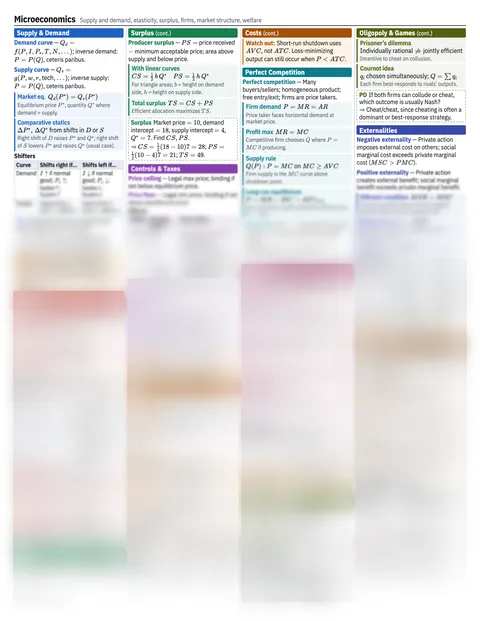
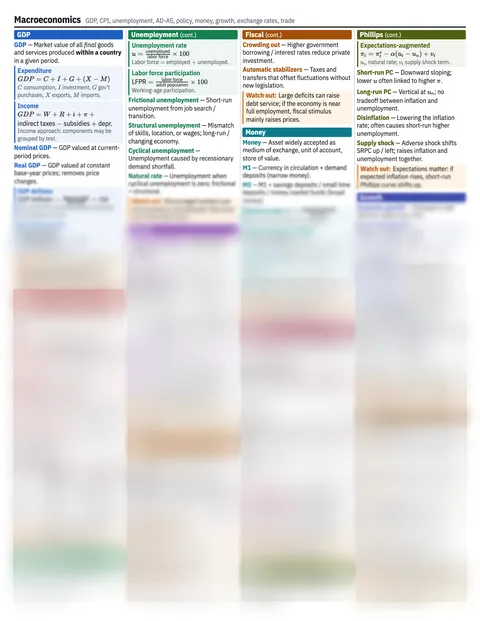
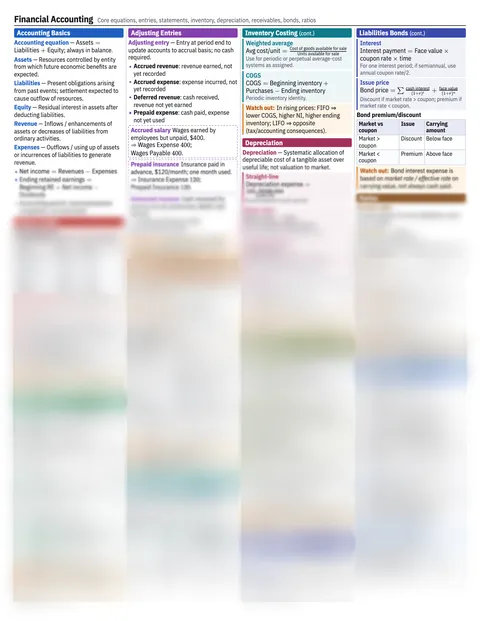

All 40 sheets are in the sheet library.
Your course, your notes, one page.
Upload your own Intro Psychology slides or notes and get a study sheet in your course’s notation. Your first sheet needs no account, and a free account adds one more. See pricing