Accounting Cheat Sheet — 1-page PDF
Core equations, entries, statements, inventory, depreciation, receivables, bonds, ratios. The whole course on one dense, printable page for your midterm or final, with every formula typeset and worked examples where they help.
The first part is free below. See pricing →
For a specific exam: Financial Accounting Midterm study sheet, Financial Accounting Final exam study sheet.
- 1 pageUS Letter
- 11 sections10 topics
- Free previewfull sheet with Unlimited
 Cheat sheet locked
On the sheet
What’s on it
The topics a typical Financial Accounting exam tests, all on the one page.
- Accounting equation
- Debits and credits
- Journal entries
- Adjusting entries
- Income statement, balance sheet, cash flows
- Inventory: FIFO, LIFO, weighted average
- Depreciation methods
- Accounts receivable and bad debt
- Liabilities and bonds
- Financial ratios
Free preview
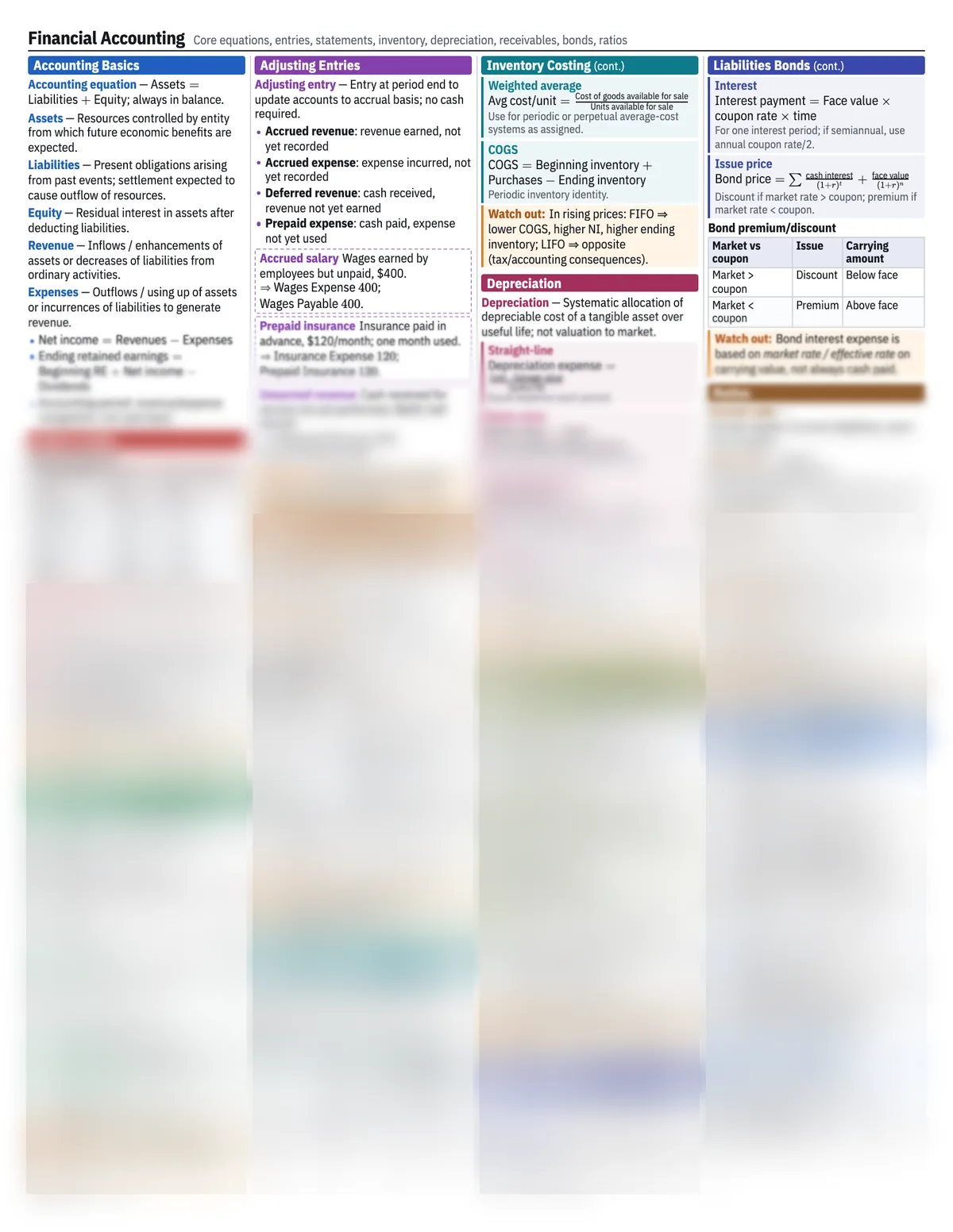
The free part, as text
The free part of the sheet, section by section. Unlock the full sheet to read the rest, edit any block, and print it or save it as a PDF.
01Accounting Basics
- Accounting equation
- ; always in balance.
- Assets
- Resources controlled by entity from which future economic benefits are expected.
- Liabilities
- Present obligations arising from past events; settlement expected to cause outflow of resources.
- Equity
- Residual interest in assets after deducting liabilities.
- Revenue
- Inflows / enhancements of assets or decreases of liabilities from ordinary activities.
- Expenses
- Outflows / using up of assets or incurrences of liabilities to generate revenue.
- Accounting period: revenue/expense recognition, not cash basis
02Debits Credits
Normal balances
| Account type | Increase | Normal balance |
|---|---|---|
| Asset | Debit | Debit |
| Expense | Debit | Debit |
| Dividends | Debit | Debit |
| Liability | Credit | Credit |
| Equity | Credit | Credit |
| Revenue | Credit | Credit |
03Adjusting Entries
- Adjusting entry
- Entry at period end to update accounts to accrual basis; no cash required.
- Accrued revenue: revenue earned, not yet recorded
- Accrued expense: expense incurred, not yet recorded
- Deferred revenue: cash received, revenue not yet earned
- Prepaid expense: cash paid, expense not yet used
Accrued salaryWages earned by employees but unpaid, $400.
; .
Prepaid insuranceInsurance paid in advance, $120/month; one month used.
; .
Unearned revenueCash received for service not yet performed, $600; half earned.
; .
Watch out:Adjusting entries change income statement and balance sheet amounts simultaneously.
04Inventory Costing
Weighted average
Use for periodic or perpetual average-cost systems as assigned.
COGS
COGS=Beginning inventory+Purchases-Ending inventory
Periodic inventory identity.
Watch out:In rising prices: FIFO ⇒ lower COGS, higher NI, higher ending inventory; LIFO ⇒ opposite (tax/accounting consequences).
05Depreciation
- Depreciation
- Systematic allocation of depreciable cost of a tangible asset over useful life; not valuation to market.
Straight-line
Equal expense each period.
Book value
Book value=Cost-Accumulated depreciation
Carrying amount on balance sheet.
Declining balance
Depreciation=Beginning book value rate
Accelerated; higher early expense. Do not depreciate below salvage value.
06Liabilities Bonds
Interest
Interest payment=Face value coupon rate time
For one interest period; if semiannual, use annual coupon rate/2.
Issue price
Discount if market rate > coupon; premium if market rate < coupon.
Bond premium/discount
| Market vs coupon | Issue | Carrying amount |
|---|---|---|
| Market > coupon | Discount | Below face |
| Market < coupon | Premium | Above face |
Watch out:Bond interest expense is based on market rate / effective rate on carrying value, not always cash paid.
07Ratios
- Current ratio
- ; short-term liquidity.
- Quick ratio
- ; acid-test liquidity.
Cheat sheet locked
Also on the full Financial Accounting sheet
9 more sections, with every definition, formula and worked example. Unlimited unlocks every full sheet in the library to edit, print or save as a PDF, and makes unlimited sheets from your own notes.
Debits Credits
- Debit/Credit rule
- Debit
- Credit
Journal Entries
- Journal entry
Statements
- Income statement
- Balance sheet
- Cash flow statement
- Statement links
Inventory Costing
- Inventory cost flow assumption
- FIFO vs LIFO vs Weighted average
Depreciation
Receivables
- Accounts receivable
- Allowance method
- Net realizable value
- Bad debt expense
Liabilities Bonds
- Current liability
- Bonds payable
Ratios
- Debt-to-equity
- Gross margin
- Net profit margin
- Return on assets
- Inventory turnover
Common Traps
- Retained earnings close
FAQ
Questions
About the Financial Accounting sheet and making your own.
- What does this Financial Accounting cheat sheet cover?
- It has 11 sections: Accounting Basics, Debits Credits, Journal Entries, Adjusting Entries, Statements, Inventory Costing, Depreciation, Receivables, Liabilities Bonds, Ratios and Common Traps. Together they cover the topics a typical Financial Accounting exam tests, including accounting equation, debits and credits, journal entries and adjusting entries.
- Is the accounting cheat sheet free?
- The first part is free to read on this page, with no account needed. The full sheet opens in the app with Unlimited ($4.99 a month or $19 for a semester), where you can edit it, print it or save it as a PDF. It is one US Letter page and prints cleanly in black and white or colour.
- Can I bring this Financial Accounting cheat sheet to my exam?
- Only if your course allows a note sheet, so check the syllabus. This one is a single US Letter page. If your exam allows a different size, such as a 3x5 or 4x6 index card or one page front and back, Cheat Sheet AI makes one at exactly that size from your own lecture notes.
- How accurate is it?
- The sheet was written by our engine from a standard course outline, then a second model fact-checked every formula and statement against it; it corrected 3 statements before publishing. Notation and emphasis vary between courses, so check it against your own lecture notes.
- Can I make a Financial Accounting sheet from my own notes?
- Yes. Upload your lecture slides, notes or study guide and Cheat Sheet AI writes a sheet in your course's notation, sized to exactly the space your exam allows. Your first sheets are free.
Keep going
More sheets
All 40 sheets are in the sheet library.
Your course, your notes, one page.
Upload your own Financial Accounting slides or notes and get a study sheet in your course’s notation. Your first sheet needs no account, and a free account adds one more. See pricing