Financial Accounting midterm study sheet
The first Financial Accounting midterm is usually the accounting cycle exam. You analyze transactions, write journal entries that balance, make the period-end adjustments, close the temporary accounts, and build an income statement, retained earnings statement and balance sheet from an adjusted trial balance. Merchandising entries under a perpetual system are often the last chapter in scope. Most of the points come from entries, not definitions.
Students in the US call it a cheat sheet or a note card, UK and Australian students a crib sheet, Canadian students an aid sheet; in every case it is one page of the entries and rules you would otherwise rebuild from memory.
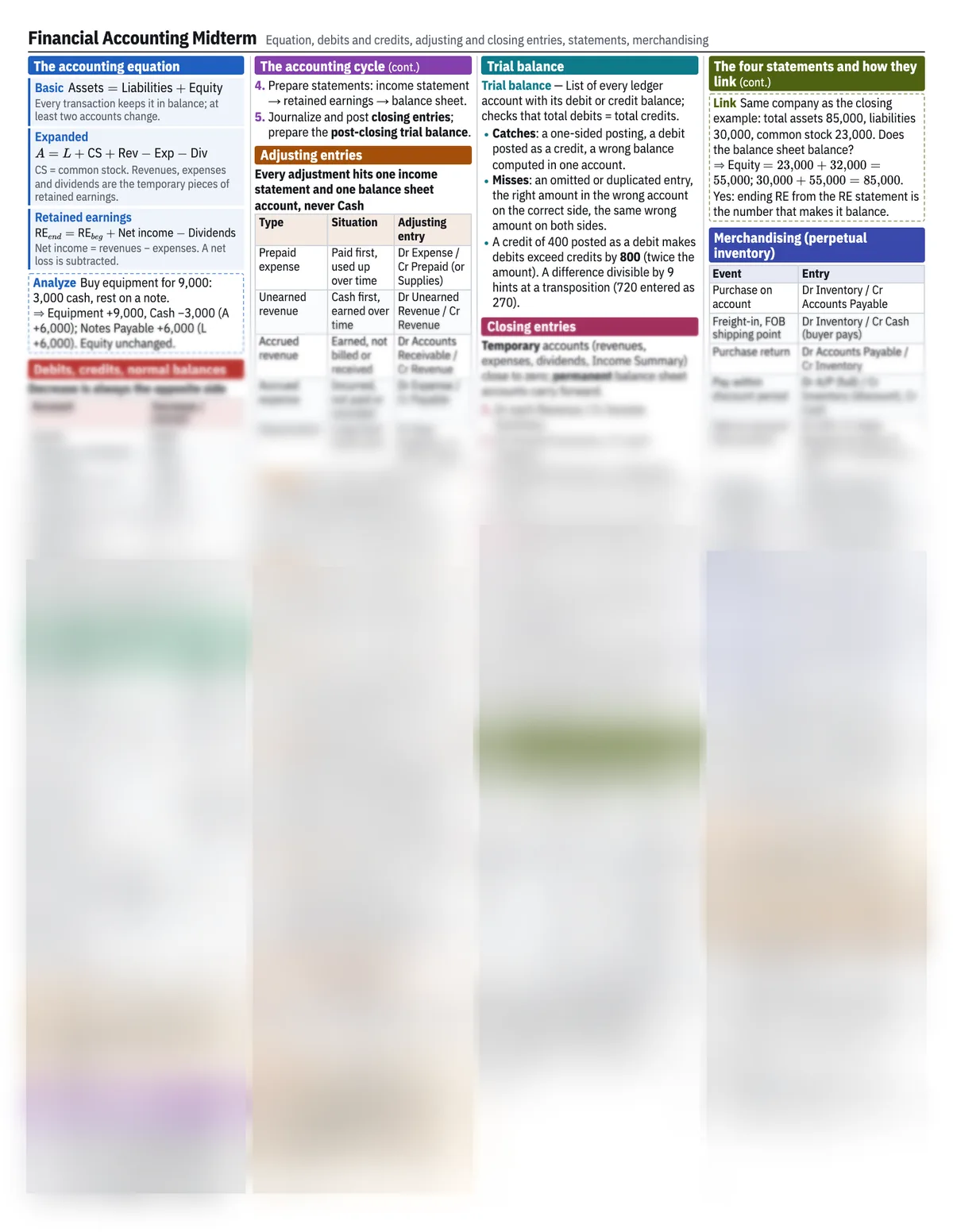 Cheat sheet locked
The scope
What this exam usually covers
These are the problem types a first accounting midterm usually grades. Check them against your syllabus and the chapters on the review sheet.
- Transaction analysis Show each transaction's effect on assets, liabilities and equity, including the expanded equation with revenues, expenses and dividends. Points go when a dividend is treated as an expense.
- Debits, credits and normal balances Know which side increases each account type, including contra accounts like Accumulated Depreciation and Sales Returns and Allowances. Most wrong entries start with a wrong side.
- Journal entries Record routine transactions with balanced debits and credits: services on account, collections, prepayments, cash received in advance, paying suppliers, dividends.
- Adjusting entries Prepaid expenses, unearned revenue, accrued revenue, accrued expenses and depreciation, with the amount prorated by months or days. The most heavily weighted section on many midterms.
- Trial balance and errors Prepare unadjusted and adjusted trial balances, and say which errors a balanced trial balance would not reveal, such as an omitted entry or a wrong account on the right side.
- Closing entries Close revenues, expenses and dividends, through Income Summary or straight to Retained Earnings, then list what remains on the post-closing trial balance.
- Statements and how they link Income statement to retained earnings statement to balance sheet, with correct headings (for the period versus as of a date) and a classified balance sheet.
- Merchandising, perpetual system Purchases, freight terms, returns, purchase discounts like 2/10, n/30, the two entries for every sale, and gross profit and the gross profit rate.
Usually later
Bonds payable and amortization, stock issuance, treasury stock and other equity transactions, preparing the statement of cash flows, and full ratio analysis usually come after the midterm. Inventory costing (FIFO, LIFO, average) and receivables with the allowance method sit right at the cutoff in many courses, so check whether those chapters are on your review list before you study them.
The rules
What a note sheet is usually allowed to include
check your exam header — it wins
Accounting midterms are more often closed-book than open-note, and a basic or financial calculator is usually the only aid. Some instructors allow one handwritten page or a 3 by 5 index card, and a few hand out a chart of accounts with the exam. Canadian courses that permit notes usually call it an aid sheet and spell out the size on the exam cover; UK and Australian modules that permit a crib sheet say so in the module handbook. The syllabus decides. Either way this page is a study sheet: writing out the adjusting entries is how you learn them.
The sheet
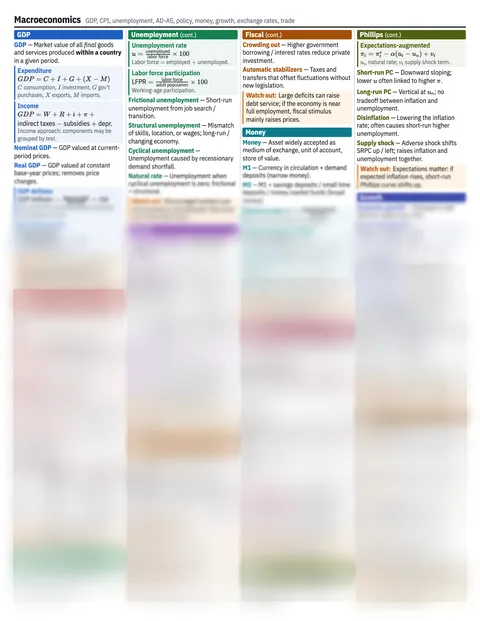
The matching library sheet
A one-page reference for the whole topic, fact-checked, with the first part free to read. This exam page does not repeat it. Use it to see the material, then make a shorter study sheet from the notes your section actually used.
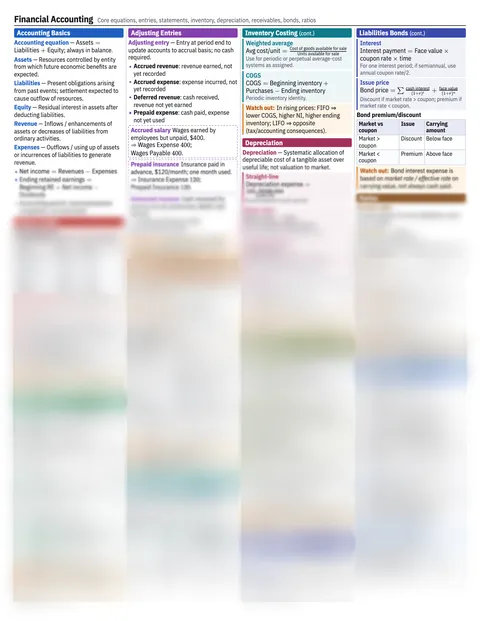
Financial Accounting reference sheet — the free part in text.
Unlock the full reference sheet to edit, print or save it as a PDF.
Unlock the full Midterm sheet, written for this exam's scope. The free part is in the preview above.
Make your own for this exam
Upload the slides or homework sets for the chapters through merchandising, not the whole textbook. In the focus step, name what the review session stressed, for example adjusting entries with partial months, or closing through Income Summary. Pick an index card or one page to match your course rule, or front and back if you only need it for study.
FAQ
Questions
- What should a Financial Accounting midterm study sheet prioritize?
- The adjusting entry for each of the five types with a worked proration, the four closing entries, the normal balance of every account type, and the two entries for a sale under a perpetual system. Definitions take little space and earn few points.
- Can I bring a crib sheet to a Financial Accounting midterm?
- Only if your instructor allows it. Many accounting exams are closed-book with a calculator only; some allow one handwritten page or an index card. Check the syllabus or the exam instructions, and practice without the sheet in case the answer is no.
- Are adjusting entries the hardest part of the first exam?
- For most students, yes. The entry pattern is simple; the points are lost on the amount, such as how many months of a prepaid policy have expired or how many days of wages have accrued at year end. Work dated examples until the proration is automatic.
- Do I need to know periodic inventory for the midterm?
- Many courses teach the perpetual system first and show periodic only as a contrast, so a COGS formula for periodic may appear. Check whether your homework used periodic entries; if not, a one-line reminder is enough.
Keep going
More study pages
All of these sit in the sheet library. Every exam study page.