Corporate Finance midterm study sheet
The Corporate Finance midterm is usually a valuation exam built on one idea, discounting cash flows. You price lump sums, annuities and perpetuities, convert between APR and EAR, amortize a loan, value bonds and dividend-paying stocks, and apply NPV, IRR and payback to a project. Risk, CAPM and the cost of capital usually come after it. Most marks are lost on timing and period mismatches, not on the formulas themselves.
Your course may call it a formula sheet, a crib sheet or an exam aid sheet; whatever the name, it is one page of discounting formulas and the timing rules that go with them.
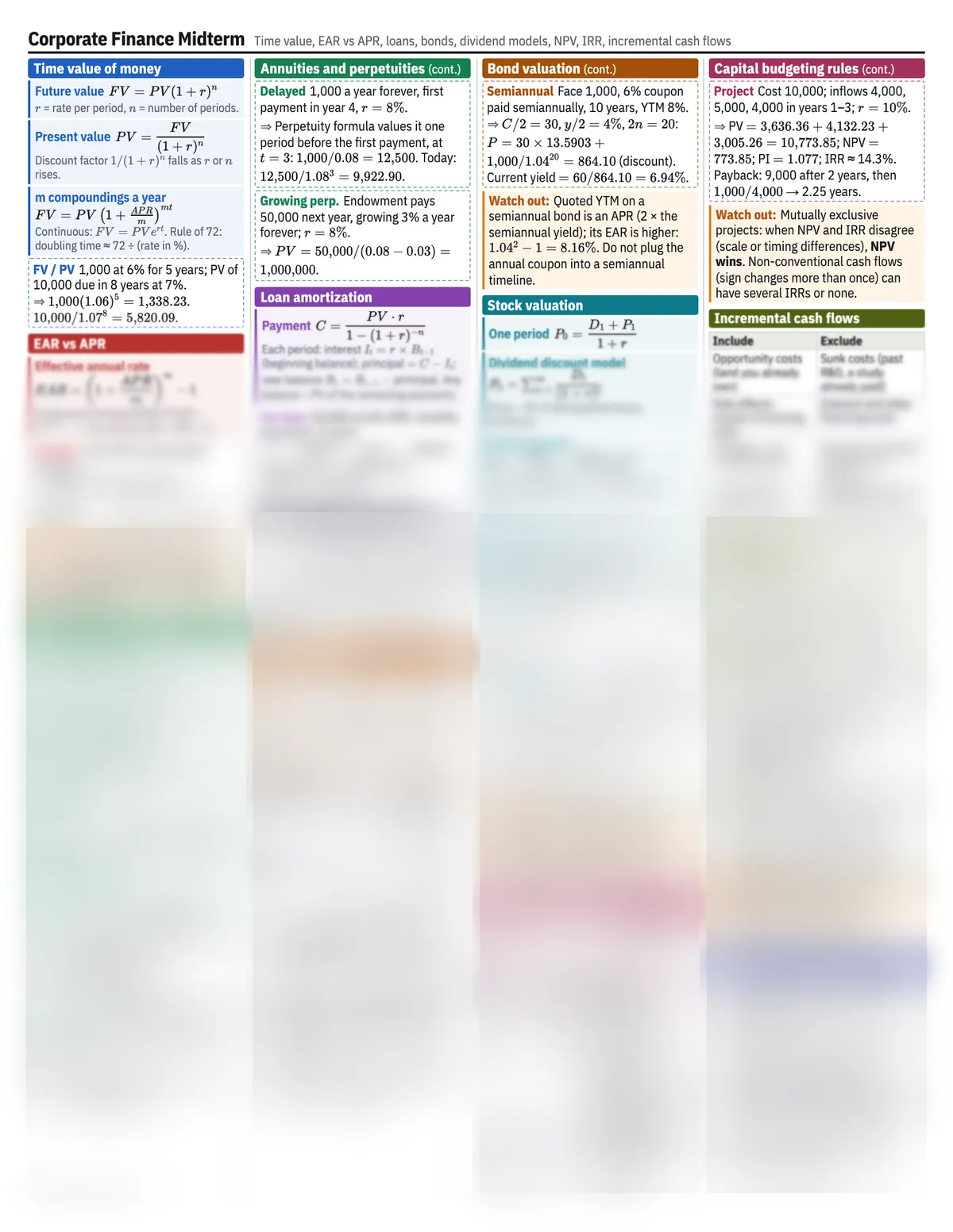 Cheat sheet locked
The scope
What this exam usually covers
These are the problem types a first corporate finance midterm usually grades, in the order most textbooks teach them. Match them to your review list.
- Lump sums and compounding FV and PV of a single amount, solving for the rate or the number of periods, and compounding more than once a year. Calculator sign conventions cost easy points.
- EAR versus APR Convert a quoted APR to an effective annual rate, compare offers on EAR, and use the per-period rate that matches the payment frequency.
- Annuities and perpetuities Ordinary annuities and annuities due, level and growing perpetuities, growing annuities, and delayed cash flows where the formula values them one period before the first payment.
- Loan amortization Find the payment, split it into interest and principal, build the first rows of a schedule, and find the balance after k payments as the PV of the remaining payments.
- Bond valuation and yields Price coupon and zero-coupon bonds with semiannual conventions, solve for YTM, compute current yield, and explain premium, par and discount and interest-rate risk.
- Stock valuation Dividend discount model, Gordon growth with D1 rather than D0, required return as dividend yield plus growth, and two-stage growth with a terminal price.
- NPV, IRR, payback, PI Compute each rule, state the accept decision, and explain why NPV wins when rankings conflict for mutually exclusive projects or cash flows change sign more than once.
- Incremental cash flows Operating cash flow, the depreciation tax shield, net working capital and its recovery, after-tax salvage, and excluding sunk and financing costs.
Usually later
Risk and return, portfolio variance, CAPM and beta, the weighted average cost of capital, capital structure and Modigliani-Miller, payout policy and options usually come after the midterm. If your review sheet stops at capital budgeting, a discount rate will be given to you, so do not spend midterm time deriving one.
The rules
What a note sheet is usually allowed to include
check your exam header — it wins
Corporate finance is one of the subjects where a note sheet is common. Many instructors allow one page, sometimes front and back, of handwritten or typed formulas plus a financial calculator; others print a formula sheet on the exam and ban your own. In the UK and Australia, finance papers often include a printed formulae page and annuity tables, so a personal crib sheet is rarely needed or allowed. Canadian courses that allow an aid sheet usually state its size. Check the syllabus, and treat this page as a study sheet either way.
The sheet
The matching library sheet
A one-page reference for the whole topic, fact-checked, with the first part free to read. This exam page does not repeat it. Use it to see the material, then make a shorter study sheet from the notes your section actually used.
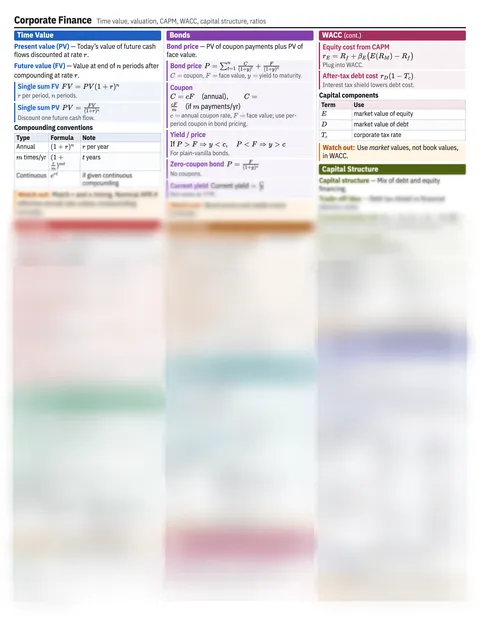
Corporate Finance reference sheet — the free part in text.
Unlock the full reference sheet to edit, print or save it as a PDF.
Unlock the full Midterm sheet, written for this exam's scope. The free part is in the preview above.
Make your own for this exam
Upload the slides and problem sets from time value through capital budgeting. In the focus step, name what the review stressed, for example semiannual bonds or two-stage dividend growth, and the calculator your course uses. Pick one page or front and back to match the formula sheet rule.
FAQ
Questions
- What goes on a Corporate Finance midterm formula sheet?
- The annuity, perpetuity and growing versions, the EAR conversion, the loan payment, the bond price with semiannual adjustments, Gordon growth, NPV, and the operating cash flow formula. Add the timing rules: when each formula places its value and which dividend Gordon uses.
- Should I memorize the formulas if a formula sheet is provided?
- Know them well enough to choose the right one fast. A provided sheet lists formulas but not when the first cash flow arrives, whether to use D0 or D1, or how to convert an annual coupon to a semiannual timeline.
- Why do my bond answers not match the solution?
- Usually a semiannual mismatch: use half the coupon, half the yield and twice the number of years. Also check that the face value is a separate lump sum at maturity, not part of the annuity.
- Is an aid sheet allowed in a corporate finance exam?
- Often, but not always. Some courses allow one page of your own formulas, some provide a sheet and ban personal ones, and some allow only a calculator. The syllabus or exam cover page is the only reliable answer.
Keep going
More study pages


All of these sit in the sheet library. Every exam study page.