Anatomy & Physiology I midterm study sheet
The first Anatomy & Physiology I midterm is mostly a vocabulary and identification exam. You name planes, cavities, tissues, epidermal layers and bones, and you explain one or two physiological ideas properly: a feedback loop, osmosis, how bone is remodeled. Many courses pair it with a lab practical where you identify the same tissues and bones on slides and models, so naming has to be exact.
Nursing and pre-health students call it a study sheet or revision notes; in the UK and Australia a crib sheet; in Canada an aid sheet. For A&P it is mostly one page of names, tables and two or three loops.
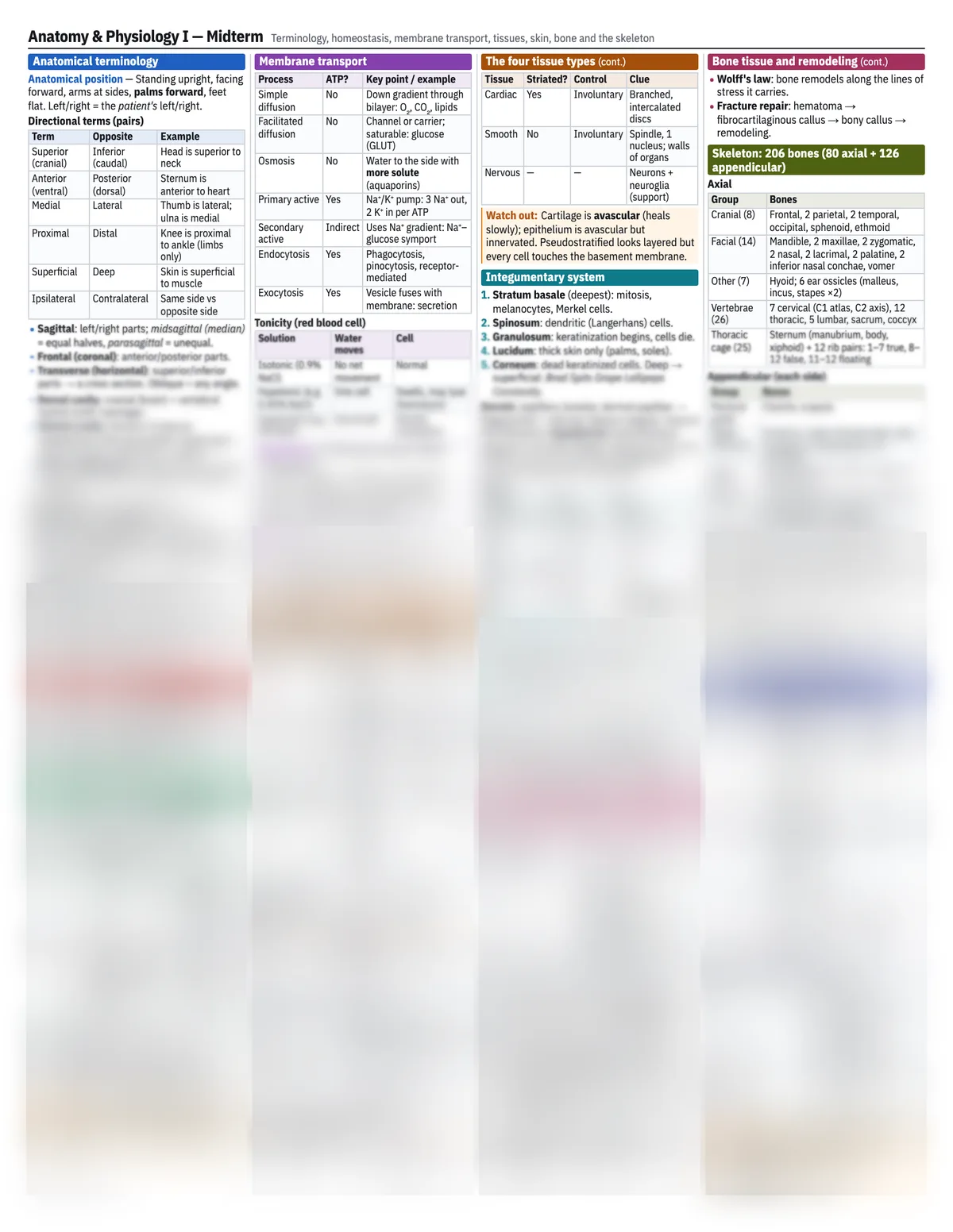 Cheat sheet locked
The scope
What this exam usually covers
These are the topics a typical first A&P I midterm grades. Check each against your lecture schedule, because the order of tissues, skin and bone varies by textbook.
- Anatomical terminology Directional pairs, the three planes, the nine abdominopelvic regions or four quadrants, and which cavity holds which organ. Points go on proximal versus superior and on mixing up parietal and visceral layers.
- Levels of organization Chemical to organism, and the eleven organ systems with one job each. Usually a few quick multiple-choice questions, but organ versus tissue is a classic trap.
- Homeostasis and feedback Receptor, control center, effector, and whether a loop is negative or positive. Expect to label a temperature or blood glucose loop and to classify labor or clotting as positive feedback.
- Membrane transport Diffusion, facilitated diffusion, osmosis, primary and secondary active transport, and vesicular transport. The tonicity question (what a red cell does in hypotonic or hypertonic solution) is where most students lose a point.
- The four tissue types Epithelial naming by layers and shape, connective tissue types with a location for each, the three muscle tissues, and neurons versus glia. Often tested again on slides in the lab practical.
- Integumentary system Epidermal layers in order, the cells in each, papillary versus reticular dermis, glands, burn depth and the rule of nines. Hypodermis is not part of the skin, and exams check that.
- Bone tissue and remodeling Osteoblasts, osteocytes and osteoclasts, osteon structure, the two kinds of ossification, and how PTH and calcitonin move blood calcium. Swapping blast and clast is the most common error.
- Skeleton and joints Axial and appendicular bones you must name (cranial and facial bones, vertebral regions, carpals and tarsals), plus structural and functional joint classes and the six synovial types with an example each.
Usually later
Muscle physiology in depth (the sliding filament model, excitation-contraction coupling, motor units), the nervous system and the endocrine system usually come after this midterm, and endocrine is often an A&P II topic. If your schedule puts muscle tissue before the exam, expect tissue identification only, not the contraction sequence. The review sheet decides.
The rules
What a note sheet is usually allowed to include
check your exam header — it wins
Most Anatomy & Physiology I lecture exams are closed-book, and lab practicals almost never allow notes because the exam is identification. A minority of instructors, often in online or community-college sections, allow a single handwritten index card or one side of a page for the lecture exam; in Canada that is an aid sheet, in the UK a crib sheet. Nursing prerequisites are usually strict about this, so read the syllabus rather than assuming. Writing out the bone lists and tissue tables by hand is how most students learn them anyway: this page is a study sheet either way.
The sheet
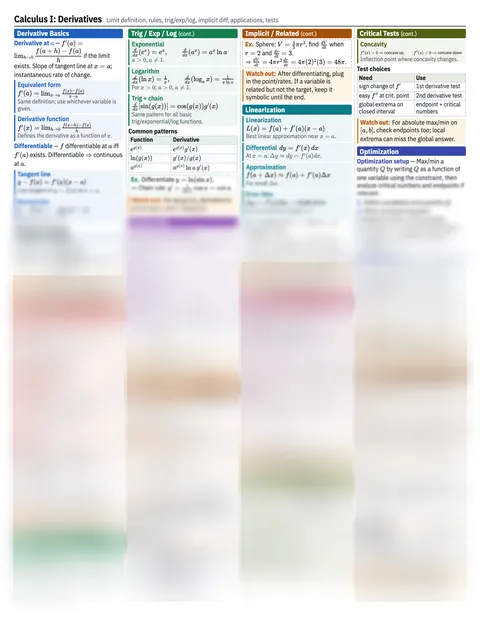
The matching library sheet
A one-page reference for the whole topic, fact-checked, with the first part free to read. This exam page does not repeat it. Use it to see the material, then make a shorter study sheet from the notes your section actually used.
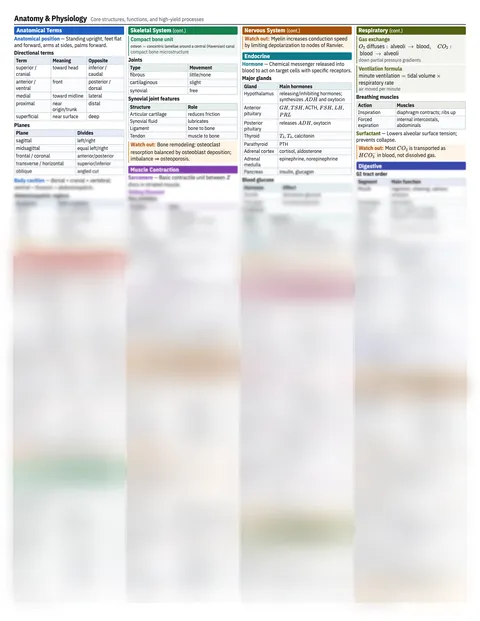
Anatomy & Physiology reference sheet — the free part in text.
Unlock the full reference sheet to edit, print or save it as a PDF.
Unlock the full Midterm sheet, written for this exam's scope. The free part is in the preview above.
Make your own for this exam
Upload the lecture slides and lab handouts for the weeks the midterm covers, from terminology through the skeleton and joints. In the focus step, name what the review stressed, for example epithelial tissue types or the bones of the skull. Pick one page for revision, or an index card if your instructor allows one for the lecture exam.
FAQ
Questions
- What is on an Anatomy & Physiology I midterm?
- Usually terminology, levels of organization, homeostasis, membrane transport, the four tissue types, skin, bone tissue and the skeleton with joints. Muscle physiology, the nervous system and endocrine usually come later.
- Can I bring a crib sheet to an A&P midterm?
- Usually not. Most A&P lecture exams are closed-book and lab practicals almost never allow notes. Some sections allow one handwritten index card for the lecture exam only. Check the syllabus or ask your instructor.
- Which bones do I need to know for the first A&P exam?
- Commonly the cranial and facial bones, vertebral regions and counts, ribs and sternum, the pectoral and pelvic girdles, and the limb bones including carpals and tarsals. Your lab list is the real list, since it decides what you name on the practical.
- How do I tell negative from positive feedback on the exam?
- Ask whether the response reverses the stimulus (negative, e.g. sweating lowers a high temperature) or reinforces it (positive, e.g. stronger contractions release more oxytocin during labor). Neither word means good or bad.
Keep going
More study pages
All of these sit in the sheet library. Every exam study page.