Pharmacology midterm study sheet
A nursing or health-sciences pharmacology midterm usually tests principles before drug classes. You are asked how a drug is absorbed, distributed, metabolized and excreted, what half-life means for dosing, and how to calculate a dose or an IV rate exactly. The drug content is usually the autonomic nervous system: cholinergic and adrenergic drugs, their prototypes, adverse effects and the nursing actions that go with them.
Students outside the US may know this as a crib sheet, an aid sheet or revision notes; for the dosage half of the exam it is really a formula sheet.
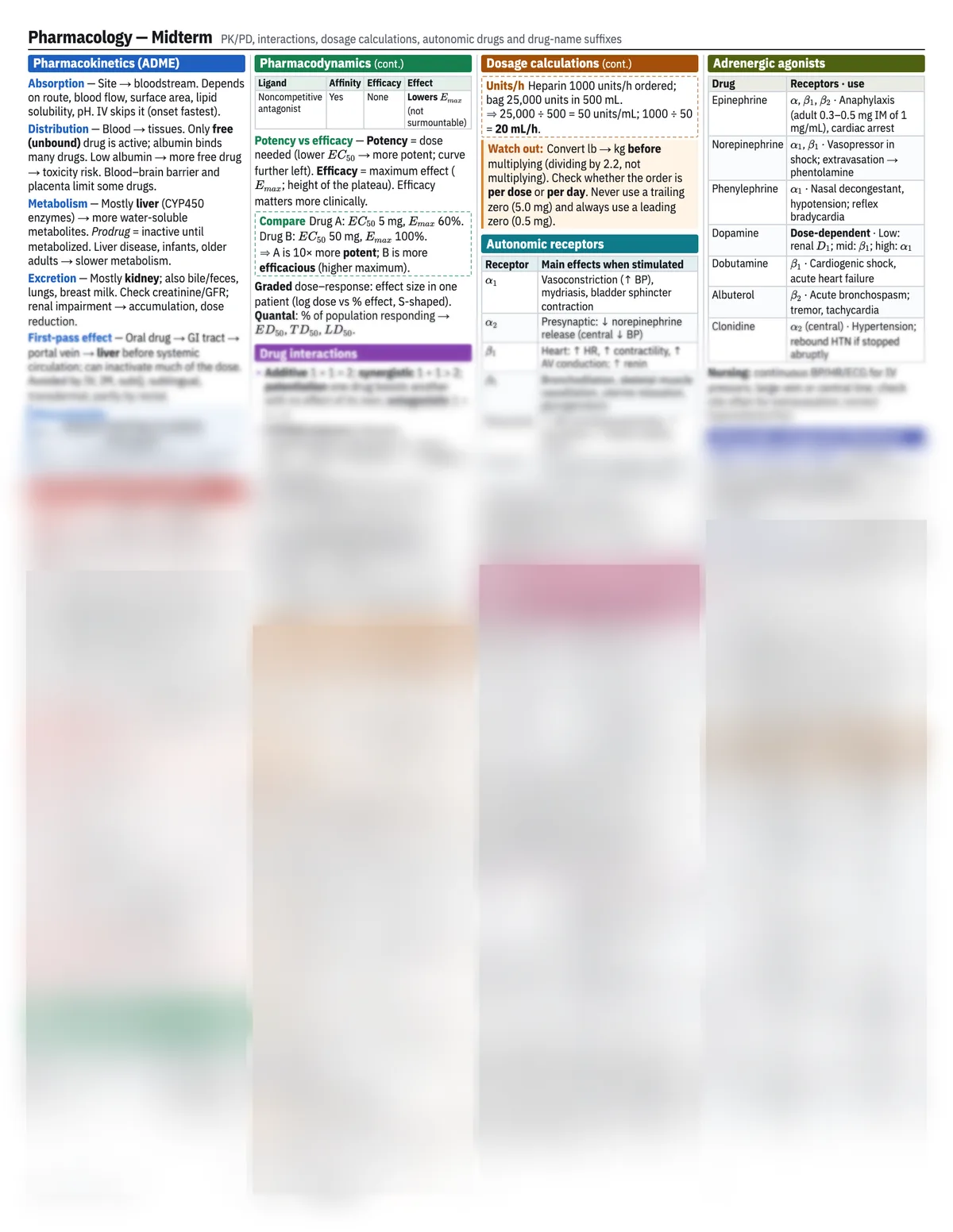 Cheat sheet locked
The scope
What this exam usually covers
These are the areas a typical pharmacology midterm grades. Your course may put the drug classes in a different order, so match them to the schedule.
- Pharmacokinetics (ADME) Absorption, distribution, metabolism and excretion, the first-pass effect, bioavailability and protein binding. Questions ask what changes in an older adult or a patient with liver or kidney disease.
- Half-life and steady state How much drug is left after a number of half-lives, why steady state takes four to five half-lives, loading versus maintenance doses, peaks and troughs, and why narrow therapeutic index drugs need levels.
- Pharmacodynamics Agonists, partial agonists and antagonists, potency versus efficacy, and reading a dose-response curve. The trap is calling the more potent drug the more effective one.
- Drug interactions Additive, synergistic and antagonistic effects, CYP450 inducers and inhibitors, protein-binding displacement and food interactions such as grapefruit juice and vitamin K with warfarin.
- Dosage calculations Desired over have times quantity, weight-based mg/kg dosing with pound-to-kilogram conversion, IV rates in mL/h and drip rates in gtt/min. Often all-or-nothing: a wrong unit or rounding step scores zero.
- Cholinergic and anticholinergic drugs Bethanechol, pilocarpine, cholinesterase inhibitors, atropine and other antimuscarinics: what each treats, the SLUDGE versus anticholinergic adverse effects, contraindications and antidotes.
- Adrenergic agonists and blockers Epinephrine, norepinephrine, dopamine, dobutamine, albuterol, clonidine, alpha-1 blockers and beta blockers: receptor targets, prototypes, first-dose hypotension, masked hypoglycemia and when to hold a dose.
- Drug-name suffixes Recognizing a class from the generic name (-olol, -pril, -sartan, -statin, -prazole and so on). Usually quick multiple-choice points, and useful for every later unit.
Usually later
Antimicrobials, cardiovascular drugs (antihypertensives, anticoagulants, antidysrhythmics, heart failure drugs) and CNS drugs (opioids, sedatives, antidepressants, antiepileptics) are usually after the midterm. You may still see their suffixes now. The review sheet decides where your course draws the line.
The rules
What a note sheet is usually allowed to include
check your exam header — it wins
Pharmacology exams in nursing programs are almost always closed-book, and dosage calculation tests are often separate, proctored and graded pass or fail with a basic calculator and no formula sheet. A few health-sciences or pharmacology-for-science courses provide the PK formulas on the exam or allow one handwritten page; in Canada that may be called an aid sheet, in the UK a crib sheet. Do not assume a formula sheet is allowed because there is math. Check the syllabus. This page is a study sheet either way: practise the calculations until you no longer need the formulas written down.
The sheet
The matching library sheet
A one-page reference for the whole topic, fact-checked, with the first part free to read. This exam page does not repeat it. Use it to see the material, then make a shorter study sheet from the notes your section actually used.
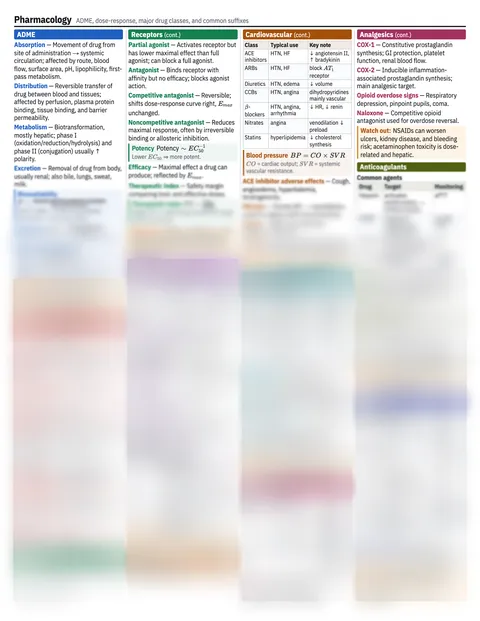
Pharmacology reference sheet — the free part in text.
Unlock the full reference sheet to edit, print or save it as a PDF.
Unlock the full Midterm sheet, written for this exam's scope. The free part is in the preview above.
Make your own for this exam
Upload the lecture slides and any dosage calculation practice sets for the weeks before the midterm. In the focus step, name the prototypes and calculation types the review stressed, such as IV drip rates or beta blocker nursing actions. Pick one page for revision, front and back if you want the worked dosage examples alongside the drug tables.
FAQ
Questions
- What is on a nursing pharmacology midterm?
- Usually pharmacokinetics, pharmacodynamics, interactions, dosage calculations and autonomic nervous system drugs with their prototypes, adverse effects and nursing considerations. Antimicrobials and cardiovascular and CNS drugs usually come later.
- What goes on a pharmacology formula sheet?
- Desired over have times quantity, mg/kg dosing, mL/h and gtt/min formulas, unit conversions, half-life and the loading and maintenance dose formulas. Even when you cannot bring it, writing it out is how you memorize it.
- Can I bring a crib sheet to a pharmacology exam?
- In nursing programs, almost never: pharmacology and dosage calculation exams are usually closed-book. Some science pharmacology courses provide formulas or allow a handwritten page. Follow your syllabus.
- How do I avoid losing points on dosage calculations?
- Convert units first, including pounds to kilograms, check whether the order is per dose or per day, round only at the end and the way your program specifies, and ask whether the answer is reasonable before you write it.
- Which autonomic drugs should I know as prototypes?
- Commonly bethanechol, neostigmine, atropine, epinephrine, norepinephrine, albuterol, prazosin, propranolol and metoprolol. Your course's prototype list is the one that counts.
Keep going
More study pages
All of these sit in the sheet library. Every exam study page.