Calculus III final exam study sheet
The Calculus III final is cumulative: vectors and planes, partial derivatives and optimization, double and triple integrals, and the vector calculus that closes the course. In many semesters the last third (line integrals, Green’s theorem, Stokes’ theorem and the divergence theorem) has had no midterm of its own, so the final often weights it heavily. The midterms tested one unit at a time; the final expects you to pick the theorem and the coordinate system yourself.
Your instructor may call it a formula sheet, a crib sheet, an aid sheet or revision notes; for multivariable calculus it is the one page that holds the Jacobians and the big theorems.
 Cheat sheet locked
The scope
What this exam usually covers
A final usually pulls one or two problems from each unit. Check each against your review sheet.
- Vectors, lines, and planes Dot product for angles and projections, cross product for normals and area, and the plane through three points. A sign slip in the cross product spoils every step that follows.
- Partial derivatives and the gradient Gradient, directional derivative with a unit vector (forgetting to normalize is the classic lost point), tangent planes, and the multivariable chain rule drawn as a tree.
- Optimization Critical points and the second derivative test with D = f_xx f_yy − (f_xy)², then Lagrange multipliers on a constraint. Closed-region problems also need the boundary checked.
- Double and triple integrals Setting up the bounds is the grade. Expect a reversal of the order of integration, a region read from a sketch, and mass or average value if your class did them.
- Polar, cylindrical, and spherical coordinates r dr dθ, r dz dr dθ, and ρ² sin φ dρ dφ dθ. A missing Jacobian factor is the most common single error on the multiple-integral question.
- Line integrals and conservative fields Parametrize the curve, then integrate F · dr. Test whether the field is conservative, find the potential, and let the fundamental theorem turn the integral into two lines.
- Green’s, Stokes’, and the divergence theorem Which one fits: a closed curve in the plane, a surface with a boundary curve, or a closed surface. Orientation (counterclockwise, outward normal, right-hand rule) decides the sign.
- Flux through a surface Parametrize the surface, take the normal from the cross product of the partials, and set up the flux integral. Many courses grade the setup more heavily than the evaluation.
Usually later
Some Calculus III courses end before Stokes’ theorem and the divergence theorem, and some test surface integrals only as setups; the review sheet tells you which. Quadric surfaces, arc length and curvature of space curves are often first-midterm topics that appear lightly or not at all on the final. Proofs of the theorems are rarely asked unless your instructor assigned them.
The rules
What a note sheet is usually allowed to include
check your exam header — it wins
Multivariable calculus finals are split. Many US sections allow one handwritten page, sometimes both sides, because the Jacobians and theorem statements are a lot to carry; others allow nothing and print the theorems on the exam. Canadian courses that permit an aid sheet usually state its size and that it must be handwritten, and UK and Australian modules more often supply a formula booklet than allow a crib sheet. Graphing calculators are frequently banned. Read the final exam policy for your section. Either way, this page is a study sheet: writing the theorem table out yourself is how you learn which one to use.
The sheet
The matching library sheet
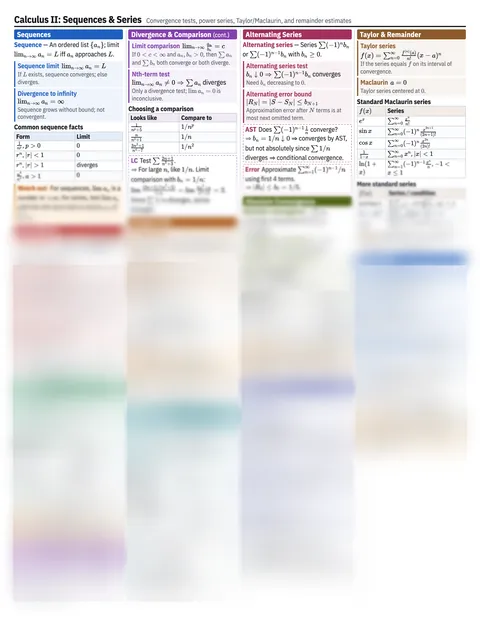
A one-page reference for the whole topic, fact-checked, with the first part free to read. This exam page does not repeat it. Use it to see the material, then make a shorter study sheet from the notes your section actually used.
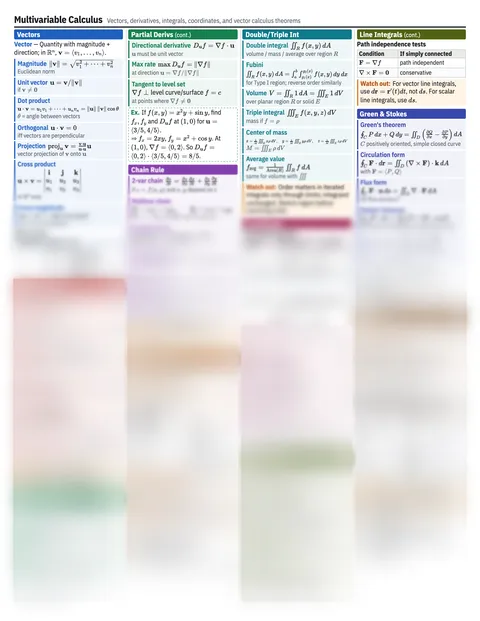
Multivariable Calculus reference sheet — the free part in text.
Unlock the full reference sheet to edit, print or save it as a PDF.
Make your own for this exam
Upload the lecture notes or problem sets for every unit the final covers, with the vector calculus weeks included if they had no midterm. In the focus step, name what the review session stressed, such as orientation or spherical bounds. Pick one page or front and back to match the allowed sheet.
FAQ
Questions
- Is the Calculus III final cumulative?
- Usually, yes. Expect at least one problem each from vectors, partials and multiple integrals, and a larger share on line integrals and the vector calculus theorems if those weeks had no midterm. The review sheet is the authority.
- What goes on a Calculus III formula sheet?
- The three Jacobians, the second derivative test, the Lagrange setup, the fundamental theorem for line integrals, and Green’s, Stokes’ and the divergence theorem with their orientation conventions. Worked examples come last, if space remains.
- How do I know which vector calculus theorem to use?
- Look at what you are given. A closed curve in the plane points to Green, a surface with a boundary curve to Stokes, a closed surface around a solid to the divergence theorem, and a conservative field to the fundamental theorem for line integrals.
- Can I bring a crib sheet to a multivariable calculus final?
- Only if your course allows it. Some allow one handwritten page; many print the theorems on the paper and allow nothing else. Check the exam rules, and use the sheet for revision even if it stays at home.
Keep going
More study pages
All of these sit in the sheet library. Every exam study page.