Trigonometry final exam study sheet
A trigonometry final, whether for a stand-alone course or the trig half of precalculus, is cumulative and fairly even across units. Expect exact values from the unit circle, identity proofs, equations solved on an interval, transformed sine and cosine graphs, and triangles solved with the laws of sines and cosines. Unlike the unit tests, the final mixes them: an equation that needs a double-angle identity before it can be solved, or a graph you must turn back into an equation.
Some call it a formula sheet, some a crib sheet or revision notes, and Canadian courses an aid sheet; in trigonometry it is mostly identities and the unit circle on one page.
 Cheat sheet locked
The scope
What this exam usually covers
These are the problem types a trig final tends to grade. Match them against your review sheet.
- Unit circle and exact values Sine, cosine and tangent at multiples of π/6 and π/4, in radians and degrees, with the right sign in each quadrant. Reference-angle sign errors are the most common lost points.
- Verifying identities Work one side only, rewrite in sine and cosine, and use the Pythagorean identities. Graders take marks for moving terms across the equals sign as if it were an equation.
- Sum, difference, double and half-angle Exact values like cos 15° from a difference formula, and the three forms of cos 2θ. Half-angle formulas need the sign chosen from the quadrant of θ/2, not of θ.
- Solving trig equations All solutions in [0, 2π), or the general solution with + 2πn (+ πn for tangent). Dividing both sides by a trig function can lose solutions; factoring keeps them.
- Graphs and transformations Amplitude, period 2π/B (π/B for tangent), phase shift and midline from y = A sin(Bx − C) + D. Reading the equation off a graph is as common as drawing one.
- Inverse trig functions Principal ranges, and compositions like sin(arccos x) found by drawing a triangle. arcsin(sin x) equals x only on [−π/2, π/2], a favorite trap question.
- Law of sines and law of cosines Choose by what is given: SSS or SAS needs the law of cosines, ASA or AAS the law of sines. The SSA ambiguous case can give zero, one, or two triangles.
- Radians, arc length, and sector area Converting between degrees and radians, arc length s = rθ, and sector area ½r²θ. Using degrees in these two formulas is a routine and costly error.
Usually later
Polar coordinates, complex numbers in trigonometric form with De Moivre’s theorem, and vectors are on some trigonometry finals and missing from others, depending on which textbook chapters your course reached. Product-to-sum formulas and harmonic motion are also course-dependent. Check the review sheet before you give them room.
The rules
What a note sheet is usually allowed to include
check your exam header — it wins
Trigonometry finals are often stricter than calculus ones, because the identities are the material being tested. Many courses allow no notes, some allow one handwritten index card, and a few hand out the sum and double-angle formulas while expecting the unit circle from memory. High school and precalculus finals sometimes come with a department reference sheet. Where a Canadian aid sheet or a UK or Australian crib sheet is allowed, it is usually limited in size and handwritten. Check the syllabus. Either way, treat this as a study sheet: writing out the identities from memory is the practice.
The sheet
The matching library sheet
A one-page reference for the whole topic, fact-checked, with the first part free to read. This exam page does not repeat it. Use it to see the material, then make a shorter study sheet from the notes your section actually used.
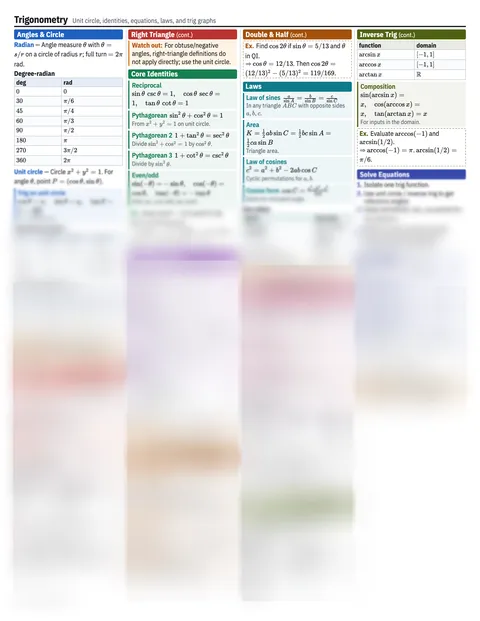
Trigonometry reference sheet — the free part in text.
Unlock the full reference sheet to edit, print or save it as a PDF.
Make your own for this exam
Upload the unit notes or worksheets for every chapter on the final. In the focus step, name what the review stressed, such as identity proofs or the ambiguous case. Choose an index card or one page to match the rule, or a full page if it is for revision only.
FAQ
Questions
- Do I need to memorize the unit circle for a trigonometry final?
- In most courses, yes. Exact values at multiples of π/6 and π/4 are expected without a calculator, and the unit circle is rarely printed on the exam. The first-quadrant values plus the signs by quadrant are enough to rebuild the rest.
- What goes on a trigonometry formula sheet?
- The Pythagorean, sum and difference, double-angle and half-angle identities, the general sine graph form, the laws of sines and cosines, and the principal ranges of the inverse functions. The unit circle too, if it is allowed.
- How do I prove a trig identity on an exam?
- Start from the more complicated side, rewrite in sine and cosine, and simplify until it matches the other side. Do not work both sides toward each other unless your instructor accepts that.
- Can I bring a crib sheet to a trigonometry final?
- Only if your course says so. Many trig finals allow no notes; others allow an index card or provide a formula sheet. Check before the exam and revise as if you will not have one.
Keep going
More study pages
All of these sit in the sheet library. Every exam study page.