Discrete Mathematics final exam study sheet
Discrete mathematics finals are cumulative and broad, because the course is a sequence of short units rather than one long build. Logic and proof techniques from the first weeks run through everything, so the final often asks for a written proof alongside computational problems. The later units, often counting, recurrences and graphs, tend to take a larger share, but the order of units varies a lot between textbooks.
It goes by formula sheet, crib sheet, aid sheet or revision notes; for discrete math it holds fewer formulas than definitions, proof templates and counting rules.
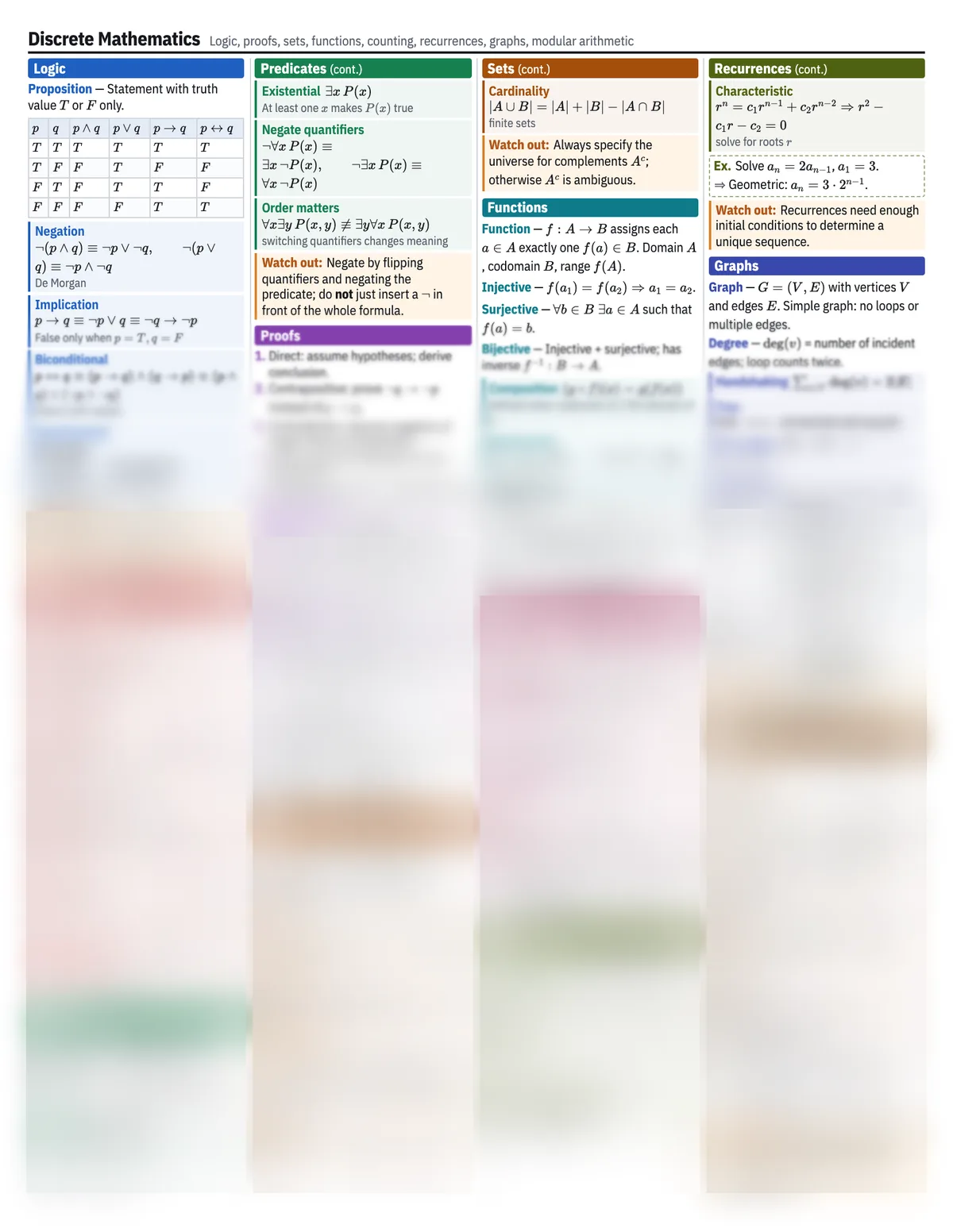 Cheat sheet locked
The scope
What this exam usually covers
These are the problem types a typical discrete math final grades. Your course may order or weight them differently.
- Propositional logic Truth tables, implication and its contrapositive, and equivalences by the laws. The converse is not equivalent to the implication, and that distinction is tested every term.
- Quantifiers Translating English into ∀ and ∃, negating nested quantifiers by flipping each one, and why ∀x ∃y differs from ∃y ∀x.
- Proof techniques Direct proof, contrapositive, contradiction, and induction. Induction loses points on a missing base case or an inductive step that never uses the hypothesis.
- Sets and functions Set identities, power sets, and proving a function injective, surjective or bijective. Apply the definition to arbitrary elements; one example is not a proof.
- Counting Sum and product rules, permutations, combinations, the binomial theorem and the pigeonhole principle. Inclusion-exclusion appears often; overcounting is the usual error.
- Recurrences Set up a recurrence from a description, then solve a linear homogeneous one with the characteristic equation, including the repeated-root case.
- Graphs and trees Degree, the handshaking lemma, connectivity, and the fact that a tree on n vertices has n − 1 edges. Euler circuits and paths where your course covered them.
- Modular arithmetic Congruences, reducing large powers mod n, and a modular inverse by the extended Euclidean algorithm. Check that the gcd is 1 first, or the inverse does not exist.
Usually later
Relations (equivalence relations and partial orders), RSA, generating functions, finite automata, and graph coloring or planarity appear on some discrete math finals and not on others, because textbooks differ in what they cover. Discrete probability is a unit in some courses. Check the review sheet before you give any of them space.
The rules
What a note sheet is usually allowed to include
check your exam header — it wins
Discrete math policies vary widely. Some courses allow one handwritten page because there are many definitions and the skill being graded is proof writing, not recall; others allow no notes, since knowing the definitions is the material. Courses taught for computer science majors and for math majors can differ here even within one school. In Canada an aid sheet is sometimes allowed, and in the UK and Australia a crib sheet is uncommon for this kind of module. Check the syllabus. Either way, this is a study sheet: writing the proof templates out is good practice.
The sheet
The matching library sheet
A one-page reference for the whole topic, fact-checked, with the first part free to read. This exam page does not repeat it. Use it to see the material, then make a shorter study sheet from the notes your section actually used.
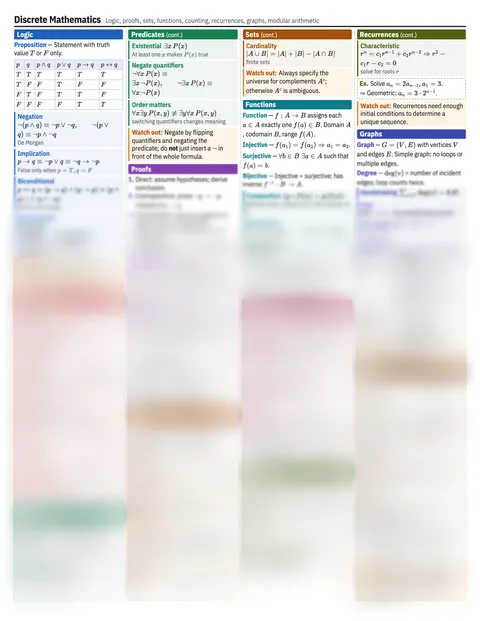
Discrete Mathematics reference sheet — the free part in text.
Unlock the full reference sheet to edit, print or save it as a PDF.
Make your own for this exam
Upload the lecture notes and problem sets for every unit on the final, including the logic and proof weeks. In the focus step, name what the review stressed, such as strong induction or inclusion-exclusion. Pick one page or front and back to match the rule.
FAQ
Questions
- What goes on a discrete math crib sheet?
- Logical equivalences, quantifier negation, a template for each proof method, counting formulas with a note on when order and repetition matter, the recurrence-solving steps, and the key graph facts. Definitions you keep misremembering earn the space.
- Will there be proofs on the discrete math final?
- Almost always at least one, often an induction proof, sometimes a direct or contrapositive proof about integers or sets. Practice writing them in full; a note sheet cannot write the argument for you.
- How do I tell permutations from combinations?
- Ask whether order matters. If rearranging the chosen items gives a different outcome, use permutations; if not, combinations. When repetition is allowed, the formulas change.
- Is a formula sheet allowed in a discrete math exam?
- It depends on the course. Some allow one handwritten page, many allow nothing. Check the syllabus or ask, and revise as if you will not have one.
Keep going
More study pages
All of these sit in the sheet library. Every exam study page.