Physics II electricity and magnetism final exam study sheet
In a calculus-based sequence, the Physics II final is usually electricity and magnetism from Coulomb's law to Faraday's law. The early units, fields, Gauss's law, and potential, return in conceptual questions, while the long problems lean on the last third of the term: magnetic forces, Ampère's law, induction, and inductance. Algebra-based Physics II often adds optics or modern topics, so the scope depends on which version you are in.
Call it a formula sheet, an exam aid sheet as many Canadian courses do, or a crib sheet in British usage: a single page that holds the E&M relationships you actually use.
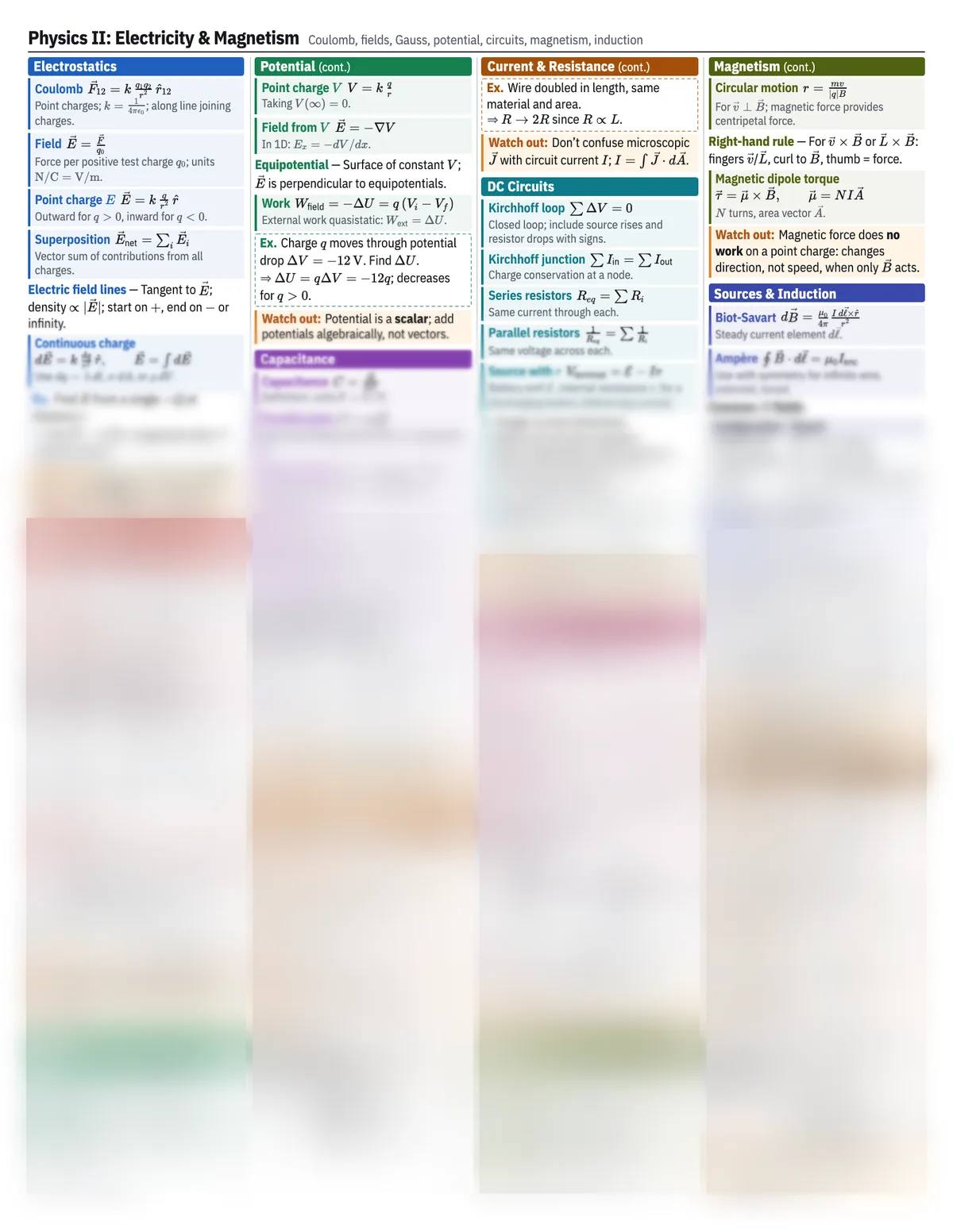 Cheat sheet locked
The scope
What this exam usually covers
These are the problem types an E&M final usually grades. Match them to your syllabus, because optics and AC circuits are the topics that vary.
- Coulomb's law and electric fields Vector superposition of point charges and fields from continuous distributions such as a rod or ring. Components and symmetry arguments are where most points are lost.
- Gauss's law Choose a sphere, cylinder, or pillbox to match the symmetry, then find enclosed charge. Conductors in equilibrium have zero field inside and charge on the surface.
- Electric potential Potential of point charges, potential energy of charge systems, and E as the negative gradient of V. Potential is a scalar, so no components; sign errors cost the most.
- Capacitance Parallel-plate capacitance, dielectrics, series and parallel combinations, and stored energy. Know what stays fixed when a battery is connected versus disconnected.
- DC and RC circuits Kirchhoff's loop and junction rules, equivalent resistance, power, and RC charging and discharging with the time constant. Sign conventions in loops are the common error.
- Magnetic force and fields Force on moving charges and current-carrying wires, circular motion in a uniform field, Biot-Savart for loops, and Ampère's law for wires and solenoids. Right-hand rules are graded.
- Faraday's law and Lenz's law Changing flux from a changing field, area, or angle, induced emf and current, and the direction from Lenz. Moving-bar and rotating-loop problems are standard finals.
- Inductance and RL circuits Self-inductance, energy stored in an inductor, and RL growth and decay. LC oscillation appears on some finals, usually as a frequency calculation.
Usually later
Maxwell's displacement current and electromagnetic waves are the last lecture in many courses and appear briefly if at all. AC circuits with phasors and resonance are covered in some Physics II courses and left to engineering circuits in others. Geometric optics, interference, and diffraction are on the final only in versions of the course that teach them, so check the review sheet.
The rules
What a note sheet is usually allowed to include
check your exam header — it wins
E&M finals tend to come with an equation sheet, either one the department prints into the exam with the constants and the main laws, or one you write yourself. Student-written sheets are typically limited to one page, sometimes one side only, and a few instructors require handwriting. Canadian courses often specify an aid sheet on the exam cover; in the UK a crib sheet is the exception rather than the rule, and constants are printed on the paper. Some sections allow no notes. Whatever your course allows, use this page as a study sheet, and bring it in only if the written policy permits.
The sheet
The matching library sheet
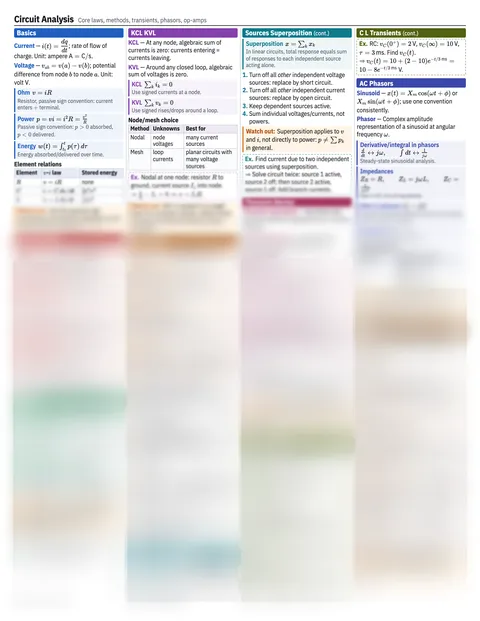
A one-page reference for the whole topic, fact-checked, with the first part free to read. This exam page does not repeat it. Use it to see the material, then make a shorter study sheet from the notes your section actually used.
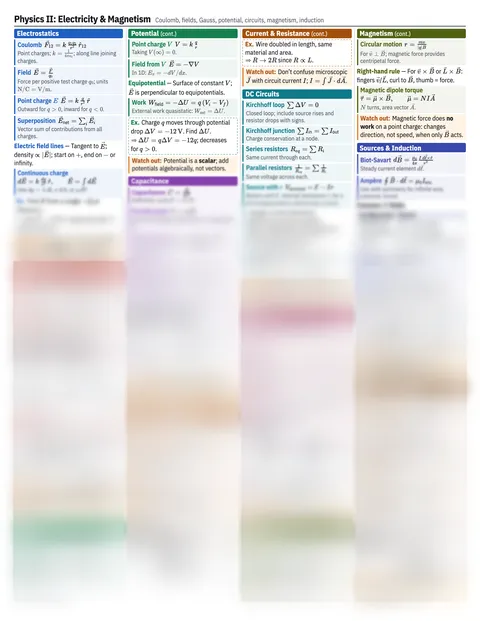
Physics II: Electricity & Magnetism reference sheet — the free part in text.
Unlock the full reference sheet to edit, print or save it as a PDF.
Make your own for this exam
Upload the slides or problem sets from the whole term, and in the focus step name what the review session stressed, often Gauss's law, induction, and RC circuits. Choose one page or front and back to match your course's rule, and keep the right-hand rules as short diagrams rather than sentences.
FAQ
Questions
- Is optics on the Physics II final?
- It depends on the course. Calculus-based Physics II is often E&M only, with optics and waves in a third course. Algebra-based Physics II frequently includes optics. Your syllabus or the review sheet settles it.
- What should an E&M formula sheet include?
- Coulomb's law, field and potential for point charges, Gauss's law with the three standard surfaces, capacitance and stored energy, the RC time constant, magnetic force on charges and wires, Ampère's law for a wire and solenoid, and Faraday's law with Lenz's rule.
- Is an aid sheet allowed in a Physics II final?
- Often, but not always. Many courses allow one page you write yourself, others print an equation sheet into the exam and allow nothing else. Check the exam cover or the course outline for the size and whether it must be handwritten.
- Which topics lose the most points on an E&M final?
- Vector addition of fields, signs in potential and Kirchhoff loops, right-hand-rule directions, and Lenz's law. A sheet that lists one worked direction example for each saves more marks than another formula.
Keep going
More study pages
All of these sit in the sheet library. Every exam study page.