Circuit Analysis final exam study sheet
A circuit analysis final grades method more than memory: write node or mesh equations correctly, reduce a network to its Thevenin equivalent, and solve an op-amp circuit with the ideal rules. It is usually cumulative, with the later units, capacitor and inductor transients and sinusoidal steady state with phasors, getting the long problems. A first course in circuits rarely needs much beyond these tools.
Engineering students in Canada know it as an aid sheet, students in the UK and Australia as a crib sheet, and most US courses as a formula sheet: one page of methods and rules you condensed yourself.
 Cheat sheet locked
The scope
What this exam usually covers
These are the problem types a first circuits final usually grades. The second-order and AC power units vary most between courses.
- Ohm's law, power, and passive sign convention Absorbed versus delivered power and the passive sign convention. Getting the sign of power wrong on a source is a quick way to lose points on an otherwise right answer.
- Series, parallel, and dividers Equivalent resistance, voltage and current dividers, and series and parallel capacitors and inductors, which combine the opposite way to resistors. Dividers only apply when nothing else loads the node.
- Nodal and mesh analysis KCL at each non-reference node, KVL around each mesh, supernodes and supermeshes for sources between nodes or shared by meshes. Dependent sources add one constraint equation.
- Superposition and source transformation Turn off sources one at a time: voltage sources become shorts, current sources become opens, dependent sources stay on. Power does not superpose, which is a standard trick.
- Thevenin and Norton equivalents Open-circuit voltage, short-circuit current, and Thevenin resistance with independent sources off, or with a test source when dependent sources are present. Maximum power transfer when the load matches.
- Ideal op-amp circuits No current into the inputs and equal input voltages under negative feedback. Inverting, noninverting, follower, summing, and difference amplifiers; integrators show up on finals that cover capacitors.
- First-order RC and RL transients Initial and final values, the time constant RC or L over R, and the exponential between them. Capacitor voltage and inductor current cannot jump at a switch, which sets the initial value.
- Phasors and impedance Convert sinusoids to phasors, use impedances jωL and 1/(jωC), and apply nodal analysis or Thevenin in the phasor domain. Convert back to the time domain with magnitude and phase for full credit.
Usually later
Second-order RLC transients with overdamped, critically damped, and underdamped cases appear on some finals and are a separate unit or course elsewhere; this reference only lists the damping idea. AC power, power factor, three-phase circuits, frequency response, Bode plots, and Laplace methods are usually a second circuits course. Check the review sheet for which of these your final includes.
The rules
What a note sheet is usually allowed to include
check your exam header — it wins
Circuits finals vary widely in what you can bring. Many engineering departments allow one page of notes, front and back, because the exam is about method rather than recall. Others allow one side, require handwriting, or allow nothing and print a short table of impedances and transient forms on the paper. Canadian engineering faculties often set the aid-sheet size on the cover and may restrict calculators to an approved model, and UK courses that allow a crib sheet normally say so in the module handbook. The course outline decides. Either way, this page works as a study sheet.
The sheet
The matching library sheet
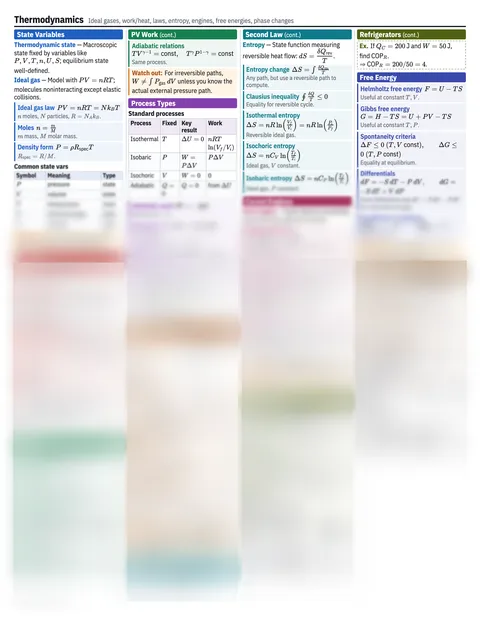
A one-page reference for the whole topic, fact-checked, with the first part free to read. This exam page does not repeat it. Use it to see the material, then make a shorter study sheet from the notes your section actually used.
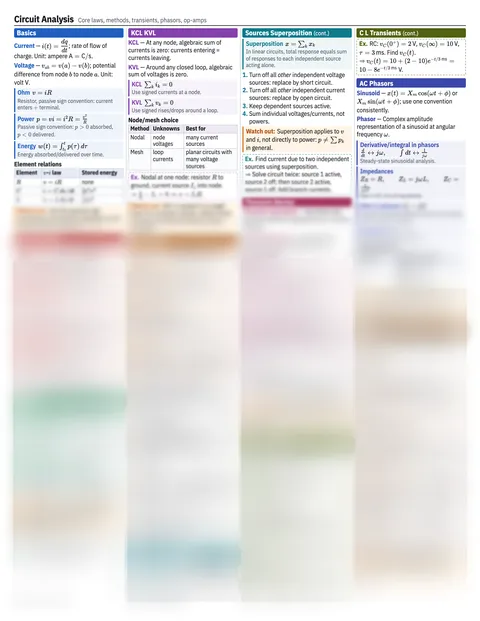
Circuit Analysis reference sheet — the free part in text.
Unlock the full reference sheet to edit, print or save it as a PDF.
Make your own for this exam
Upload the lecture slides and homework from the whole term, and in the focus step name the methods the review stressed, for example Thevenin with dependent sources or RL transients. Choose one page or front and back to match the rule, and keep one worked nodal example with a dependent source.
FAQ
Questions
- Is the circuit analysis final cumulative?
- Usually yes. Nodal and mesh analysis are used inside the later problems anyway, so they come back even when the final is weighted toward transients and phasors.
- What should a circuits aid sheet contain?
- Divider formulas, the nodal and mesh setup rules, supernode and supermesh steps, the Thevenin procedure with dependent sources, the ideal op-amp rules and gains, first-order transient form with initial and final values, and the impedance of R, L, and C.
- Is a formula sheet allowed in a circuit analysis final?
- Often, but rules differ: one page front and back, one side, handwritten only, or no notes with a provided table. Read the syllabus or exam announcement for your section.
- Are second-order circuits on the final?
- Only in courses that teach them before the final. Many first courses stop at first-order RC and RL circuits and phasors; others include RLC step responses. The review sheet tells you which.
Keep going
More study pages
All of these sit in the sheet library. Every exam study page.