Modern Physics final exam study sheet
A modern physics final usually covers special relativity, the evidence for photons and matter waves, the Bohr model, and an introduction to the Schrödinger equation, sometimes with nuclear decay at the end. Early relativity topics come back as calculation problems, while the quantum material carries the conceptual questions and the longer derivations. The order and depth vary more than in introductory physics, so the syllabus matters more than usual.
Whether your course calls it a formula sheet, your UK friends call it a crib sheet, or a Canadian department calls it an aid sheet, it is the same thing here: one page of the relations and constants you condense yourself.
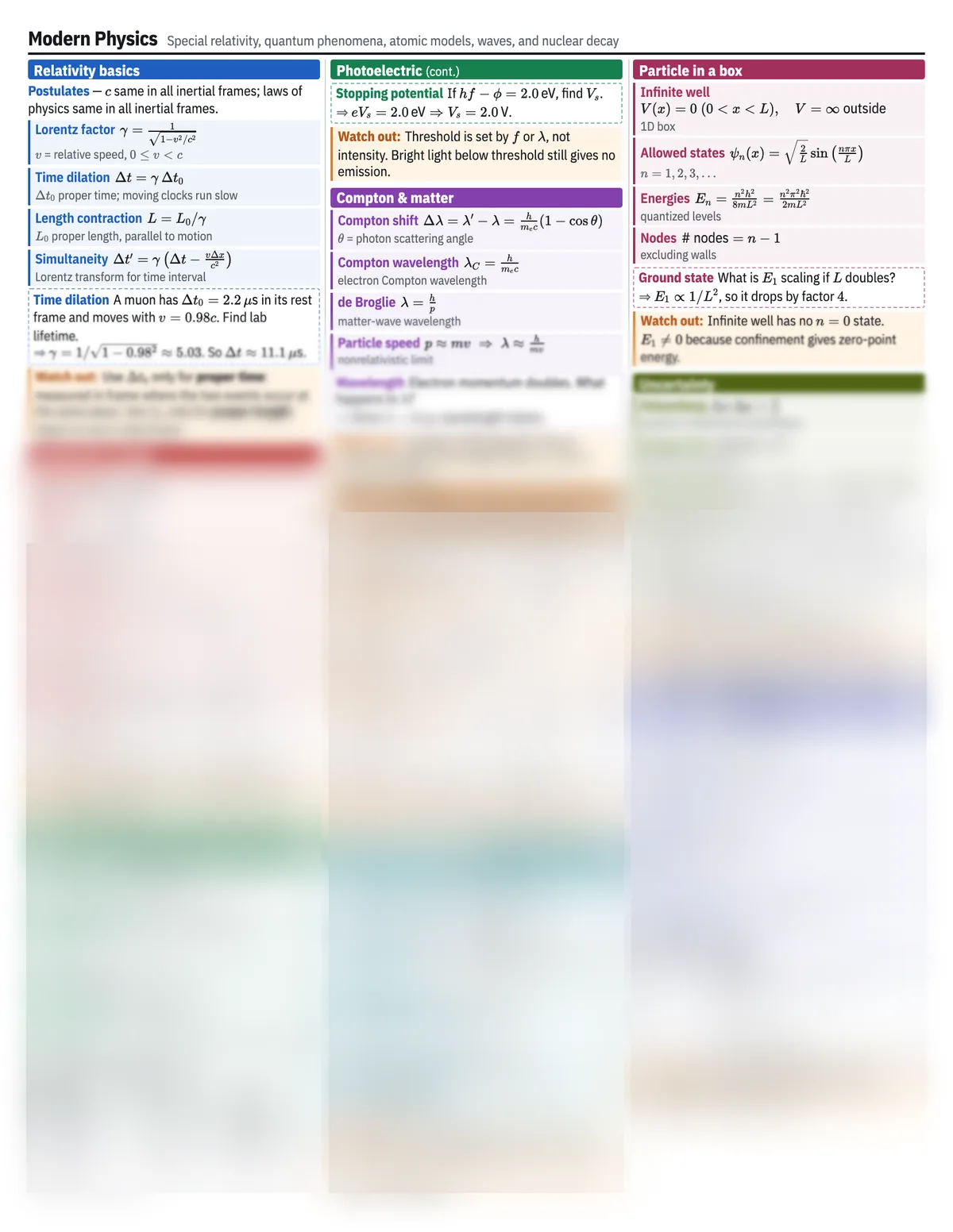 Cheat sheet locked
The scope
What this exam usually covers
These are the problem types a sophomore-level modern physics final commonly grades. Courses differ most in how far they go into quantum mechanics.
- Time dilation and length contraction Identify proper time and proper length first, then apply the Lorentz factor. Most lost points come from putting gamma on the wrong side of the equation.
- Relativistic energy and momentum Total energy, rest energy, kinetic energy as total minus rest, and the energy-momentum relation. Units of MeV and MeV/c save time in particle problems.
- Photoelectric effect Einstein's equation with work function, threshold frequency, and stopping potential. Intensity changes the current, not the maximum kinetic energy, which is a standard conceptual question.
- Compton scattering and de Broglie waves Compton shift with the scattering angle, and de Broglie wavelength for electrons and other particles. Use relativistic momentum when the speed is a sizeable fraction of c.
- Bohr model and hydrogen spectra Energy levels at minus 13.6 eV over n squared, photon energy for a transition, and named series such as Balmer. Emission versus absorption sign conventions are easy to mix up.
- Schrödinger equation and the infinite well Normalization, probability from the squared wavefunction, and the particle-in-a-box energies and wavefunctions. Counting nodes and finding probability in a region are common questions.
- Uncertainty principle Position-momentum and energy-time forms used as order-of-magnitude estimates, for example the minimum kinetic energy of a confined electron. Exact factors of 2 depend on your textbook.
- Radioactive decay Decay constant, half-life, mean life, and activity over time. Taking logarithms correctly and keeping time units consistent are where points go.
Usually later
Tunneling, the finite well, the quantum harmonic oscillator, quantum numbers of the hydrogen atom, spin, and the periodic table appear on some modern physics finals and not others, and none of them are on this reference. Statistical physics, solid-state physics, and particle physics are often brief closing units. The review sheet tells you whether they carry real points.
The rules
What a note sheet is usually allowed to include
check your exam header — it wins
Modern physics finals are often more lenient than introductory ones about notes, because the constants and relations are many and the grading is on reasoning. A common rule is one page of your own notes, sometimes front and back, with a list of physical constants printed on the exam. Some instructors give a full equation sheet and allow nothing else; a few allow no notes. Canadian courses usually state the aid-sheet size, and UK modules that permit a crib sheet say so in the handbook. Check the syllabus, and treat this page as a study sheet whatever the rule.
The sheet
The matching library sheet
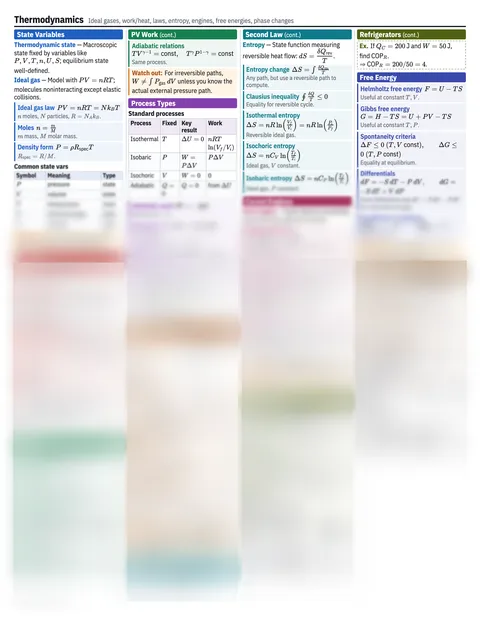
A one-page reference for the whole topic, fact-checked, with the first part free to read. This exam page does not repeat it. Use it to see the material, then make a shorter study sheet from the notes your section actually used.
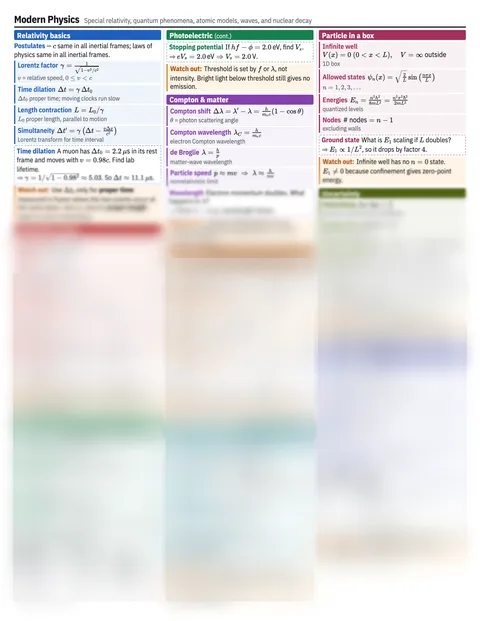
Modern Physics reference sheet — the free part in text.
Unlock the full reference sheet to edit, print or save it as a PDF.
Make your own for this exam
Upload the lecture slides and problem sets from the term, and in the focus step name the topics the review session stressed, such as relativity kinematics or the infinite well. Pick one page or front and back to match the rule, and keep constants like hc in eV nm and the electron rest energy in MeV close to the formulas that use them.
FAQ
Questions
- What goes on a modern physics formula sheet?
- The Lorentz factor with time dilation and length contraction, relativistic energy and momentum, photoelectric and Compton equations, de Broglie wavelength, Bohr energy levels, the particle-in-a-box energies, the uncertainty relations, and the decay law, plus handy constants such as hc equals 1240 eV nm.
- Is the modern physics final cumulative?
- Usually yes. Relativity often returns as one or two calculation problems, and the quantum topics carry the rest. Some courses split the final into a relativity part and a quantum part.
- Can I bring a crib sheet to a modern physics exam?
- Many courses allow one page of notes; others provide an equation sheet and allow nothing else. Check the course outline or exam announcement, and do not assume the rule from another physics course carries over.
- How much quantum mechanics is on the final?
- It depends on the course. Most include the Schrödinger equation and the infinite well; tunneling, the harmonic oscillator, and hydrogen quantum numbers are included only in some. The review list is the reliable guide.
Keep going
More study pages
All of these sit in the sheet library. Every exam study page.