Biochemistry final exam study sheet
A one-semester biochemistry course usually spends its first half on structure (amino acids, proteins, enzymes) and its second half on metabolism. The final is normally cumulative, but the new material is the pathways: glycolysis, the citric acid cycle, the electron transport chain and how each is regulated. Expect the earlier half to come back as kinetics problems and pI calculations rather than as definitions.
Students call it different things depending on the country: a crib sheet, a formula sheet, an exam aid sheet, or the revision notes you boil down to a page of pathways and constants.
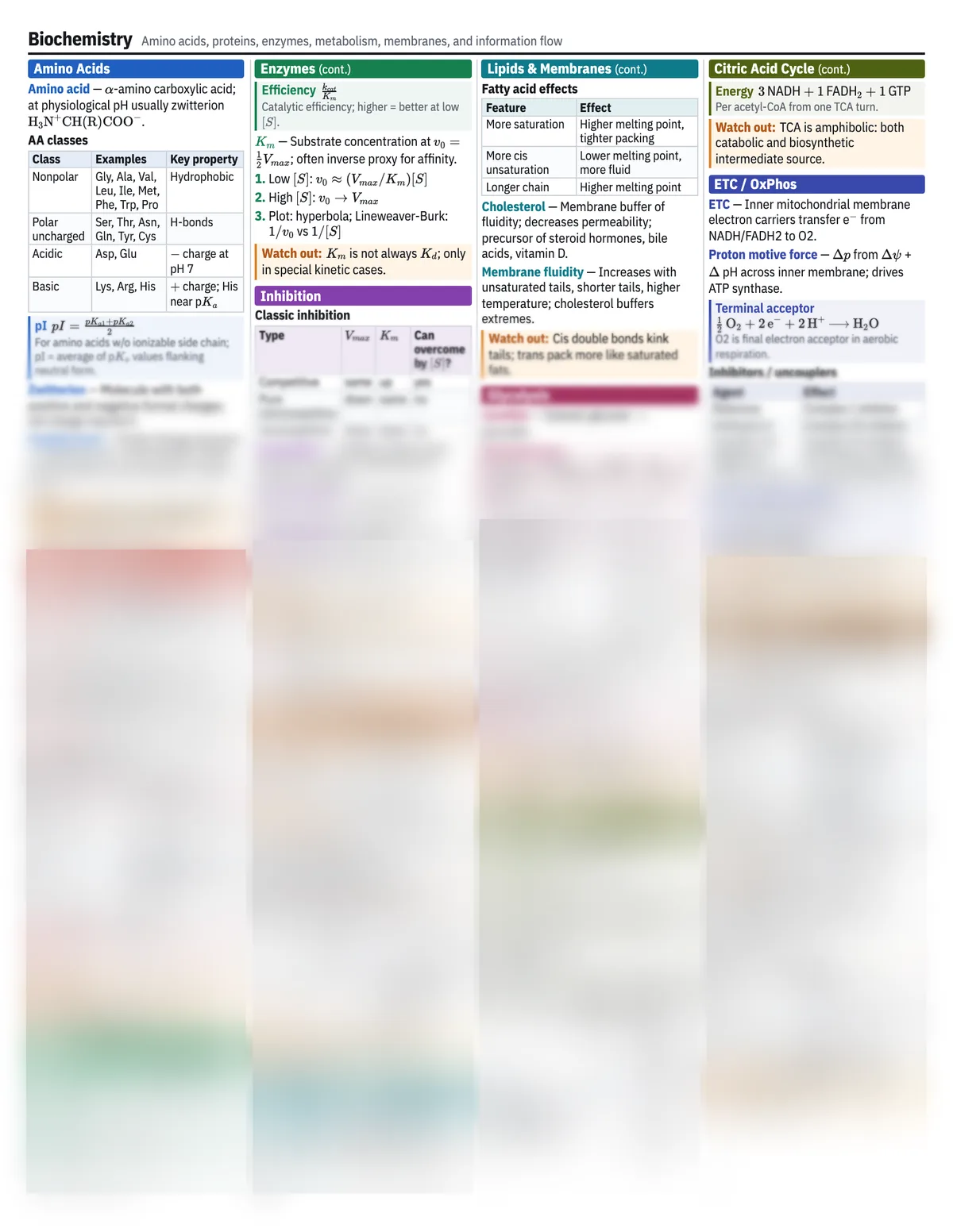 Cheat sheet locked
The scope
What this exam usually covers
These are the question types a typical biochemistry final grades. Check each against your own syllabus, since courses split structure and metabolism differently.
- Amino acids, pKa and pI Net charge at a given pH, the pI as the average of the two pKa values that flank the neutral form, and titration curves. Students lose points by averaging the wrong pair of pKa values for acidic and basic side chains.
- Protein structure and binding Which bonds hold primary through quaternary structure, alpha helix versus beta sheet, and hemoglobin versus myoglobin binding curves. Cooperativity, the Bohr effect and 2,3-BPG are favourite short-answer items.
- Michaelis–Menten kinetics Vmax, Km, kcat and kcat/Km from data or a Lineweaver–Burk plot. Read the intercepts carefully: the x-intercept is −1/Km and the y-intercept is 1/Vmax, and swapping them is a common lost mark.
- Inhibition types Competitive raises apparent Km with Vmax unchanged; uncompetitive lowers both; pure noncompetitive lowers Vmax with Km unchanged. Exams give a double-reciprocal plot and ask you to name the type and justify it.
- Glycolysis and its control The ten steps in order, the three irreversible steps (hexokinase, PFK-1, pyruvate kinase), where ATP is spent and made, and how ATP, AMP and fructose 2,6-bisphosphate regulate PFK-1. Net yield per glucose is 2 ATP and 2 NADH.
- Citric acid cycle Per acetyl-CoA: 3 NADH, 1 FADH2, 1 GTP or ATP and 2 CO2. Questions trace a labelled carbon, or ask which steps release CO2 and which enzymes are regulated by NADH and ATP.
- Electron transport and ATP synthase The order of complexes, where protons are pumped, what rotenone, antimycin A, cyanide, oligomycin and uncouplers each do to oxygen use and ATP output, and the P/O ratios your course uses (2.5 and 1.5, or the older 3 and 2).
Usually later
Gluconeogenesis, glycogen metabolism, the pentose phosphate pathway, fatty acid oxidation and synthesis, and amino acid catabolism are on some biochemistry finals and in a second-semester course at others. The library sheet stops at oxidative phosphorylation plus a short gene-expression section, so if your review sheet lists those pathways, add them to your own sheet. Also check whether you are expected to draw structures or only name them.
The rules
What a note sheet is usually allowed to include
check your exam header — it wins
Biochemistry finals lean toward closed-book, because so much of the exam is recall of structures and pathway steps. Where notes are allowed, the usual form is one handwritten page or one side of a page, sometimes an index card, and a few instructors provide a table of amino-acid pKa values or a pathway map on the exam itself. UK and Australian courses that allow a crib sheet usually spell out its size; Canadian courses call the same thing an aid sheet. The syllabus decides. This page is a study sheet either way: writing the pathways out from memory is the review.
The sheet
The matching library sheet
A one-page reference for the whole topic, fact-checked, with the first part free to read. This exam page does not repeat it. Use it to see the material, then make a shorter study sheet from the notes your section actually used.
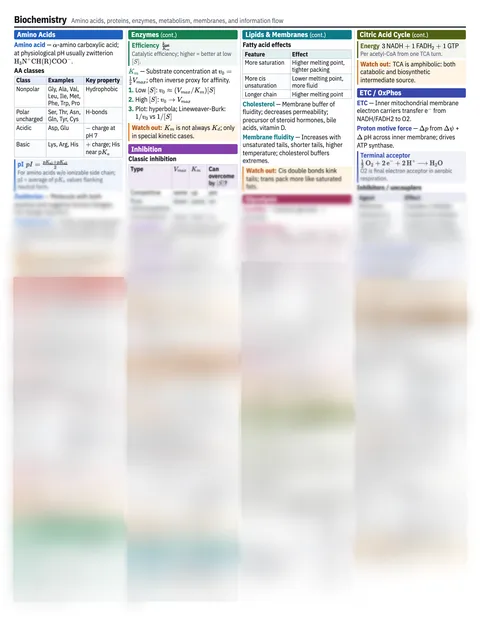
Biochemistry reference sheet — the free part in text.
Unlock the full reference sheet to edit, print or save it as a PDF.
Make your own for this exam
Upload the metabolism lectures and the problem sets on kinetics and inhibition, plus any review slides on the first half. In the focus step, name what the review session stressed, for example regulation of PFK-1 or reading Lineweaver–Burk plots. Pick one page or front and back to match the rule your instructor set.
FAQ
Questions
- What should a biochemistry final study sheet prioritize?
- Regulation points over full structures: the irreversible steps of glycolysis, the regulated enzymes of the citric acid cycle, the ETC inhibitors, and the kinetics formulas with how each inhibition type moves Km and Vmax. Add pI rules and the ATP accounting your course uses.
- Can I bring a crib sheet to a biochemistry final?
- Only if your course allows one. Many biochemistry finals are closed-book; others allow a single handwritten page or card, and some provide a pKa table or pathway chart instead. Check the syllabus or the exam cover page.
- How many ATP per glucose should I use?
- Use the number your instructor uses. Current textbooks give about 30 to 32 ATP per glucose, based on 2.5 per NADH and 1.5 per FADH2; older materials give 36 to 38. Showing the accounting usually earns the marks even when the final total differs.
- Is the biochemistry final cumulative?
- Usually yes, but weighted toward metabolism. Kinetics and protein structure tend to return as calculation and data-reading questions, so practise those rather than rereading definitions.
Keep going
More study pages
All of these sit in the sheet library. Every exam study page.