Microbiology final exam study sheet
Microbiology is often a prerequisite for nursing and allied-health programmes, and its final is usually cumulative and largely multiple choice or short answer. The early units (cell structure, Gram staining, growth) return alongside the later ones, which are commonly antimicrobials, immunity and disease. Many courses also hold a separate lab practical, which is examined differently.
Called a crib sheet or revision notes in the UK and Australia, an aid sheet in Canada, and a study sheet in the US, the microbiology version is a page of comparisons: Gram positive against Gram negative, lytic against lysogenic, innate against adaptive.
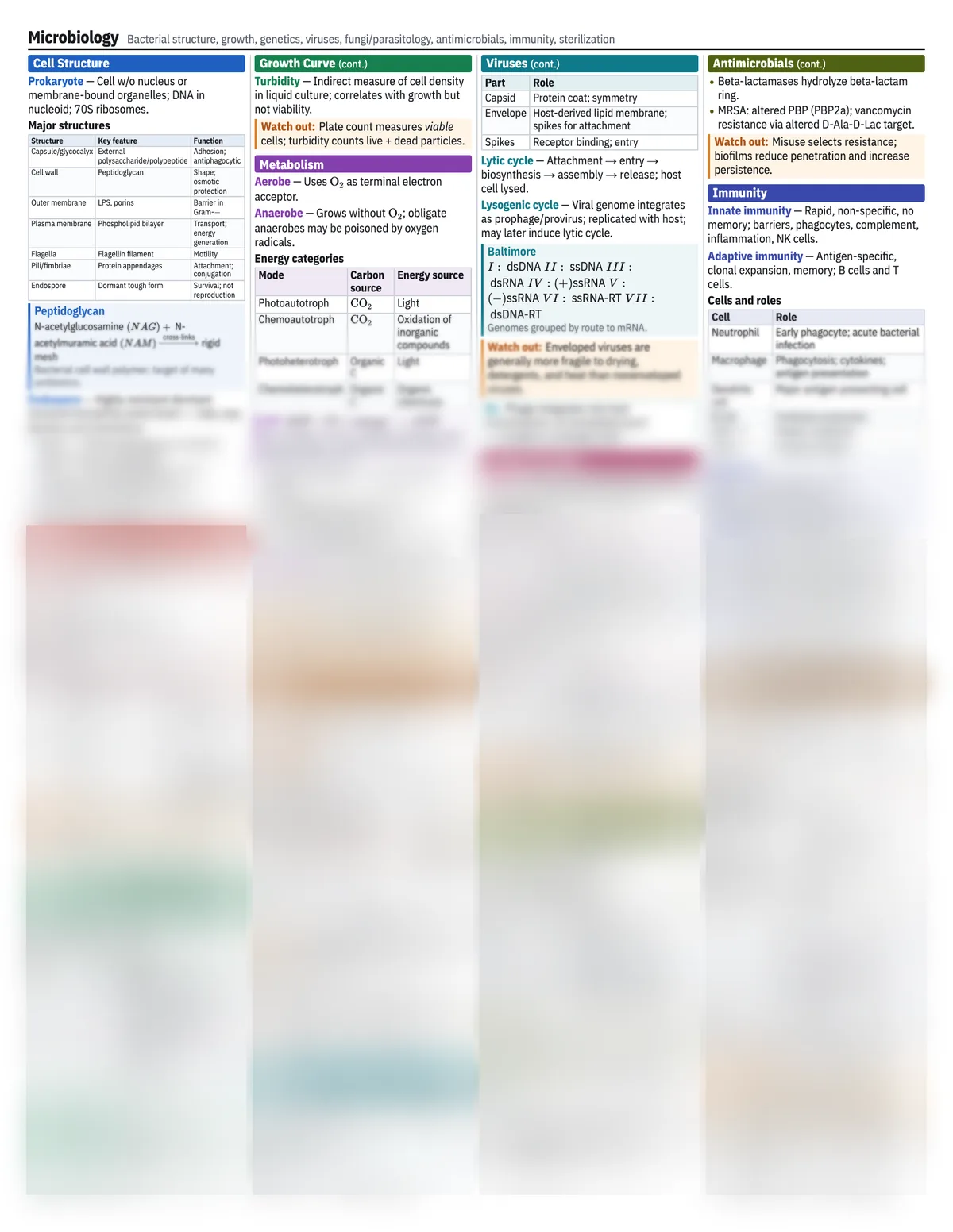 Cheat sheet locked
The scope
What this exam usually covers
These are the topics microbiology finals most often grade. Courses for nursing tend to weight disease and infection control more; majors' courses weight genetics and metabolism more.
- Cell structure and Gram stain Peptidoglycan thickness, the outer membrane and LPS in Gram-negatives, endospores, and the four Gram-stain steps with what each does. A frequent question asks what colour each type is if a step is skipped, especially decolourising.
- Growth and generation time The four phases of the growth curve and the calculation N = N₀ × 2ⁿ with generation time t/n. Mistakes come from counting generations wrongly or mixing natural and base-10 logs.
- Oxygen and metabolism Obligate aerobes, facultative anaerobes, microaerophiles, aerotolerant and obligate anaerobes, and where each grows in a thioglycolate tube. Fermentation versus respiration and how much ATP each yields.
- Bacterial genetics Transformation, transduction and conjugation (F⁺, Hfr), plasmids, and the lac operon with and without lactose and glucose. Scenario questions ask which transfer method spread a resistance gene.
- Viruses Structure, lytic versus lysogenic cycles, enveloped versus naked viruses, retroviruses and reverse transcriptase. Some courses add the Baltimore classes; check yours before memorising all seven.
- Antimicrobials and resistance Targets by drug class: cell wall (beta-lactams, vancomycin), ribosome, nucleic acid synthesis, membrane and folate synthesis. Selective toxicity, bactericidal versus bacteriostatic, and the main resistance mechanisms.
- Immunity Innate barriers, phagocytosis, inflammation and complement, then adaptive immunity: B and T cells, antibody classes, and active versus passive, natural versus artificial immunity. Vaccine-type questions are common.
- Sterilization and disinfection Autoclaving conditions, pasteurization, filtration, radiation and chemical agents, and the difference between sterilization, disinfection and antisepsis. Endospores and prions as the hardest to kill come up often.
Usually later
Diseases by body system (respiratory, gastrointestinal, sexually transmitted and so on), epidemiology terms, fungi, protozoa and helminths are heavily weighted on some finals and only lightly touched on others. The library sheet gives fungi and parasites a short section only, so if your review list names specific pathogens and diseases, add them to your own sheet. Check whether the lab practical is part of the final or a separate grade.
The rules
What a note sheet is usually allowed to include
check your exam header — it wins
Microbiology finals are most often closed-book, particularly in large prerequisite courses for nursing and allied health where the exam is multiple choice. Where notes are allowed, it is usually one handwritten page or an index card, and lab practicals almost never allow notes. Some UK and Australian modules allow a crib sheet of a stated size; Canadian courses would call it an aid sheet. Go by the written policy. Either way, condensing the course into one page of revision notes is how this page is meant to be used.
The sheet
The matching library sheet
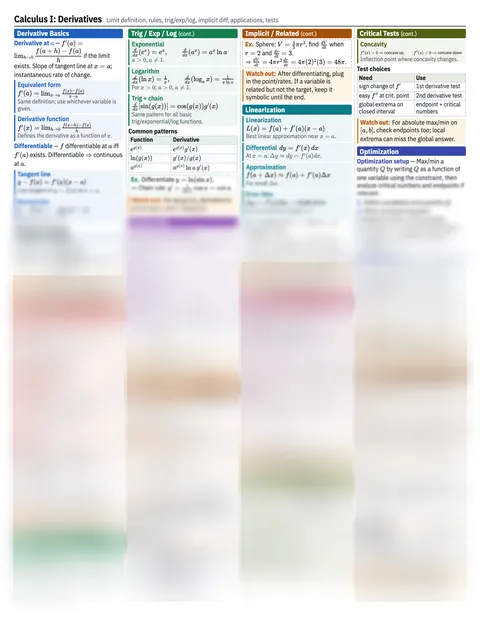
A one-page reference for the whole topic, fact-checked, with the first part free to read. This exam page does not repeat it. Use it to see the material, then make a shorter study sheet from the notes your section actually used.
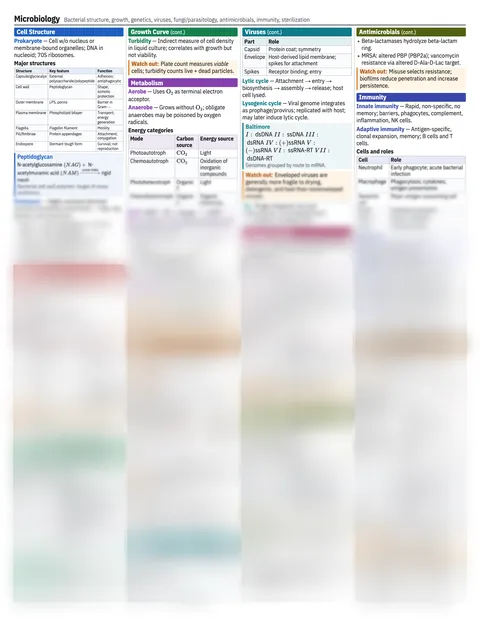
Microbiology reference sheet — the free part in text.
Unlock the full reference sheet to edit, print or save it as a PDF.
Make your own for this exam
Upload the lecture slides for the units the final covers and your instructor's review guide if there is one. In the focus step, say whether the course leans clinical or majors-level, and name what the review session stressed, for example antibiotic targets or immunity. Choose one page or front and back to match the rule or your revision plan.
FAQ
Questions
- What should a microbiology final study sheet include?
- A Gram-positive versus Gram-negative table, the growth-curve phases and generation-time formula, the three gene-transfer methods, lytic versus lysogenic cycles, antibiotic targets by class, innate versus adaptive immunity, and sterilization methods. Add named diseases if your course examines them.
- Can I bring a crib sheet to a microbiology final?
- Only if the course allows one, and many do not. Prerequisite microbiology finals for nursing are usually closed-book. Use the sheet as revision notes and check the syllabus before bringing anything into the room.
- Is the lab practical part of the microbiology final?
- In many courses it is a separate exam, often with stations for staining, media and identification. Ask your instructor; the practical rarely allows notes.
- How do I calculate generation time on a microbiology exam?
- Find the number of generations n from the starting and final counts using N = N₀ × 2ⁿ, so n = log(N/N₀) ÷ log 2, then divide the elapsed time by n. Use the same log base on top and bottom.
Keep going
More study pages
All of these sit in the sheet library. Every exam study page.