Microeconomics final exam study sheet
A principles microeconomics final is a graphs-and-calculations exam. The early units (supply and demand, elasticity, surplus, taxes) come back, but the final is usually weighted toward what came after the midterms: cost curves, perfect competition, monopoly, oligopoly and externalities. Most marks come from drawing a graph correctly and reading numbers off it.
This is the formula sheet in a US course, an aid sheet in Canada, a crib sheet or revision notes in the UK and Australia. For microeconomics it is half formulas and half small labelled graphs.
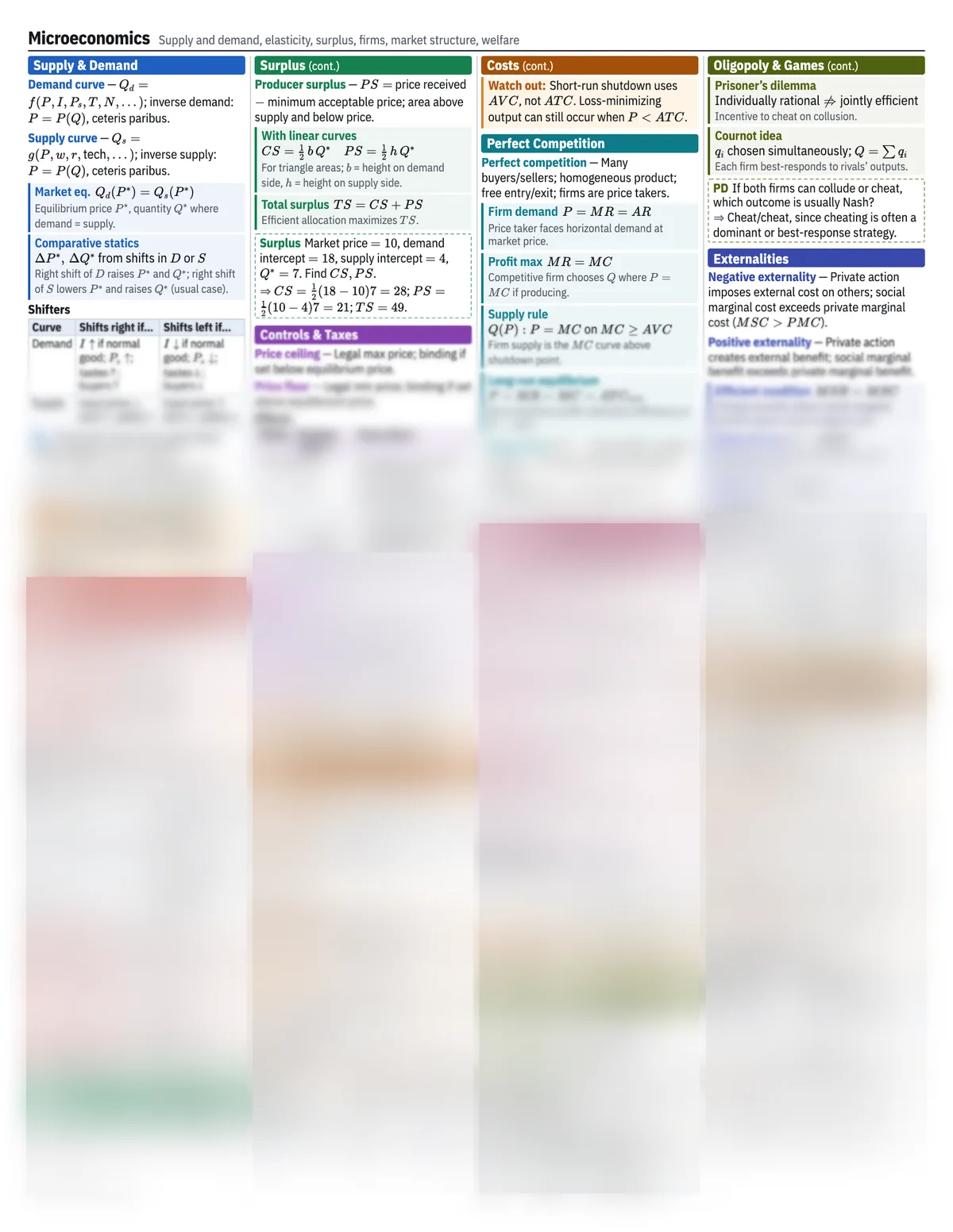 Cheat sheet locked
The scope
What this exam usually covers
These are the problem types a principles microeconomics final grades most. Draw every graph as part of your practice; a correct number with a wrong graph rarely gets full marks.
- Market equilibrium and shifts Solve for price and quantity from linear demand and supply, then predict what a shift does. Confusing a shift of the curve with a movement along it is the most common lost mark on the whole exam.
- Elasticity Price elasticity by the midpoint formula, what it implies for total revenue, and income and cross-price elasticity with the sign telling you normal versus inferior or substitutes versus complements.
- Surplus, taxes and price controls Consumer and producer surplus as triangle areas, the tax wedge and who bears the burden, and deadweight loss from a tax, a binding ceiling or a binding floor. Check that the ceiling is below equilibrium before calling it binding.
- Costs of production Fixed, variable, average and marginal cost, and why MC crosses ATC and AVC at their minimums. Filling a cost table from partial data is a standard question.
- Perfect competition P = MR = MC for output, the shutdown rule P < AVC, and long-run zero economic profit at minimum ATC. Graph the firm and market side by side.
- Monopoly MR below demand (with linear demand, same intercept and twice the slope), output where MR = MC, price read from the demand curve, and the deadweight loss compared with competition. Price discrimination appears on many finals.
- Oligopoly and game theory Payoff matrices, dominant strategies, Nash equilibrium and the prisoner's dilemma. Students lose points by finding the best joint outcome instead of each player's best response.
- Externalities and public goods Social versus private cost or benefit, the efficient quantity, Pigouvian taxes and subsidies, and non-rival, non-excludable goods with the free-rider problem.
Usually later
Consumer choice with indifference curves and budget lines, labour and factor markets, monopolistic competition and information problems are on some principles finals and not others. The library sheet includes utility maximization but not factor markets, so add them if your review sheet lists them. Check whether your course expects calculus or only algebra and graphs.
The rules
What a note sheet is usually allowed to include
check your exam header — it wins
Economics departments vary. Many principles finals are closed-book with a basic calculator allowed. Some allow one handwritten formula sheet, either one side or both sides of a page, or a provided formula page. Canadian universities often name the allowance in the exam instructions as an aid sheet with stated dimensions, and UK modules that allow a crib sheet do the same. A formula sheet does not draw the graphs for you, so practise them anyway. Check the syllabus; this page is a study sheet either way.
The sheet
The matching library sheet
A one-page reference for the whole topic, fact-checked, with the first part free to read. This exam page does not repeat it. Use it to see the material, then make a shorter study sheet from the notes your section actually used.
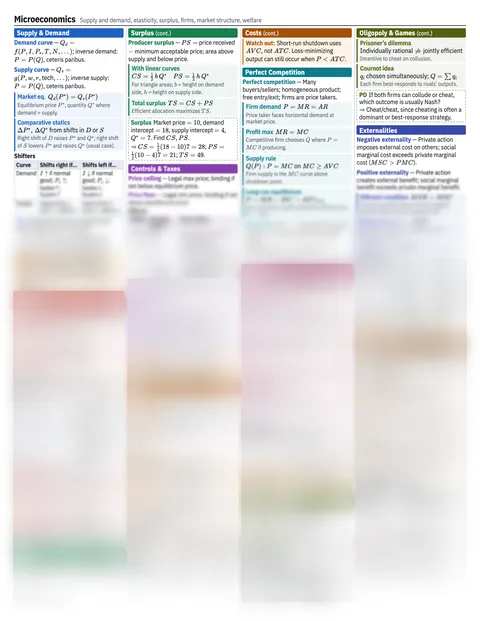
Microeconomics reference sheet — the free part in text.
Unlock the full reference sheet to edit, print or save it as a PDF.
Make your own for this exam
Upload the lecture slides and problem sets for the units the final covers, including the graph-heavy ones. In the focus step, name what the review session stressed, such as deadweight loss or monopoly pricing, and ask for the formulas next to the graph they belong to. Pick one page or front and back to match the rule.
FAQ
Questions
- What goes on a microeconomics formula sheet?
- The midpoint elasticity formula and the revenue rule, surplus and deadweight-loss triangle areas, the cost definitions (ATC, AVC, MC), the profit-maximising rule MR = MC with the shutdown condition, and the monopoly MR shortcut for linear demand. Add one small labelled graph per market structure.
- Is an aid sheet allowed in a microeconomics final?
- Some courses allow one, usually a single handwritten page of stated size; others are closed-book with a calculator. The exam instructions or syllabus will say exactly what is permitted.
- Is the microeconomics final cumulative?
- Usually yes, with heavier weight on market structures and externalities. Supply, demand and elasticity reappear as tools inside later questions.
- How do I find monopoly profit on the exam?
- Set MR equal to MC to get quantity, read price off the demand curve at that quantity, then profit is (P − ATC) × Q. Using the MR value as the price is the usual mistake.
Keep going
More study pages
All of these sit in the sheet library. Every exam study page.