Macroeconomics final exam study sheet
A principles macroeconomics final starts from measurement (GDP, inflation, unemployment) and spends most of its marks on models: aggregate demand and supply, fiscal and monetary policy, the money supply and, in many courses, the Phillips curve and open-economy topics. Finals are usually cumulative, but the policy units at the end of term tend to carry the most weight. Expect to explain a chain of effects, not only to compute.
It might be your formula sheet, your crib sheet, an exam aid sheet or a page of revision notes; for macroeconomics it is a few formulas and the cause-and-effect chains for each policy.
 Cheat sheet locked
The scope
What this exam usually covers
These are the question types a principles macroeconomics final grades most often. Practise writing each policy chain in one line.
- GDP and its measurement The expenditure identity Y = C + I + G + NX, what is and is not counted, nominal versus real GDP, and the GDP deflator. Counting intermediate goods or transfer payments is a reliable trap question.
- Inflation and the CPI Computing a CPI from a basket, the inflation rate as a percentage change, and converting nominal to real values. Questions also ask about CPI biases such as substitution and quality change.
- Unemployment Labour force, unemployment rate and participation rate from given numbers, and frictional, structural and cyclical unemployment. Discouraged workers are not in the labour force, and that is the point most often tested.
- AD-AS model Why AD slopes down, short-run versus long-run aggregate supply, and what demand and supply shocks do to output and the price level in each run. Graph the recessionary and inflationary gaps and show the self-correction.
- Fiscal policy and multipliers The spending multiplier 1/(1 − MPC), the tax multiplier −MPC/(1 − MPC), automatic stabilisers, and crowding out. Most errors come from using MPS where the formula needs MPC, or forgetting the minus sign on the tax multiplier.
- Money, banks and monetary policy Functions of money, M1 and M2, the simple deposit multiplier 1/rr, and how the central bank changes interest rates and what follows for investment, AD and output. Know the tools your course teaches by name.
- Phillips curve and expectations The short-run trade-off between inflation and unemployment, the vertical long-run curve at the natural rate, and how expectations and supply shocks shift the short-run curve.
- Growth and open economy Sources of growth, the rule of 70, exchange-rate appreciation and depreciation and their effect on net exports, and comparative advantage. Some courses add the balance of payments.
Usually later
Growth models such as Solow, the loanable funds market, and the full open-economy macro model are on some principles finals and saved for intermediate macroeconomics in others. Note too that many textbooks still teach the reserve requirement as a policy tool, while the US Federal Reserve set required reserves to zero in 2020 and now steers rates mainly through interest on reserves; answer in the framework your instructor uses. Check the review sheet for which model to expect.
The rules
What a note sheet is usually allowed to include
check your exam header — it wins
Note-sheet policies in macroeconomics follow the same pattern as micro but vary by department. Many principles finals are closed-book with a simple calculator; some allow one handwritten formula sheet, one side or both; a few hand out a page of formulas. UK modules that permit a crib sheet set its size, and Canadian courses list any aid sheet in the exam instructions. Since much of the marking is on the reasoning behind a policy, a formula sheet helps less than practised explanations. Check the syllabus; this page is a study sheet either way.
The sheet
The matching library sheet
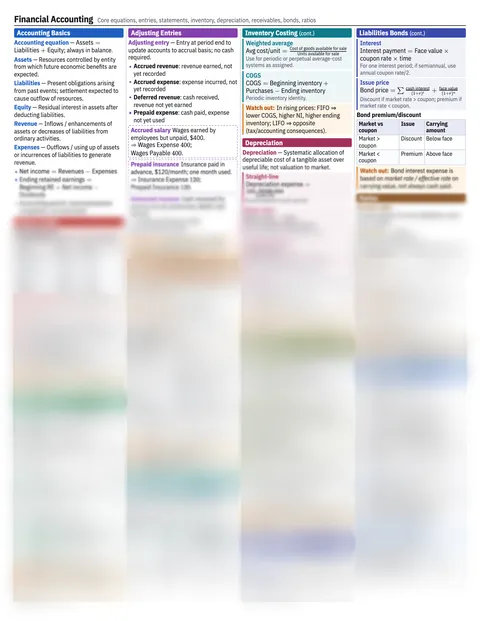
A one-page reference for the whole topic, fact-checked, with the first part free to read. This exam page does not repeat it. Use it to see the material, then make a shorter study sheet from the notes your section actually used.

Macroeconomics reference sheet — the free part in text.
Unlock the full reference sheet to edit, print or save it as a PDF.
Make your own for this exam
Upload the lecture slides and problem sets for the units the final covers, with extra weight on the policy chapters. In the focus step, name what the review session stressed, such as multipliers or the money market graph, and which country's central bank your course uses as its example. Pick one page or front and back to match the rule.
FAQ
Questions
- What goes on a macroeconomics formula sheet?
- The GDP identity, the deflator and CPI inflation formulas, the unemployment and participation rates, the spending and tax multipliers, the money multiplier, real versus nominal interest (the Fisher relation) and the rule of 70. Add the AD-AS graph with one shock drawn on it.
- Can I bring a crib sheet to a macroeconomics final?
- Only where the course allows one. Many principles macro finals are closed-book with a calculator; some allow one handwritten page. The exam instructions say exactly what is permitted.
- Is the macroeconomics final cumulative?
- Usually, with the heaviest weight on the policy units: fiscal and monetary policy, the money supply and the Phillips curve. Measurement questions return as short calculations.
- Why does my textbook's money multiplier differ from how central banks work now?
- The simple multiplier assumes banks are limited by required reserves. Many central banks now run with ample reserves and steer rates directly. Use the model your course teaches on the exam, and note the assumption if asked.
Keep going
More study pages


All of these sit in the sheet library. Every exam study page.