Intro Psychology final exam study sheet
An introductory psychology final usually covers a dozen or more textbook chapters, often in a large multiple-choice exam. Some finals are fully cumulative; others weight the last units (personality, disorders and treatment, social psychology) and include only a slice of earlier material. The questions test applying terms to short scenarios more than recalling definitions.
Some students call it a crib sheet, others revision notes or an exam aid sheet; for intro psychology it is a page of paired terms and the classic studies, written so you can tell similar concepts apart.
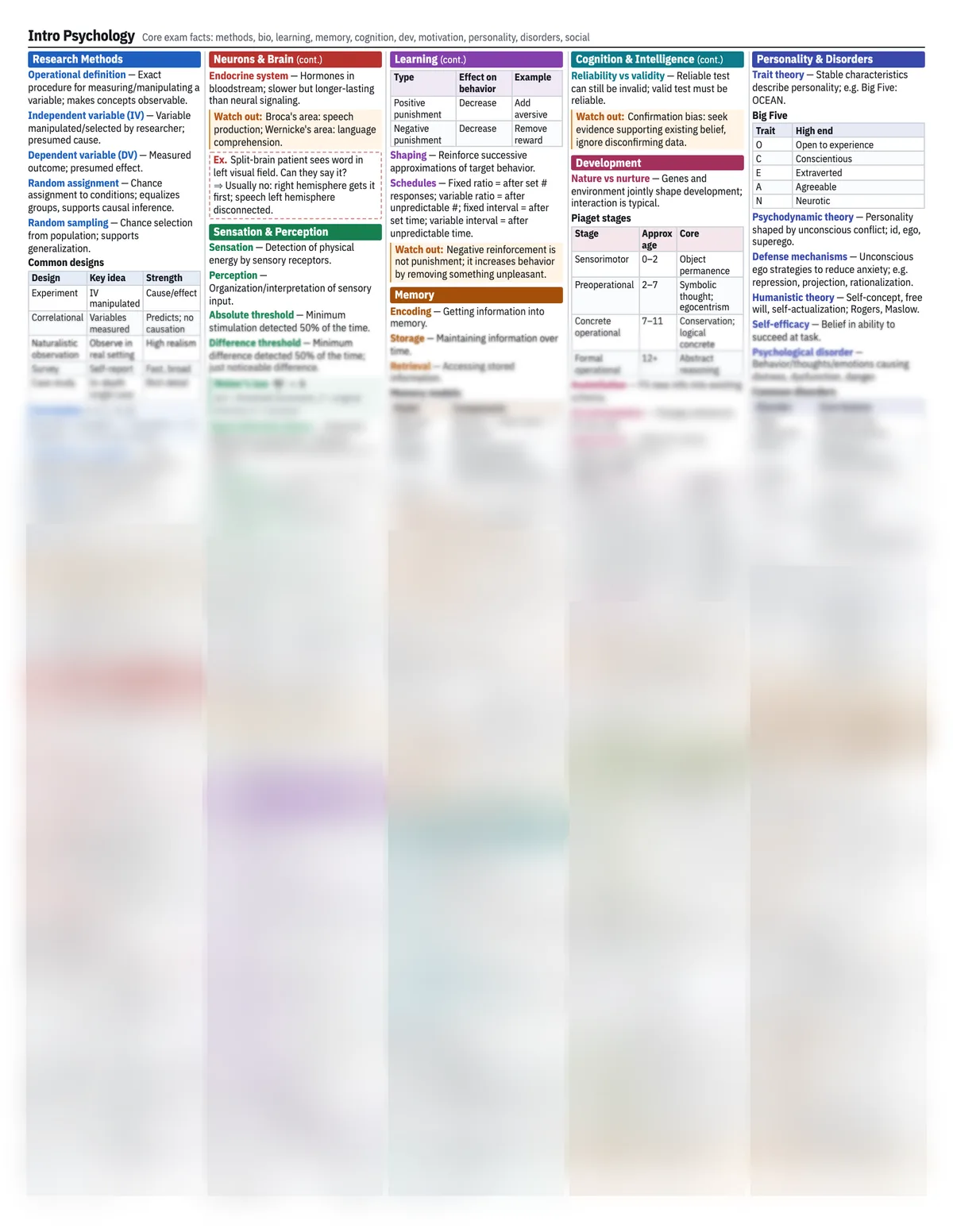 Cheat sheet locked
The scope
What this exam usually covers
These are the areas an intro psychology final draws on most. Weight them by how many lectures your course spent on each.
- Research methods Independent and dependent variables, random assignment versus random sampling, correlation versus causation, and reliability versus validity. A scenario asks you to identify the design or the confound, and the paired terms are where points go.
- Biopsychology Neuron structure, the action potential, neurotransmitters and their usual functions, the lobes and key structures of the brain, and the endocrine system. Questions match a behaviour or symptom to a brain area or transmitter.
- Learning Classical conditioning terms (US, UR, CS, CR) applied to a new example, and operant conditioning with reinforcement versus punishment, positive versus negative, and the four schedules. Negative reinforcement is the most-missed item.
- Memory and cognition Encoding, storage and retrieval, the multi-store model, working memory, interference, and heuristics such as availability and representativeness. Proactive versus retroactive interference is a reliable question.
- Development Piaget's stages with the milestones that mark each (object permanence, conservation), attachment styles, and Erikson's stages. Questions describe a child and ask which stage or concept fits.
- Personality and disorders Psychodynamic, humanistic, trait and social-cognitive approaches, the Big Five, and the main categories of disorders with their key symptoms. Distinguishing similar diagnoses from a short vignette is common.
- Social psychology Attribution and the fundamental attribution error, conformity (Asch), obedience (Milgram), cognitive dissonance, the bystander effect and group polarization. Know what each study found and what it changed.
Usually later
Treatment and therapy, sleep and states of consciousness, sensation and perception details, and stress and health are covered by some intro courses and skipped by others; the library sheet does not include therapies or sleep, so add them if your review sheet lists them. Check also whether the final is fully cumulative or covers only the units since the last exam.
The rules
What a note sheet is usually allowed to include
check your exam header — it wins
Large intro psychology courses usually give closed-book multiple-choice finals, so a note sheet is the exception. A minority of instructors allow one index card or one handwritten side of a page. In the UK and Australia a crib sheet is rarely allowed in first-year psychology exams, and Canadian courses that permit one call it an aid sheet. Because the exam is mostly applying terms to scenarios, writing the sheet is itself the main study benefit. Follow the syllabus; this page is a study sheet either way.
The sheet
The matching library sheet
A one-page reference for the whole topic, fact-checked, with the first part free to read. This exam page does not repeat it. Use it to see the material, then make a shorter study sheet from the notes your section actually used.
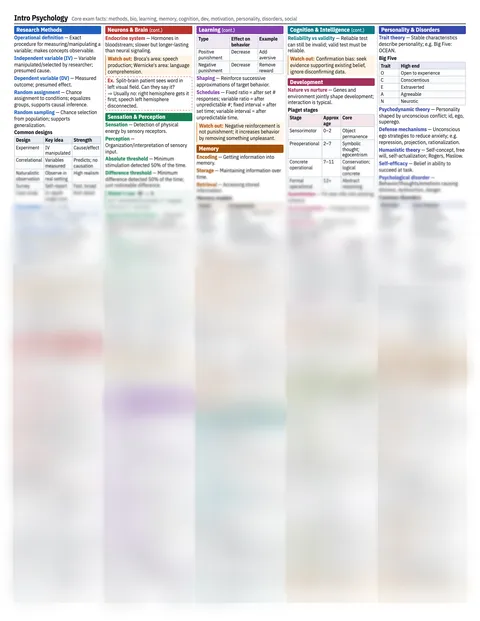
Intro Psychology reference sheet — the free part in text.
Unlock the full reference sheet to edit, print or save it as a PDF.
Make your own for this exam
Upload the lecture slides for every unit the final covers, or just the post-midterm units if it is not cumulative. In the focus step, name what the review session stressed and ask for paired terms to be kept side by side. One page is usually right for revision; switch to an index card if that is what your course allows.
FAQ
Questions
- Is the intro psychology final cumulative?
- It depends on the course. Many are cumulative across all chapters; others cover only the units since the last exam with a few earlier questions. The syllabus or review guide will say.
- Can I bring a crib sheet or index card to an intro psychology final?
- Usually not, since most large intro courses give closed-book multiple-choice exams. Some instructors allow one index card. Check the syllabus, and use the sheet as revision notes if notes are not allowed.
- What are the most-confused terms on intro psychology finals?
- Negative reinforcement versus punishment, random sampling versus random assignment, reliability versus validity, proactive versus retroactive interference, and assimilation versus accommodation. Put each pair side by side with one example.
- Which classic studies should be on my intro psychology study sheet?
- Usually Pavlov, Skinner, Bandura's Bobo doll, Harlow's monkeys, Asch, Milgram and Festinger's dissonance study, plus any others your lecturer spent time on. Note what each found in one line.
Keep going
More study pages
All of these sit in the sheet library. Every exam study page.