Pharmacology Cheat Sheet for Nursing — 1-page PDF
ADME, dose-response, major drug classes, and common suffixes. The whole course on one dense, printable page for your midterm or final, with every formula typeset and worked examples where they help.
The first part is free below. See pricing →
For a specific exam: Pharmacology Midterm study sheet, Pharmacology Final exam study sheet.
- 1 pageUS Letter
- 9 sections10 topics
- Free previewfull sheet with Unlimited
 Cheat sheet locked
On the sheet
What’s on it
The topics a typical Pharmacology exam tests, all on the one page.
- Pharmacokinetics: ADME
- Half-life and steady state
- Pharmacodynamics: agonists, antagonists
- Therapeutic index
- Autonomic drugs
- Cardiovascular drugs
- Antibiotics classes
- Analgesics: NSAIDs and opioids
- Anticoagulants
- Common drug suffixes
Free preview
The free part, as text
The free part of the sheet, section by section. Unlock the full sheet to read the rest, edit any block, and print it or save it as a PDF.
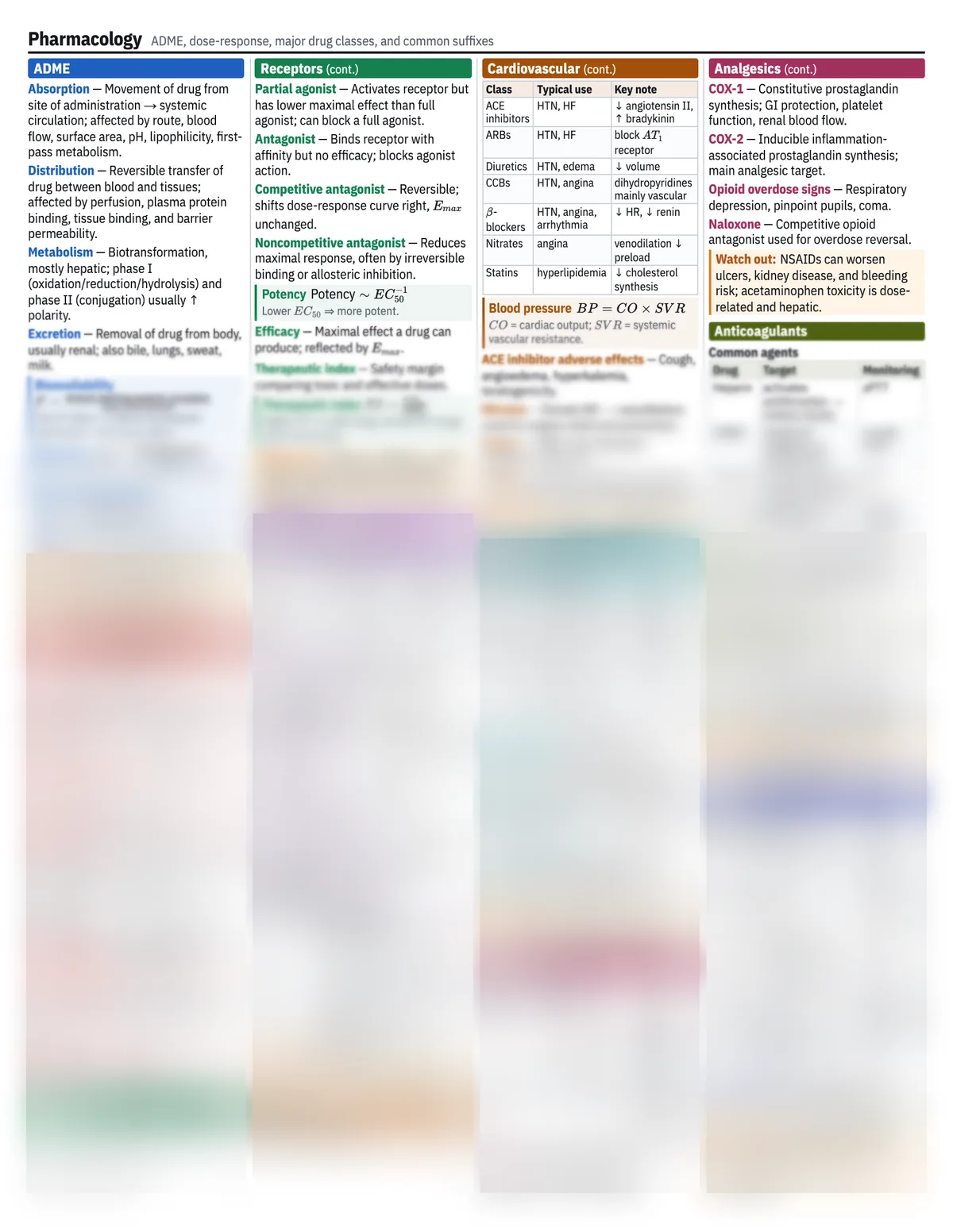
01ADME
- Absorption
- Movement of drug from site of administration → systemic circulation; affected by route, blood flow, surface area, pH, lipophilicity, first-pass metabolism.
- Distribution
- Reversible transfer of drug between blood and tissues; affected by perfusion, plasma protein binding, tissue binding, and barrier permeability.
- Metabolism
- Biotransformation, mostly hepatic; phase I (oxidation/reduction/hydrolysis) and phase II (conjugation) usually ↑ polarity.
- Excretion
- Removal of drug from body, usually renal; also bile, lungs, sweat, milk.
Bioavailability
Oral often < 1 due to incomplete absorption + first-pass effect.
Clearance
Volume of plasma cleared per unit time.
Volume of distribution
Large ⇒ extensive tissue distribution; small ⇒ mostly intravascular.
02Receptors
- Partial agonist
- Activates receptor but has lower maximal effect than full agonist; can block a full agonist.
- Antagonist
- Binds receptor with affinity but no efficacy; blocks agonist action.
- Competitive antagonist
- Reversible; shifts dose-response curve right, unchanged.
- Noncompetitive antagonist
- Reduces maximal response, often by irreversible binding or allosteric inhibition.
Potency
Lower ⇒ more potent.
- Efficacy
- Maximal effect a drug can produce; reflected by .
- Therapeutic index
- Safety margin comparing toxic and effective doses.
Therapeutic index
Higher ⇒ safer drug; narrow drugs need monitoring.
Watch out:Potency ≠ efficacy: a very potent drug can have low maximal effect; a less potent drug can be more efficacious.
03Cardiovascular
Major drug groups
| Class | Typical use | Key note |
|---|---|---|
| ACE inhibitors | HTN, HF | ↓ angiotensin II, ↑ bradykinin |
| ARBs | HTN, HF | block receptor |
| Diuretics | HTN, edema | ↓ volume |
| CCBs | HTN, angina | dihydropyridines mainly vascular |
| -blockers | HTN, angina, arrhythmia | ↓ HR, ↓ renin |
| Nitrates | angina | venodilation ↓ preload |
| Statins | hyperlipidemia | ↓ cholesterol synthesis |
Blood pressure
= cardiac output; = systemic vascular resistance.
- ACE inhibitor adverse effects
- Cough, angioedema, hyperkalemia, teratogenicity.
- Nitrates
- Donate NO → vasodilation; used for angina relief and prevention.
- Statins
- HMG-CoA reductase inhibitors; lower LDL.
- Digoxin
- Positive inotrope; inhibits Na/K-ATPase; narrow therapeutic index.
Watch out:Nitrates + PDE5 inhibitors can cause severe hypotension.
04Analgesics
- COX-1
- Constitutive prostaglandin synthesis; GI protection, platelet function, renal blood flow.
- COX-2
- Inducible inflammation-associated prostaglandin synthesis; main analgesic target.
- Opioid overdose signs
- Respiratory depression, pinpoint pupils, coma.
- Naloxone
- Competitive opioid antagonist used for overdose reversal.
Watch out:NSAIDs can worsen ulcers, kidney disease, and bleeding risk; acetaminophen toxicity is dose-related and hepatic.
05Anticoagulants
Common agents
| Drug | Target | Monitoring |
|---|---|---|
| Heparin | activates antithrombin → inhibits IIa/Xa | aPTT |
| LMWH | mostly Xa inhibition via antithrombin | usually none |
| Warfarin | inhibits vitamin K epoxide reductase | INR |
| DOACs | direct Xa or IIa inhibition | usually none |
Cheat sheet locked
Also on the full Pharmacology sheet
8 more sections, with every definition, formula and worked example. Unlimited unlocks every full sheet in the library to edit, print or save as a PDF, and makes unlimited sheets from your own notes.
ADME
Half-life
- Half-life
- Elimination
- Half-life relation
- Steady state
- Loading dose
- Maintenance dose
- Maintenance dose rate
Receptors
- Agonist
Autonomic Drugs
- Core autonomic categories
- Sympathomimetics
- Sympatholytics
- Cholinomimetics
- Cholinesterase inhibitor
- Autonomic receptor effects
Antibiotics
- High-yield classes
- Bactericidal
- Bacteriostatic
- Spectrum
- β-lactam mechanism
- Vancomycin
Analgesics
- NSAIDs vs opioids
- NSAIDs
Anticoagulants
- Heparin
- Warfarin
- Vitamin K cycle
- INR
- aPTT
Suffixes
- Common suffix clues
- Suffix strategy
FAQ
Questions
About the Pharmacology sheet and making your own.
- What does this Pharmacology cheat sheet cover?
- It has 9 sections: ADME, Half-life, Receptors, Autonomic Drugs, Cardiovascular, Antibiotics, Analgesics, Anticoagulants and Suffixes. Together they cover the topics a typical Pharmacology exam tests, including pharmacokinetics: ADME, half-life and steady state, pharmacodynamics: agonists, antagonists and therapeutic index.
- Is the pharmacology cheat sheet for nursing free?
- The first part is free to read on this page, with no account needed. The full sheet opens in the app with Unlimited ($4.99 a month or $19 for a semester), where you can edit it, print it or save it as a PDF. It is one US Letter page and prints cleanly in black and white or colour.
- Can I bring this Pharmacology cheat sheet to my exam?
- Only if your course allows a note sheet, so check the syllabus. This one is a single US Letter page. If your exam allows a different size, such as a 3x5 or 4x6 index card or one page front and back, Cheat Sheet AI makes one at exactly that size from your own lecture notes.
- How accurate is it?
- The sheet was written by our engine from a standard course outline, then a second model fact-checked every formula and statement against it; it made no corrections before publishing. Notation and emphasis vary between courses, so check it against your own lecture notes.
- Can I make a Pharmacology sheet from my own notes?
- Yes. Upload your lecture slides, notes or study guide and Cheat Sheet AI writes a sheet in your course's notation, sized to exactly the space your exam allows. Your first sheets are free.
Your course, your notes, one page.
Upload your own Pharmacology slides or notes and get a study sheet in your course’s notation. Your first sheet needs no account, and a free account adds one more. See pricing