Pharmacology final exam study sheet
A pharmacology final is usually cumulative, and it is where the drug classes pile up: cardiovascular, CNS, antimicrobial and often endocrine drugs on top of the autonomic unit and the principles from the midterm. Most questions are applied, in the style of nursing licensure exams: which finding means you hold the dose, which lab value to check, which adverse effect to teach the patient about. Dosage calculations usually appear again.
Whether you call it a study sheet, revision notes, a crib sheet or an aid sheet, for a pharmacology final it is a page of prototypes, adverse effects and the few formulas you must not miss.
 Cheat sheet locked
The scope
What this exam usually covers
The exact class list varies a lot between programs. Use this as a checklist against your final review sheet.
- Principles review ADME, half-life and steady state, potency versus efficacy, therapeutic index and interactions come back, often as quick questions or folded into case questions.
- Dosage calculations Desired over have, mg/kg, mL/h, gtt/min and weight-based infusions such as units/h or mcg/kg/min. Exact answers with correct rounding are expected; some programs require a separate passing score.
- Cardiovascular drugs ACE inhibitors, ARBs, beta blockers, calcium channel blockers, diuretics, digoxin, anticoagulants and statins: what to check before giving (BP, apical pulse, potassium, INR or aPTT) and the signature adverse effect of each.
- CNS drugs Opioids and naloxone, benzodiazepines and flumazenil, antidepressants including serotonin syndrome, lithium levels, antiepileptics and Parkinson drugs, depending on what your course covered.
- Antimicrobials Penicillins and allergy, cephalosporins, aminoglycosides (ototoxicity, nephrotoxicity, peak and trough), vancomycin, fluoroquinolones and the culture-before-first-dose rule.
- Endocrine drugs Often included: insulin types with onset and peak, oral antidiabetic agents, thyroid replacement and corticosteroids. Hypoglycemia recognition and timing insulin with meals are frequent questions.
- Prototypes and suffixes One prototype per class with its main adverse effect and one nursing action. Suffixes let you place an unfamiliar drug name in its class.
Usually later
Chemotherapy, immunosuppressants, GI and respiratory drugs and herbal supplements are on some finals and not others. Detailed mechanisms at the molecular level matter less than nursing actions in most nursing courses. Check the review sheet for which classes are in and whether calculations are tested separately.
The rules
What a note sheet is usually allowed to include
check your exam header — it wins
Pharmacology finals in nursing programs are closed-book almost everywhere, often taken on a lockdown testing platform, and dosage calculations use a provided basic calculator with no formula sheet. Science pharmacology courses sometimes print the PK equations on the paper or allow one handwritten side, which a Canadian course would call an aid sheet and a UK course a crib sheet. Because the policy decides how you study, confirm it before the final. This page is a study sheet either way: a page of prototypes you wrote yourself is the fastest revision for this exam.
The sheet
The matching library sheet
A one-page reference for the whole topic, fact-checked, with the first part free to read. This exam page does not repeat it. Use it to see the material, then make a shorter study sheet from the notes your section actually used.
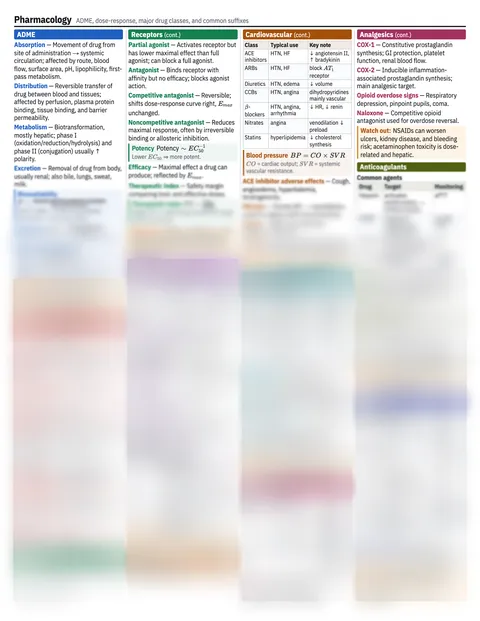
Pharmacology reference sheet — the free part in text.
Unlock the full reference sheet to edit, print or save it as a PDF.
Make your own for this exam
Upload the slides for every drug unit plus your dosage calculation practice, then use the focus step to name the classes and prototypes on the final review. Ask for a table per class: prototype, use, main adverse effect, what to check before giving. Use front and back if you are covering the whole term.
FAQ
Questions
- Is the pharmacology final cumulative?
- Usually yes. The principles and autonomic drugs from the midterm return, but most of the new points come from cardiovascular, CNS, antimicrobial and often endocrine drugs.
- Is an aid sheet allowed on a pharmacology final?
- In nursing programs, almost never: finals are closed-book and calculations use a provided calculator only. Some science pharmacology courses allow a handwritten page or print the formulas. Your syllabus decides.
- What should my pharmacology final revision notes include?
- For each class, one prototype, its use, its key adverse effect, what to check before giving it and one patient teaching point. Add the dosage formulas and the antidotes (naloxone, flumazenil, vitamin K, protamine) your course taught.
- How should I study drug classes for a pharmacology final?
- Learn the prototype first, then the suffix that marks the class, and practise with application questions rather than flashcards alone. Nursing finals ask what you would do, not only what the drug is.
Keep going
More study pages
All of these sit in the sheet library. Every exam study page.