Differential Equations final exam study sheet
An introductory differential equations final asks you to recognize the equation type and pick the method. The early material (separable, linear with an integrating factor, exact) usually returns as one or two problems, while second-order linear equations, Laplace transforms and systems take most of the paper. Courses differ most at the end: some finish with Laplace, some with systems, so the final leans toward whichever unit came last.
Whether your syllabus calls it a formula sheet, an aid sheet, a crib sheet or your revision notes, for an ODE course it is a method-picking page: equation type on one side, technique on the other.
 Cheat sheet locked
The scope
What this exam usually covers
Each item is a problem type that turns up on a typical final. Name the method before you start computing.
- First-order equations Separable, linear with the integrating factor e^(∫p dx), and exact equations with the M_y = N_x test. Dropping the constant or dividing by a zero solution is where points go.
- Existence and uniqueness The interval on which a linear initial value problem has a unique solution, read from where p and g are continuous. A short question that is easy points if you know the theorem.
- Homogeneous second-order equations The characteristic equation with distinct real, repeated, and complex roots. Repeated roots need the extra factor of t; complex roots α ± βi give e^(αt) times cosine and sine of βt.
- Undetermined coefficients Guess the form from the forcing term, and multiply by t when the guess duplicates a homogeneous solution. Missing that correction is the most common wrong answer.
- Variation of parameters The Wronskian and the formulas for u1′ and u2′, applied to the equation in standard form. Forgetting to divide by the leading coefficient first breaks the whole problem.
- Laplace transforms Transform the initial value problem, solve algebraically, then invert with partial fractions and the table. Step functions and the second shift theorem are where setups go wrong.
- Linear systems Eigenvalues and eigenvectors of the coefficient matrix, the general solution for real distinct and complex eigenvalues, and stability read from the signs of the real parts.
- Initial conditions Apply them after the general solution is complete, particular part included. Fitting constants to the homogeneous solution alone is a frequent partial-credit loss.
Usually later
Power series solutions, Fourier series, and partial differential equations such as the heat equation appear on some finals and not at all on others; it depends on whether your course runs one semester or two. Repeated-eigenvalue systems, nonlinear phase-plane analysis, and Cauchy-Euler equations are also course-dependent. Check the review sheet before you give them space.
The rules
What a note sheet is usually allowed to include
check your exam header — it wins
Differential equations courses allow a sheet more often than many math courses, because the Laplace table is long and memorizing it is not the point. A common US rule is one handwritten page or index card, sometimes with a short Laplace table printed on the exam instead. Canadian engineering-stream courses often permit an aid sheet of a stated size, while UK and Australian modules more usually provide a formula booklet than allow a crib sheet. Some instructors allow nothing and supply only the transforms they expect you to use. Read the final exam announcement. Either way, this is a study sheet: building the method table yourself is the revision.
The sheet
The matching library sheet
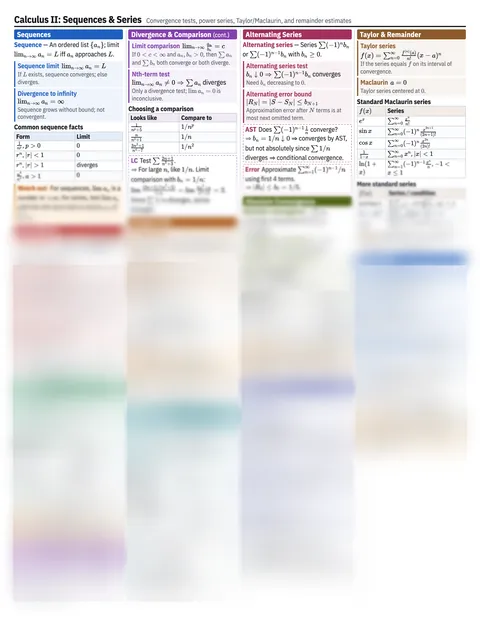
A one-page reference for the whole topic, fact-checked, with the first part free to read. This exam page does not repeat it. Use it to see the material, then make a shorter study sheet from the notes your section actually used.
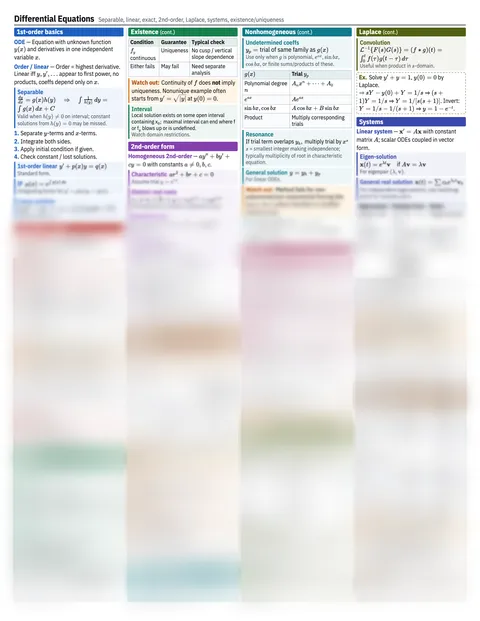
Differential Equations reference sheet — the free part in text.
Unlock the full reference sheet to edit, print or save it as a PDF.
Make your own for this exam
Upload the lecture notes and problem sets for the units the final covers, including the first-order material if the review sheet lists it. In the focus step, say what your instructor stressed, for example Laplace with step functions or systems with complex eigenvalues. Choose one page, front and back, or an index card to match the rule.
FAQ
Questions
- What goes on a differential equations formula sheet?
- A method table by equation type, the three characteristic-root cases, the undetermined-coefficients guesses with the multiply-by-t rule, the variation of parameters formulas, and a Laplace table with both shift theorems. Skip derivations.
- Is a Laplace transform table provided on the final?
- Often, but not always. Some instructors print a short table on the exam, others expect it on your allowed sheet, and a few expect it memorized. The syllabus or the review session will say.
- How much first-order material is on the final?
- Usually a problem or two: a separable or linear initial value problem, perhaps an exact equation or an existence question. Most of the paper is second-order equations, Laplace transforms and systems in a typical course.
- Is an aid sheet allowed in a differential equations exam?
- Sometimes. Many courses allow one handwritten page or card, others provide a table and allow nothing else. Check the exam rules for your section rather than assuming.
Keep going
More study pages
All of these sit in the sheet library. Every exam study page.