Probability final exam study sheet
A first course in probability, the calculus-based one taken by math, statistics and engineering students, usually ends with a cumulative final. The early units (counting, conditional probability, Bayes, discrete random variables) return as quick problems, while joint distributions, covariance and the limit theorems often carry more weight because they came last. The final also mixes units: a counting argument inside a conditional probability, or an expectation found with indicator variables.
Your course might call it a formula sheet, an aid sheet, a crib sheet or revision notes; in probability it is mostly the distribution table and the conditioning rules.
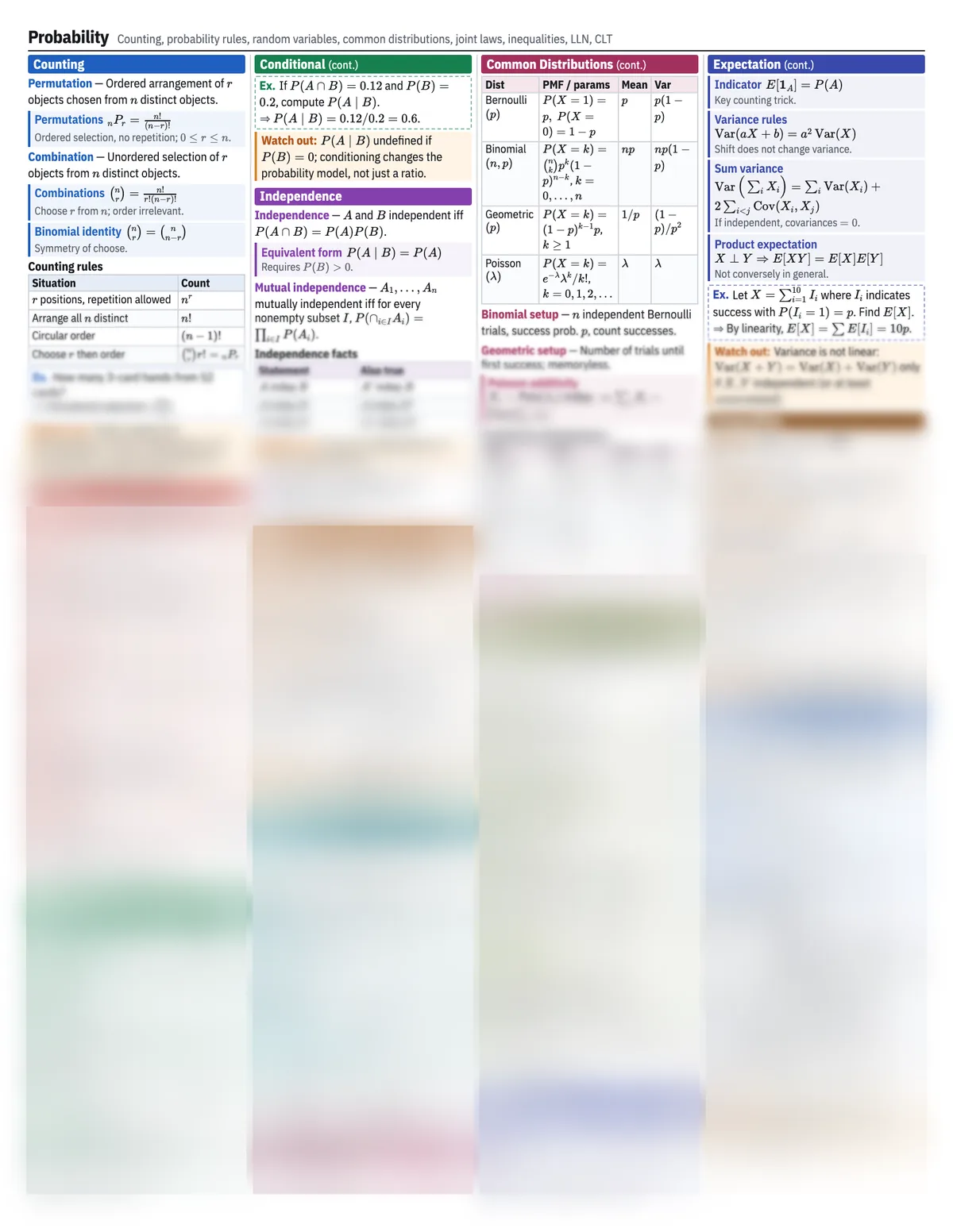 Cheat sheet locked
The scope
What this exam usually covers
These are the problem types a probability final typically grades. Confirm each against your review sheet.
- Counting Permutations versus combinations, with and without replacement, and when order matters. Overcounting by not dividing out identical arrangements is the usual error.
- Conditional probability and Bayes The law of total probability over a partition, then Bayes for the reverse conditional. A tree diagram earns partial credit even when the arithmetic slips.
- Independence P(A ∩ B) = P(A)P(B), pairwise versus mutual independence, and why disjoint events with positive probability are never independent.
- Random variables and expectation PMF, PDF and CDF, expectation and variance from the definition, Var(X) = E[X²] − (E[X])², and linearity of expectation with indicator variables.
- Common distributions Bernoulli, binomial, geometric, Poisson, uniform, exponential and normal: when each applies, the mean and variance, and your textbook’s convention for the geometric and exponential.
- Joint distributions Marginals from a joint PMF or PDF, conditional distributions, and independence. Setting the limits of a double integral over a region like 0 < x < y < 1 is where continuous problems go wrong.
- Covariance and correlation Cov(X, Y) = E[XY] − E[X]E[Y], the variance of a sum, and the fact that zero covariance does not imply independence.
- Inequalities and limit theorems Markov and Chebyshev bounds, the law of large numbers, and the central limit theorem for a sum or a mean, with a continuity correction if your course uses one.
Usually later
Transformations of random variables, order statistics, and the bivariate normal are on some probability finals and absent from others, and moment generating functions get a full problem in some courses and a single line in others. Markov chains are usually a separate course. Check which of these your review sheet names before giving them space.
The rules
What a note sheet is usually allowed to include
check your exam header — it wins
Probability finals are among the more generous on note sheets, because the distribution table is reference material rather than the skill being graded. A common US rule is one or two handwritten pages; some courses provide a table of distributions and allow nothing else. Canadian courses often allow an aid sheet of a stated size, and UK and Australian modules more often provide a formula booklet than allow a crib sheet. A normal table is usually supplied when one is needed. Check your syllabus. Either way, this is a study sheet: deciding what earns a place on it is part of revising.
The sheet
The matching library sheet
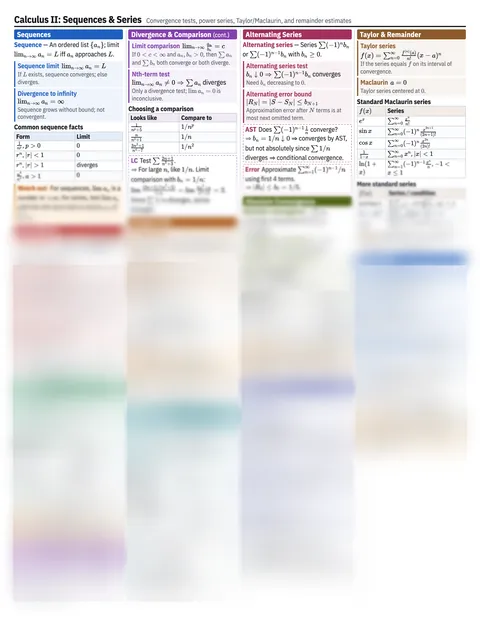
A one-page reference for the whole topic, fact-checked, with the first part free to read. This exam page does not repeat it. Use it to see the material, then make a shorter study sheet from the notes your section actually used.
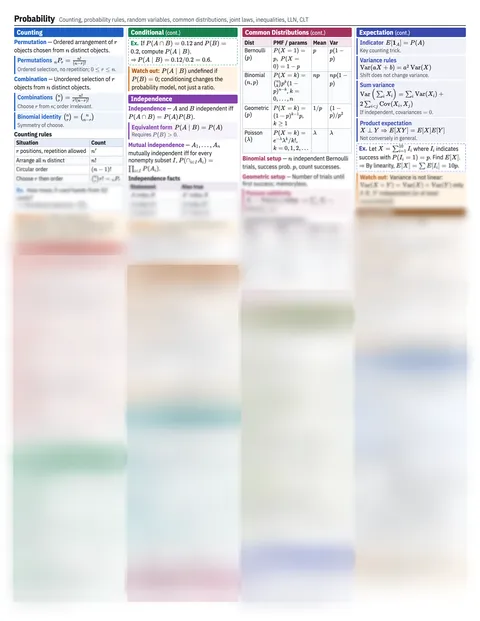
Probability reference sheet — the free part in text.
Unlock the full reference sheet to edit, print or save it as a PDF.
Make your own for this exam
Upload the lecture notes and problem sets for every unit on the final, joint-distribution and limit-theorem weeks included. In the focus step, name what the review session stressed, such as Bayes or covariance. Choose one page or front and back to match the allowed sheet.
FAQ
Questions
- What goes on a probability formula sheet?
- A distribution table with the PMF or PDF, mean and variance, the total probability and Bayes formulas, the variance and covariance rules, Markov and Chebyshev, and the CLT statement. A small worked Bayes tree is worth the space.
- Is a probability final the same as an intro statistics final?
- No. A probability course is usually calculus-based and centers on distributions, expectation and joint behavior, while intro statistics spends its second half on inference. If your course has confidence intervals and hypothesis tests, use the statistics page.
- How do I know which distribution to use?
- Read for the structure: a fixed number of independent trials points to binomial, waiting for the first success to geometric, counts of events in an interval to Poisson, and a continuous waiting time to exponential.
- Is an aid sheet allowed in a probability exam?
- Often, but it varies. Many courses allow one handwritten page or provide a distribution table; some allow nothing. Read the exam rules for your section.
Keep going
More study pages
All of these sit in the sheet library. Every exam study page.