Circuit Analysis Cheat Sheet — 1-page PDF
Core laws, methods, transients, phasors, op-amps. The whole course on one dense, printable page for your midterm or final, with every formula typeset and worked examples where they help.
The first part is free below. See pricing →
For a specific exam: Circuit Analysis Final exam study sheet.
- 1 pageUS Letter
- 10 sections10 topics
- Free previewfull sheet with Unlimited
 Cheat sheet locked
On the sheet
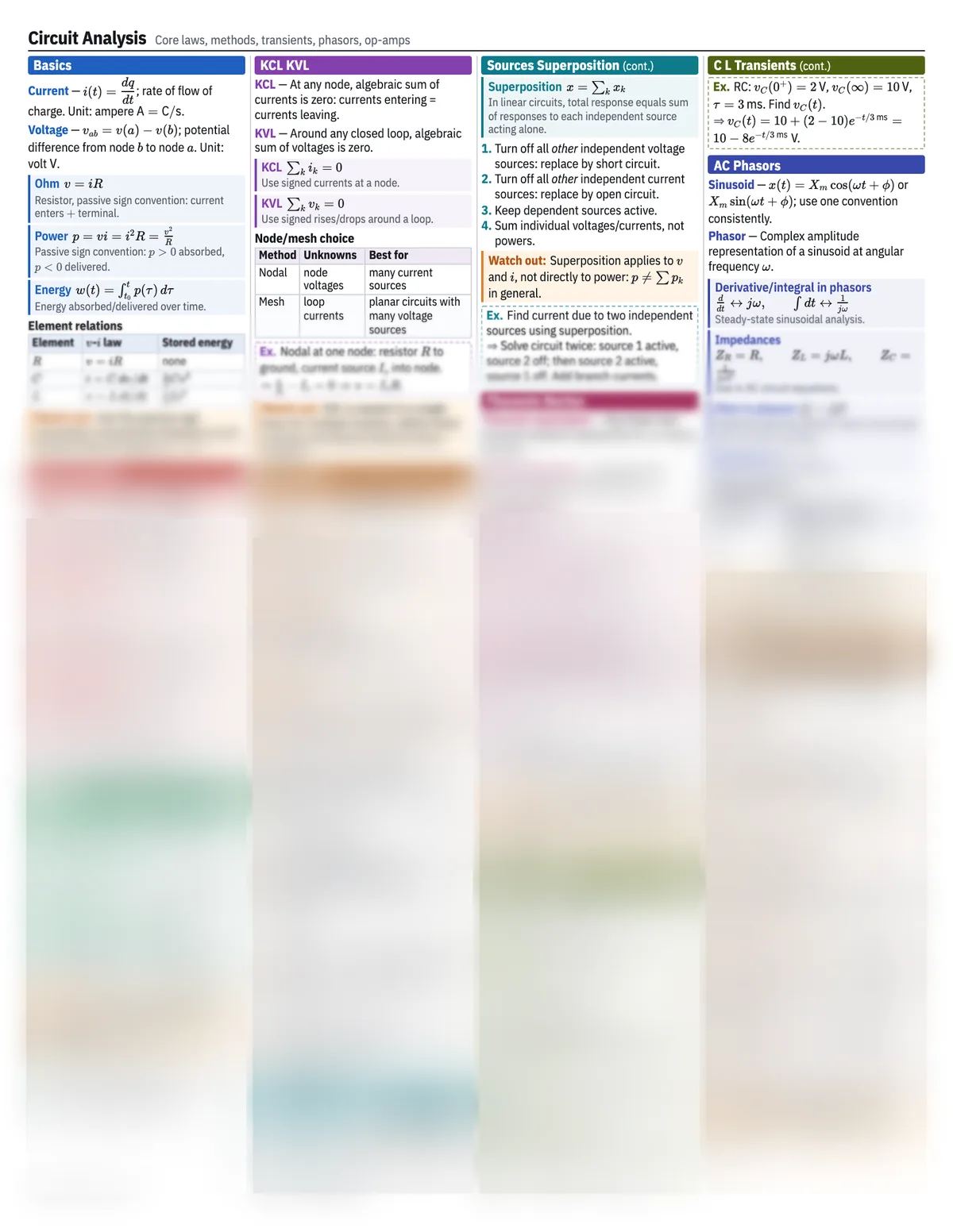
What’s on it
The topics a typical Circuit Analysis exam tests, all on the one page.
- Ohm's law and power
- Series and parallel
- Voltage and current dividers
- KCL, KVL, nodal and mesh analysis
- Thevenin and Norton equivalents
- Superposition
- Capacitors and inductors
- First-order RC/RL transients
- AC phasors and impedance
- Op-amp configurations
Free preview
The free part, as text
The free part of the sheet, section by section. Unlock the full sheet to read the rest, edit any block, and print it or save it as a PDF.
01Basics
- Current
- ; rate of flow of charge. Unit: ampere .
- Voltage
- ; potential difference from node to node . Unit: volt .
Ohm
Resistor, passive sign convention: current enters terminal.
Power
Passive sign convention: absorbed, delivered.
Energy
Energy absorbed/delivered over time.
Element relations
| Element | - law | Stored energy |
|---|---|---|
| none | ||
Watch out:Use the passive sign convention consistently; flipping current direction flips the sign of .
02Series Parallel
Series resistors
Same current through each element.
03KCL KVL
- KCL
- At any node, algebraic sum of currents is zero: currents entering = currents leaving.
- KVL
- Around any closed loop, algebraic sum of voltages is zero.
KCL
Use signed currents at a node.
KVL
Use signed rises/drops around a loop.
Node/mesh choice
| Method | Unknowns | Best for |
|---|---|---|
| Nodal | node voltages | many current sources |
| Mesh | loop currents | planar circuits with many voltage sources |
Ex.Nodal at one node: resistor to ground, current source into node.
.
Watch out:KVL is easiest in a single loop; for multiple meshes, define mesh currents and shared-element drops carefully.
04Nodal Mesh
Nodal equation
At node ; use conductance form for resistors.
05Sources Superposition
Superposition
In linear circuits, total response equals sum of responses to each independent source acting alone.
- Turn off all other independent voltage sources: replace by short circuit.
- Turn off all other independent current sources: replace by open circuit.
- Keep dependent sources active.
- Sum individual voltages/currents, not powers.
Watch out:Superposition applies to and , not directly to power: in general.
Ex.Find current due to two independent sources using superposition.
Solve circuit twice: source 1 active, source 2 off; then source 2 active, source 1 off. Add branch currents.
06Thevenin Norton
- Thevenin equivalent
- Any linear two-terminal network replaced by in series with .
- Norton equivalent
- Any linear two-terminal network replaced by in parallel with .
07C L Transients
Ex.RC: , , . Find .
V.
08AC Phasors
- Sinusoid
- or ; use one convention consistently.
- Phasor
- Complex amplitude representation of a sinusoid at angular frequency .
Derivative/integral in phasors
Steady-state sinusoidal analysis.
Impedances
Use in AC circuit equations.
Ohm in phasors
Underline denotes phasor; same circuit laws with complex numbers.
Admittance
Useful for parallel branches.
Phase behavior
| Element | Current vs voltage |
|---|---|
| in phase | |
| lags by | |
| leads by |
Cheat sheet locked
Also on the full Circuit Analysis sheet
8 more sections, with every definition, formula and worked example. Unlimited unlocks every full sheet in the library to edit, print or save as a PDF, and makes unlimited sheets from your own notes.
Series Parallel
- Parallel resistors
- Two in parallel
- Series capacitors
- Parallel capacitors
- Series inductors
- Parallel inductors
Dividers
- Voltage divider
- Two-resistor divider
- Current divider
- Two-branch current divider
Nodal Mesh
- Ground reference
- Mesh equation
- Supermesh
Sources Superposition
- Independent source
- Dependent source
Thevenin Norton
- Equivalence
- Open-circuit voltage
- Short-circuit current
- Resistance by sources off
C L Transients
- Capacitor
- Inductor
- Cap energy
- Ind energy
- RC time constant
- RL time constant
- First-order response
AC Phasors
Op Amps
- Ideal op-amp
- Golden rules
- Inverting amplifier
- Noninverting amplifier
- Voltage follower
- Summing amplifier
- Integrator
- Differentiator
FAQ
Questions
About the Circuit Analysis sheet and making your own.
- What does this Circuit Analysis cheat sheet cover?
- It has 10 sections: Basics, Series Parallel, Dividers, KCL KVL, Nodal Mesh, Sources Superposition, Thevenin Norton, C L Transients, AC Phasors and Op Amps. Together they cover the topics a typical Circuit Analysis exam tests, including Ohm's law and power, series and parallel, voltage and current dividers and KCL, KVL, nodal and mesh analysis.
- Is the circuit analysis cheat sheet free?
- The first part is free to read on this page, with no account needed. The full sheet opens in the app with Unlimited ($4.99 a month or $19 for a semester), where you can edit it, print it or save it as a PDF. It is one US Letter page and prints cleanly in black and white or colour.
- Can I bring this Circuit Analysis cheat sheet to my exam?
- Only if your course allows a note sheet, so check the syllabus. This one is a single US Letter page. If your exam allows a different size, such as a 3x5 or 4x6 index card or one page front and back, Cheat Sheet AI makes one at exactly that size from your own lecture notes.
- How accurate is it?
- The sheet was written by our engine from a standard course outline, then a second model fact-checked every formula and statement against it; it corrected 3 statements before publishing. Notation and emphasis vary between courses, so check it against your own lecture notes.
- Can I make a Circuit Analysis sheet from my own notes?
- Yes. Upload your lecture slides, notes or study guide and Cheat Sheet AI writes a sheet in your course's notation, sized to exactly the space your exam allows. Your first sheets are free.
Keep going
More sheets
All 40 sheets are in the sheet library.
Your course, your notes, one page.
Upload your own Circuit Analysis slides or notes and get a study sheet in your course’s notation. Your first sheet needs no account, and a free account adds one more. See pricing