Biochemistry Cheat Sheet — 1-page PDF
Amino acids, proteins, enzymes, metabolism, membranes, and information flow. The whole course on one dense, printable page for your midterm or final, with every formula typeset and worked examples where they help.
The first part is free below. See pricing →
For a specific exam: Biochemistry Final exam study sheet.
- 1 pageUS Letter
- 10 sections10 topics
- Free previewfull sheet with Unlimited
 Cheat sheet locked
On the sheet
What’s on it
The topics a typical Biochemistry exam tests, all on the one page.
- Amino acids and properties
- Protein structure levels
- Enzyme kinetics: Michaelis-Menten
- Inhibition types
- Carbohydrates
- Lipids and membranes
- Glycolysis
- Citric acid cycle
- Electron transport and oxidative phosphorylation
- DNA replication, transcription, translation
Free preview
The free part, as text
The free part of the sheet, section by section. Unlock the full sheet to read the rest, edit any block, and print it or save it as a PDF.
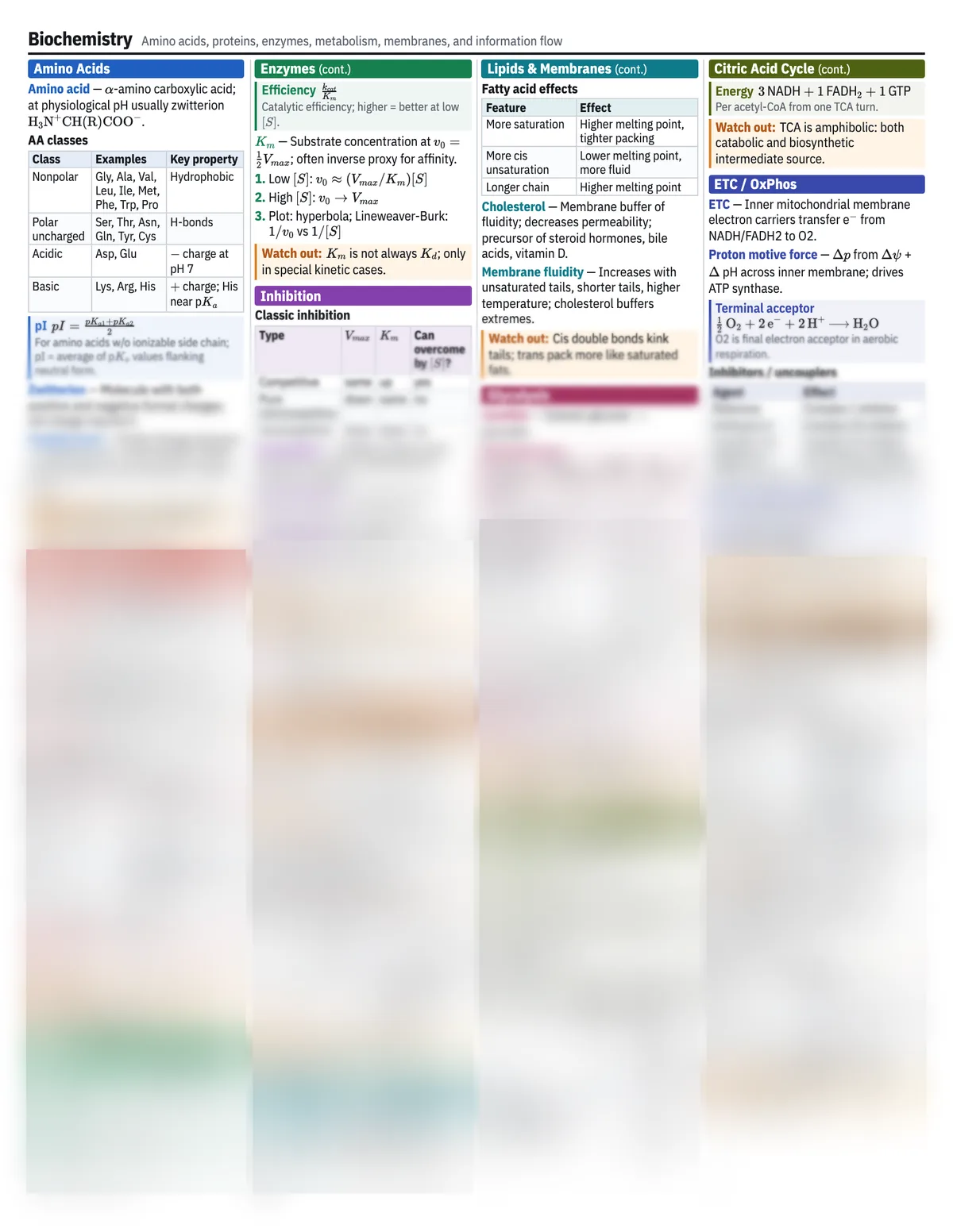
01Amino Acids
- Amino acid
- -amino carboxylic acid; at physiological pH usually zwitterion .
AA classes
| Class | Examples | Key property |
|---|---|---|
| Nonpolar | Gly, Ala, Val, Leu, Ile, Met, Phe, Trp, Pro | Hydrophobic |
| Polar uncharged | Ser, Thr, Asn, Gln, Tyr, Cys | H-bonds |
| Acidic | Asp, Glu | charge at pH 7 |
| Basic | Lys, Arg, His | charge; His near p |
pI
For amino acids w/o ionizable side chain; pI = average of p values flanking neutral form.
- Zwitterion
- Molecule with both positive and negative formal charges; net charge may be 0.
- Peptide bond
- Amide linkage between -carboxyl and -amino group; planar, partial double-bond character; usually trans.
Watch out:At pH pI: net charge but not all groups uncharged; solubility often minimal.
02Enzymes
Efficiency
Catalytic efficiency; higher = better at low .
- Substrate concentration at ; often inverse proxy for affinity.
- Low :
- High :
- Plot: hyperbola; Lineweaver-Burk: vs
Watch out: is not always ; only in special kinetic cases.
03Inhibition
Classic inhibition
| Type | Can overcome by ? | ||
|---|---|---|---|
| Competitive | same | up | yes |
| Pure noncompetitive | down | same | no |
| Uncompetitive | down | down | no |
- Competitive
- Inhibitor binds active site of free enzyme; substrate and inhibitor compete.
- Noncompetitive
- Inhibitor binds allosteric site to and/or ; decreases active enzyme.
04Lipids & Membranes
Fatty acid effects
| Feature | Effect |
|---|---|
| More saturation | Higher melting point, tighter packing |
| More cis unsaturation | Lower melting point, more fluid |
| Longer chain | Higher melting point |
- Cholesterol
- Membrane buffer of fluidity; decreases permeability; precursor of steroid hormones, bile acids, vitamin D.
- Membrane fluidity
- Increases with unsaturated tails, shorter tails, higher temperature; cholesterol buffers extremes.
Watch out:Cis double bonds kink tails; trans pack more like saturated fats.
05Glycolysis
- Location
- Cytosol; glucose pyruvate.
Net glycolysis
Net per glucose in aerobic conditions.
06Citric Acid Cycle
Energy
Per acetyl-CoA from one TCA turn.
Watch out:TCA is amphibolic: both catabolic and biosynthetic intermediate source.
07ETC / OxPhos
- ETC
- Inner mitochondrial membrane electron carriers transfer e from NADH/FADH2 to O2.
- Proton motive force
- from + pH across inner membrane; drives ATP synthase.
Terminal acceptor
O2 is final electron acceptor in aerobic respiration.
Inhibitors / uncouplers
| Agent | Effect |
|---|---|
| Rotenone | Complex I inhibitor |
| Antimycin A | Complex III inhibitor |
| Cyanide / CO | Complex IV inhibitor |
| Oligomycin | ATP synthase inhibitor |
| DNP, uncouplers | Collapse gradient; heat |
ATP per NADH/FADH2
ATP per NADHATP per FADH
Modern P/O estimates.
Cheat sheet locked
Also on the full Biochemistry sheet
9 more sections, with every definition, formula and worked example. Unlimited unlocks every full sheet in the library to edit, print or save as a PDF, and makes unlimited sheets from your own notes.
Protein Structure
- Primary
- Secondary
- Tertiary
- Quaternary
- Stabilizing forces
- Saturation
Enzymes
- Michaelis-Menten
- Turnover
Inhibition
- Uncompetitive
Carbohydrates
- Monosaccharide
- Anomer
- Reducing sugar
- Important polysaccharides
Lipids & Membranes
- Triacylglycerol
- Phospholipid
Glycolysis
- Irreversible steps
- PFK-1
- ATP yield
Citric Acid Cycle
- Location
- Per acetyl-CoA
- Key regulation
ETC / OxPhos
Gene Expression
- Replication
- Replication proteins
- Transcription
- Translation
- Genetic code
FAQ
Questions
About the Biochemistry sheet and making your own.
- What does this Biochemistry cheat sheet cover?
- It has 10 sections: Amino Acids, Protein Structure, Enzymes, Inhibition, Carbohydrates, Lipids & Membranes, Glycolysis, Citric Acid Cycle, ETC / OxPhos and Gene Expression. Together they cover the topics a typical Biochemistry exam tests, including amino acids and properties, protein structure levels, enzyme kinetics: Michaelis-Menten and inhibition types.
- Is the biochemistry cheat sheet free?
- The first part is free to read on this page, with no account needed. The full sheet opens in the app with Unlimited ($4.99 a month or $19 for a semester), where you can edit it, print it or save it as a PDF. It is one US Letter page and prints cleanly in black and white or colour.
- Can I bring this Biochemistry cheat sheet to my exam?
- Only if your course allows a note sheet, so check the syllabus. This one is a single US Letter page. If your exam allows a different size, such as a 3x5 or 4x6 index card or one page front and back, Cheat Sheet AI makes one at exactly that size from your own lecture notes.
- How accurate is it?
- The sheet was written by our engine from a standard course outline, then a second model fact-checked every formula and statement against it; it corrected 4 statements before publishing. Notation and emphasis vary between courses, so check it against your own lecture notes.
- Can I make a Biochemistry sheet from my own notes?
- Yes. Upload your lecture slides, notes or study guide and Cheat Sheet AI writes a sheet in your course's notation, sized to exactly the space your exam allows. Your first sheets are free.
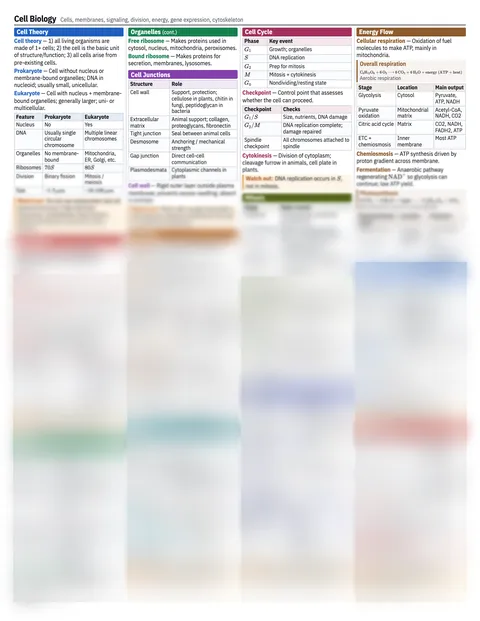
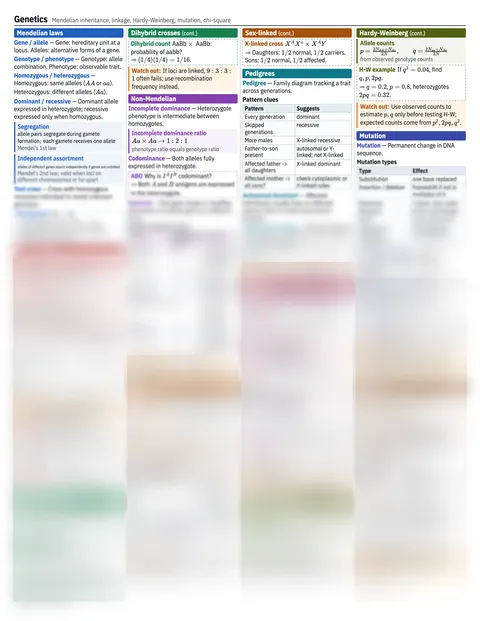
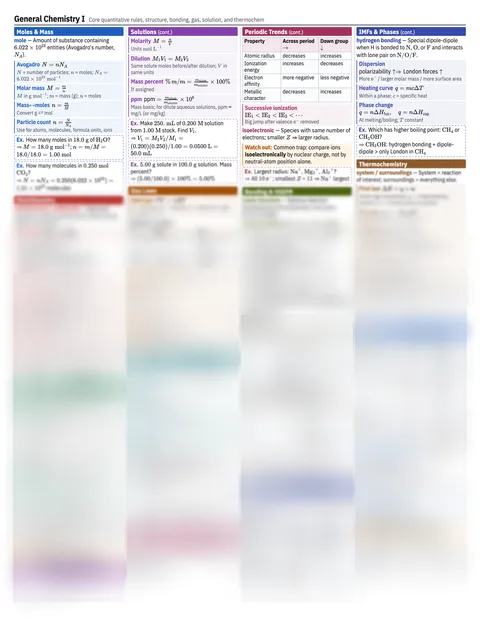
Your course, your notes, one page.
Upload your own Biochemistry slides or notes and get a study sheet in your course’s notation. Your first sheet needs no account, and a free account adds one more. See pricing