Genetics final exam study sheet
A genetics final is a problem-solving exam. You are given crosses, pedigrees, recombination counts or allele frequencies and asked to get a number or a genotype, then justify it. Most finals are cumulative, so Mendelian ratios and probability come back inside harder questions about linkage and populations, which are often the last topics taught.
Whether you call it a formula sheet, a crib sheet, an exam aid sheet or revision notes, the genetics version is mostly ratios, probability rules and three or four formulas you must apply without hesitating.
 Cheat sheet locked
The scope
What this exam usually covers
These are the problem types genetics finals grade most often. Work them under time, because the setup is where marks are lost.
- Mono- and dihybrid crosses 3:1, 1:2:1, 9:3:3:1 and the test-cross ratios, but asked as probabilities: the chance a child of two carriers is affected, or the fraction of a trihybrid cross with a given phenotype. The product rule is faster than a big Punnett square.
- Modified ratios and epistasis Incomplete dominance, codominance, ABO blood groups, lethal alleles (2:1) and epistatic ratios such as 9:3:4 and 9:7. The exam gives the observed numbers and asks you to name the gene interaction.
- Pedigree analysis Decide autosomal versus X-linked and dominant versus recessive from the chart, then compute a risk for a named individual. Points go when students forget that an unaffected child of carriers is a carrier with probability 2/3, not 1/2.
- Sex linkage X-linked crosses written with the X and Y explicitly, hemizygous males, reciprocal crosses giving different results, and X-inactivation in females. Some courses add sex-influenced and sex-limited traits.
- Linkage and gene mapping Recombination frequency from test-cross progeny, map units, and the three-point cross: identify parental and double-crossover classes, find the middle gene, then compute distances, coefficient of coincidence and interference.
- Chi-square goodness of fit Expected counts from the hypothesised ratio, the sum of (O − E)²/E, degrees of freedom as categories minus one, and a correctly worded conclusion. Using percentages instead of counts is the classic error.
- Hardy–Weinberg p + q = 1 and p² + 2pq + q² = 1, carrier frequency from disease incidence, and testing whether a population is in equilibrium. Questions often add one twist: selection, migration or inbreeding.
Usually later
Molecular genetics (replication, transcription, the lac and trp operons, eukaryotic gene regulation), chromosome rearrangements, and quantitative traits with heritability sit on some genetics finals and not others, depending on whether the course is transmission-first or molecular-first. The library sheet is mostly transmission genetics, so add operon logic or chromosome mutations to your own sheet if the review list names them.
The rules
What a note sheet is usually allowed to include
check your exam header — it wins
Genetics instructors split on notes. Some allow one handwritten page or index card because the exam tests applying ratios, not remembering them; some provide the chi-square critical value table and nothing else; some allow a calculator but no notes at all. A formula sheet for genetics is short in any case: the probability rules, the chi-square formula and table row for your df, and Hardy–Weinberg. In Canada this may be called an aid sheet, in the UK a crib sheet. Follow the written policy. Either way this page works as a study sheet to practise from.
The sheet
The matching library sheet
A one-page reference for the whole topic, fact-checked, with the first part free to read. This exam page does not repeat it. Use it to see the material, then make a shorter study sheet from the notes your section actually used.
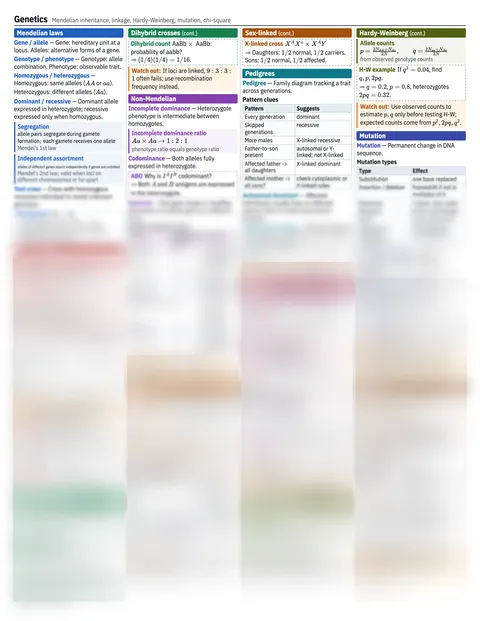
Genetics reference sheet — the free part in text.
Unlock the full reference sheet to edit, print or save it as a PDF.
Make your own for this exam
Upload the problem sets and the worked examples from lecture, especially the mapping and pedigree problems. In the focus step, say what the review session stressed, such as three-point crosses or epistasis ratios. Pick one page, front and back, or an index card to match what your course allows.
FAQ
Questions
- What goes on a genetics formula sheet?
- The product and sum rules, the binomial expression for family-size questions, the standard and modified ratios, recombination frequency and map units, the chi-square formula with the critical values you need, and the Hardy–Weinberg equations. Add one worked three-point cross if mapping is on your exam.
- Is a chi-square table provided on genetics finals?
- Often, but not always. Some instructors print the table on the exam; others expect you to know that 3.84 is the 0.05 cutoff for one degree of freedom. Check the exam instructions and practise with the table your course uses.
- How do I find the middle gene in a three-point cross?
- Compare the parental classes (the most common) with the double crossovers (the rarest). The gene whose allele is swapped between them is the middle gene. Then add the double crossovers into both single-interval distances.
- Is the genetics final cumulative?
- Usually. Early Mendelian material rarely appears on its own; it is folded into pedigree, linkage and population questions, so the early rules still need to be fast.
Keep going
More study pages
All of these sit in the sheet library. Every exam study page.