General Chemistry II final exam study sheet
The General Chemistry II final usually spans kinetics, chemical equilibrium, acids and bases with buffers and titrations, solubility, thermodynamics, and electrochemistry. It is typically cumulative, with the last units, free energy and electrochemistry, carrying more problems because they tie the earlier ones together through delta G, K, and cell potential. ICE tables appear in some form on almost every page.
A formula sheet in most US courses, an aid sheet in Canadian ones, a crib sheet or revision notes in the UK: whatever the name, one page of the equations and the ICE-table steps you condensed yourself.
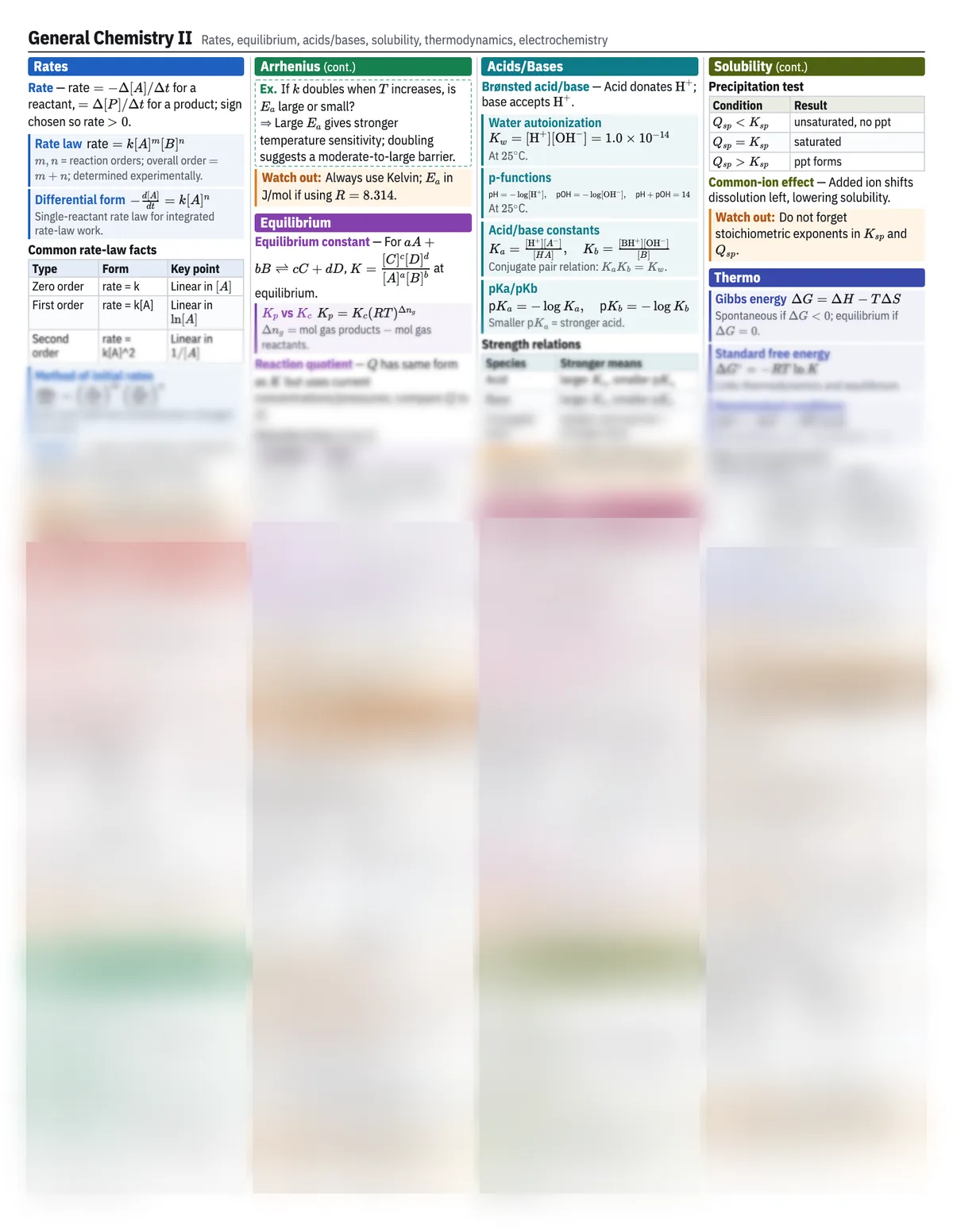 Cheat sheet locked
The scope
What this exam usually covers
These are the problem types a cumulative General Chemistry II final usually grades. The order of units differs by textbook, so check them against the syllabus.
- Rate laws and integrated rate laws Method of initial rates for orders, integrated forms for zero, first, and second order, half-life, and which plot is linear. The rate constant's units depend on the order.
- Arrhenius equation Activation energy from rate constants at two temperatures. Use kelvin and R in joules; a kilojoule-joule mismatch is the most common lost point.
- Equilibrium constants and ICE tables Write K from the balanced equation, leave out pure solids and liquids, compare Q to K, and solve ICE tables with the small-x check. Kp and Kc conversion needs delta n of gases.
- Le Chatelier's principle Predict shifts from concentration, pressure, and temperature changes. Only temperature changes the value of K; catalysts change neither K nor the equilibrium position.
- Acids, bases, and pH Strong versus weak, Ka and Kb with Kw, pH of weak acids and bases, and salts that hydrolyze. Forgetting that the conjugate of a weak acid is a weak base is a frequent error.
- Buffers and titrations Henderson-Hasselbalch, pH equals pKa at half-equivalence, and the pH at the equivalence point for weak-strong titrations. Work in moles before the volume changes.
- Solubility and Ksp Molar solubility from Ksp with the right stoichiometric powers, the common-ion effect, and predicting precipitation with Q versus Ksp.
- Thermodynamics and electrochemistry Entropy and Gibbs energy, delta G standard equals minus RT ln K, cell potential from reduction potentials, delta G equals minus nFE, and the Nernst equation. Anode is oxidation in both cell types.
Usually later
Nuclear chemistry, coordination compounds, and an introduction to organic chemistry close out General Chemistry II at some schools and are not on this reference; they usually count for little on the final. Electrolysis with Faraday's law is on some finals and not others. Check the review sheet for the last chapter included.
The rules
What a note sheet is usually allowed to include
check your exam header — it wins
General Chemistry II finals often provide a periodic table, constants, and a table of reduction potentials or Ka values, and some allow nothing else. Where student notes are permitted, the usual size is one index card or one handwritten side of a page. Departments that give a standardized or common final tend to forbid personal notes. Canadian exam covers usually say whether an aid sheet is allowed, and UK chemistry papers that issue a data booklet rarely permit a crib sheet. Check your syllabus; either way, building the sheet is useful revision.
The sheet
The matching library sheet
A one-page reference for the whole topic, fact-checked, with the first part free to read. This exam page does not repeat it. Use it to see the material, then make a shorter study sheet from the notes your section actually used.
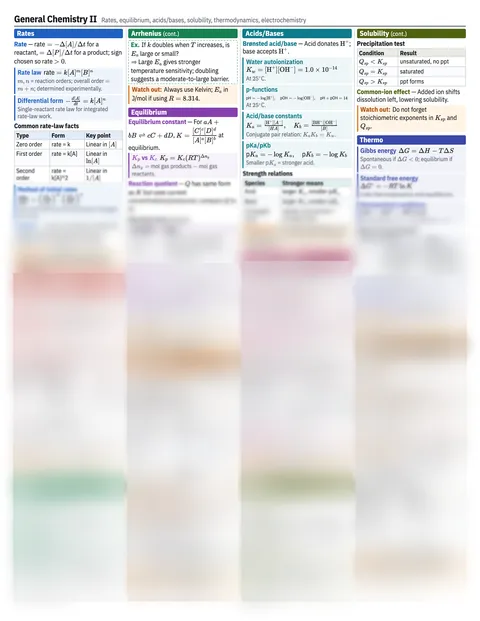
General Chemistry II reference sheet — the free part in text.
Unlock the full reference sheet to edit, print or save it as a PDF.
Make your own for this exam
Upload the lecture slides and problem sets from the term, and in the focus step name what the review session stressed, such as titration curves or the Nernst equation. Pick one page or an index card to match the rule, and keep one ICE table worked through to the small-x check.
FAQ
Questions
- Is the General Chemistry II final cumulative?
- Usually yes, with extra weight on thermodynamics and electrochemistry, which reuse equilibrium constants. Kinetics from the start of term often gets fewer problems but does not disappear.
- What should a General Chemistry II formula sheet contain?
- The integrated rate laws and half-lives, the Arrhenius two-point form, K expressions and Kp-Kc conversion, Kw and pH relations, Henderson-Hasselbalch, the Ksp setup, delta G with K and with cell potential, and the Nernst equation.
- Is an aid sheet allowed in a General Chemistry II exam?
- Sometimes. Many courses provide data tables and allow no notes; others allow one card or one side of a page. Check the exam cover or the syllabus for your section.
- How do I keep the ICE-table problems straight?
- Write the balanced equation, set up initial, change, and equilibrium rows in moles or molarity, substitute into K, and check whether x is under 5 percent of the starting value before dropping it.
Keep going
More study pages

All of these sit in the sheet library. Every exam study page.