Organic Chemistry Reactions Cheat Sheet — 1-page PDF
Aromaticity, carbonyl chemistry, enolates, amines, oxidation/reduction, IR/NMR. The whole course on one dense, printable page for your midterm or final, with every formula typeset and worked examples where they help.
The first part is free below. See pricing →
For a specific exam: Organic Chemistry II Midterm study sheet, Organic Chemistry II Final exam study sheet.
- 1 pageUS Letter
- 10 sections11 topics
- Free previewfull sheet with Unlimited
 Cheat sheet locked
On the sheet
What’s on it
The topics a typical Organic Chemistry II: Reactions exam tests, all on the one page.
- Aromaticity and electrophilic aromatic substitution
- Directing effects
- Carbonyl nucleophilic addition
- Aldehyde and ketone reactions
- Carboxylic acid derivatives reactivity
- Grignard reagents
- Oxidation and reduction reagents
- Aldol and Claisen condensations
- Enolates
- Amines
- Spectroscopy: IR and NMR key values
Free preview
The free part, as text
The free part of the sheet, section by section. Unlock the full sheet to read the rest, edit any block, and print it or save it as a PDF.
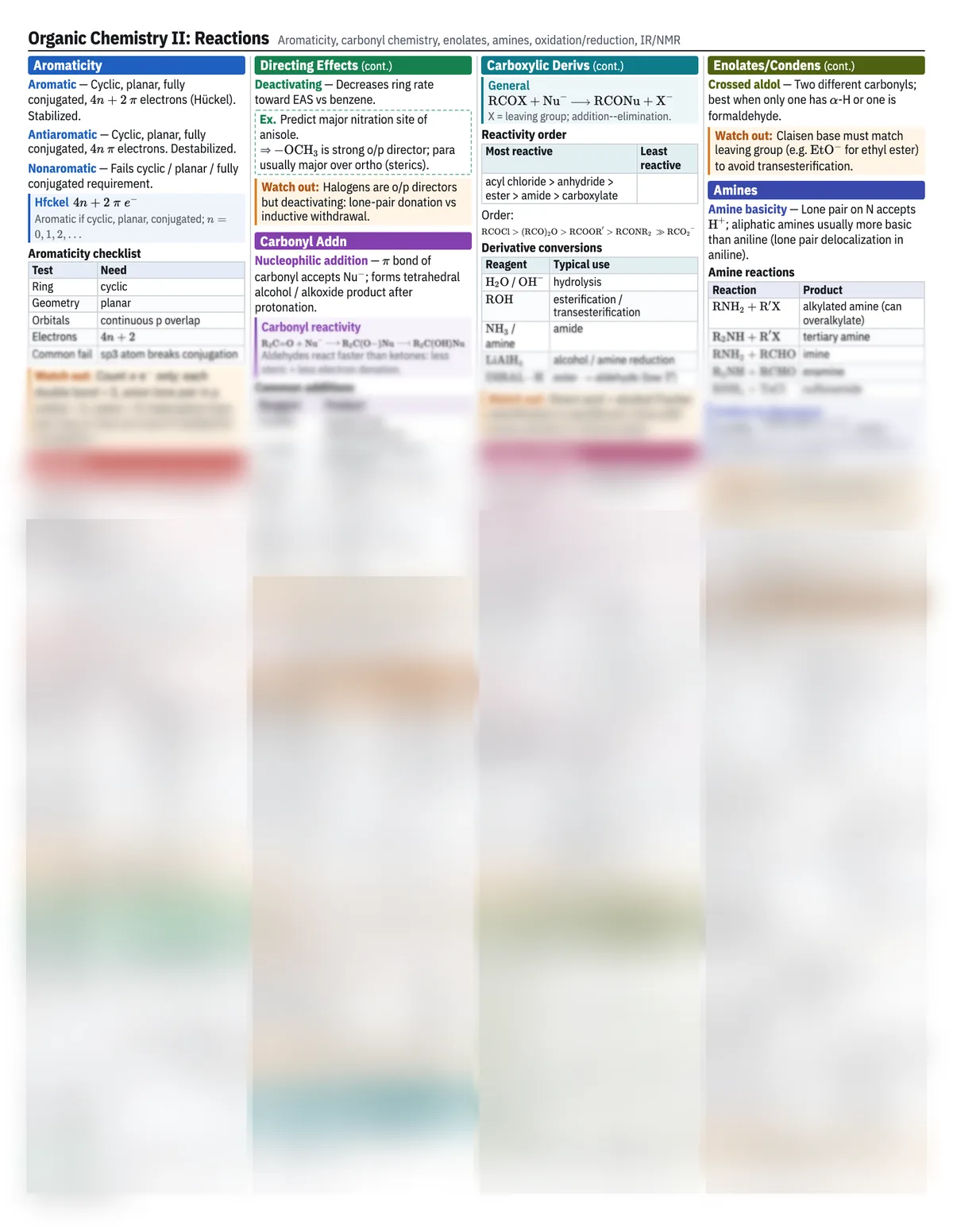
01Aromaticity
- Aromatic
- Cyclic, planar, fully conjugated, electrons (Hückel). Stabilized.
- Antiaromatic
- Cyclic, planar, fully conjugated, electrons. Destabilized.
- Nonaromatic
- Fails cyclic / planar / fully conjugated requirement.
Hfckel
Aromatic if cyclic, planar, conjugated;
Aromaticity checklist
| Test | Need |
|---|---|
| Ring | cyclic |
| Geometry | planar |
| Orbitals | continuous p overlap |
| Electrons | |
| Common fail | sp atom breaks conjugation |
Watch out:Count e only: each double bond = , anion lone pair in p orbital = , cation = ; heteroatom lone pair may or may not count if needed for conjugation.
02EAS Core
- Electrophilic aromatic substitution (EAS)
- Replace ring H by E while retaining aromaticity.
03Directing Effects
- Deactivating
- Decreases ring rate toward EAS vs benzene.
Ex.Predict major nitration site of anisole.
is strong o/p director; para usually major over ortho (sterics).
Watch out:Halogens are o/p directors but deactivating: lone-pair donation vs inductive withdrawal.
04Carbonyl Addn
- Nucleophilic addition
- bond of carbonyl accepts Nu; forms tetrahedral alcohol / alkoxide product after protonation.
Carbonyl reactivity
Aldehydes react faster than ketones: less steric + less electron donation.
Common additions
| Reagent | Product |
|---|---|
| alcohol from aldehyde/ketone | |
| alcohol; also reduces derivatives | |
| , | C--C bond; alcohol after workup |
| cyanohydrin | |
| hemiacetal / acetal | |
| imine | |
| enamine |
05Carboxylic Derivs
General
X = leaving group; addition--elimination.
Reactivity order
| Most reactive | Least reactive |
|---|---|
| acyl chloride > anhydride > ester > amide > carboxylate |
Order:
Derivative conversions
| Reagent | Typical use |
|---|---|
| / | hydrolysis |
| esterification / transesterification | |
| / amine | amide |
| alcohol / amine reduction | |
| ester aldehyde (low ) |
Watch out:Direct acid + alcohol Fischer esterification is equilibrium; drive with excess alcohol or remove water.
06Grignard/Redox
- Grignard reagent
- Organomagnesium halide, ; strong base and nucleophile.
07Enolates/Condens
- Crossed aldol
- Two different carbonyls; best when only one has -H or one is formaldehyde.
Watch out:Claisen base must match leaving group (e.g. for ethyl ester) to avoid transesterification.
08Amines
- Amine basicity
- Lone pair on N accepts ; aliphatic amines usually more basic than aniline (lone pair delocalization in aniline).
Amine reactions
| Reaction | Product |
|---|---|
| alkylated amine (can overalkylate) | |
| tertiary amine | |
| imine | |
| enamine | |
| sulfonamide |
Aniline to diazonium
Aryl diazonium = versatile intermediate for substitution / Sandmeyer.
Watch out:Primary amines give imines; secondary amines give enamines. Tertiary amines cannot form imines (no N--H).
Cheat sheet locked
Also on the full Organic Chemistry II: Reactions sheet
9 more sections, with every definition, formula and worked example. Unlimited unlocks every full sheet in the library to edit, print or save as a PDF, and makes unlimited sheets from your own notes.
EAS Core
- EAS pattern
- General EAS
- Common EAS reagents
Directing Effects
- Directors
- Activating
Carbonyl Addn
Aldehydes/Ketones
- Key reactions
- Imines
- Enamine
- Acetal/ketal terms
Carboxylic Derivs
- Acyl substitution
Grignard/Redox
- Grignard + carbonyl
- Grignard outcomes
- Key restriction
- Reductions
Enolates/Condens
- Enolate
- Aldol
- Claisen
Amines
IR/NMR
- IR key peaks
- H NMR quick
- Coupling
- C NMR
FAQ
Questions
About the Organic Chemistry II: Reactions sheet and making your own.
- What does this Organic Chemistry II: Reactions cheat sheet cover?
- It has 10 sections: Aromaticity, EAS Core, Directing Effects, Carbonyl Addn, Aldehydes/Ketones, Carboxylic Derivs, Grignard/Redox, Enolates/Condens, Amines and IR/NMR. Together they cover the topics a typical Organic Chemistry II: Reactions exam tests, including aromaticity and electrophilic aromatic substitution, directing effects, carbonyl nucleophilic addition and aldehyde and ketone reactions.
- Is the organic chemistry reactions cheat sheet free?
- The first part is free to read on this page, with no account needed. The full sheet opens in the app with Unlimited ($4.99 a month or $19 for a semester), where you can edit it, print it or save it as a PDF. It is one US Letter page and prints cleanly in black and white or colour.
- Can I bring this Organic Chemistry II: Reactions cheat sheet to my exam?
- Only if your course allows a note sheet, so check the syllabus. This one is a single US Letter page. If your exam allows a different size, such as a 3x5 or 4x6 index card or one page front and back, Cheat Sheet AI makes one at exactly that size from your own lecture notes.
- How accurate is it?
- The sheet was written by our engine from a standard course outline, then a second model fact-checked every formula and statement against it; it corrected 9 statements before publishing. Notation and emphasis vary between courses, so check it against your own lecture notes.
- Can I make a Organic Chemistry II: Reactions sheet from my own notes?
- Yes. Upload your lecture slides, notes or study guide and Cheat Sheet AI writes a sheet in your course's notation, sized to exactly the space your exam allows. Your first sheets are free.
Your course, your notes, one page.
Upload your own Organic Chemistry II: Reactions slides or notes and get a study sheet in your course’s notation. Your first sheet needs no account, and a free account adds one more. See pricing