Organic Chemistry II midterm study sheet
The Organic Chemistry II midterm is a reaction exam. The usual core is electrophilic aromatic substitution with directing effects, nucleophilic addition to aldehydes and ketones, and the reactivity order of carboxylic acid derivatives. Enolates and the aldol or Claisen reaction are on this exam at some schools and saved for the final at others. IR and NMR are often a separate quiz.
Call it a crib sheet, a reaction summary or your revision notes; it is the one page that maps each carbonyl and aromatic reaction to its conditions.
 Cheat sheet locked
The scope
What this exam usually covers
Organize by mechanism family. A flat list of reagents without the intermediate is how these exams are failed.
- Aromaticity Hückel’s rule for the compounds your class cares about, and a non-aromatic or anti-aromatic counterexample so you do not call every ring aromatic.
- Electrophilic aromatic substitution Halogenation, nitration, sulfonation, Friedel-Crafts alkylation and acylation: the electrophile, the sigma complex, and why polyalkylation or a meta director changes the plan.
- Directing effects Activators and ortho/para directors versus deactivators and meta directors. Halogens are the usual exception: deactivating but ortho/para.
- Carbonyl addition Hydride reductions, Grignard or organolithium additions, acetals, and imines, with the tetrahedral intermediate drawn. Acid versus base workup is part of the answer.
- Carboxylic derivatives The reactivity order: acid chloride, anhydride, ester, amide. One addition-elimination mechanism written in full, plus the reagents that interconvert them.
- Oxidation and reduction reagents The short list your instructor uses (PCC versus chromic acid, LiAlH4 versus NaBH4, and whatever ozonolysis variant you saw), not every reagent in the textbook appendix.
Usually later
If enolates, the aldol condensation, Claisen, and alpha-substitution have not been lectured, leave them off this sheet. Amine reactions and a full spectroscopy problem set are a common final unit. A midterm study sheet that tries to hold both EAS and the entire carbonyl chapter plus NMR will not be readable.
The rules
What a note sheet is usually allowed to include
check your exam header — it wins
Reaction-heavy organic exams sometimes allow a handwritten reagent sheet and sometimes allow nothing, because a complete reagent list is an answer key. Where a sheet is allowed it is often one side, handwritten, with names and structures but not worked synthesis problems. Department finals are more likely to ban notes than in-term midterms. Model kits, if allowed in Organic I, are sometimes banned once mechanisms start. This page does not replace the rule in your course. It is a way to decide which mechanisms deserve the limited space.
The sheet
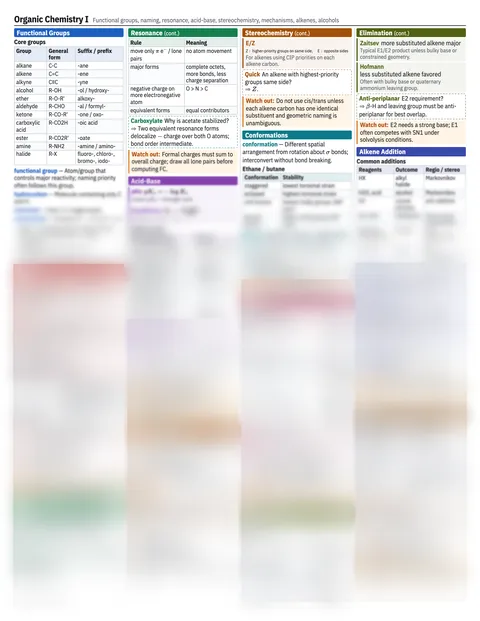
The matching library sheet
A one-page reference for the whole topic, fact-checked, with the first part free to read. This exam page does not repeat it. Use it to see the material, then make a shorter study sheet from the notes your section actually used.
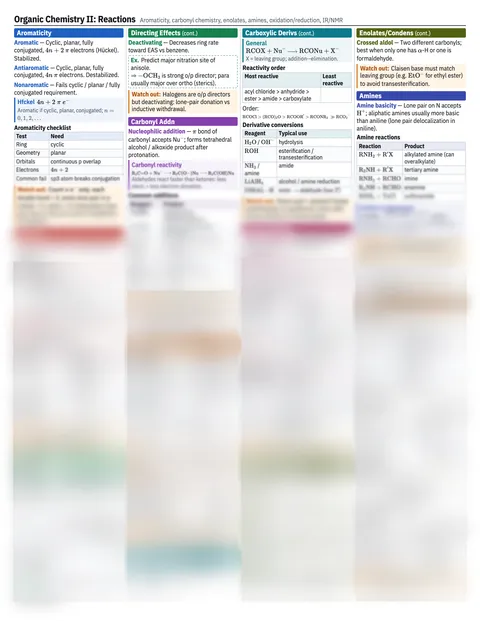
Organic Chemistry II: Reactions reference sheet — the free part in text.
Unlock the full reference sheet to edit, print or save it as a PDF.
Make your own for this exam
Upload the aromatic and carbonyl lecture notes, and name the reactions on the posted study guide in the focus box. Ask for one mechanism drawn per family and a directing-effects table, not every named reaction in the chapter summary. Your instructor’s choice of hydride reagent should come from their slides.
FAQ
Questions
- What reactions belong on an Organic Chemistry II midterm study sheet?
- Electrophilic aromatic substitution with directors, nucleophilic addition to aldehydes and ketones, and addition-elimination of carboxylic acid derivatives. Add enolates only if those lectures already happened.
- Should I include NMR chemical shifts?
- Only if this exam has a spectroscopy problem. Many Organic II midterms are reactions only, with IR and NMR on a different day.
- Is a reagent table allowed in the exam room?
- Sometimes one handwritten side, often nothing. A full printed reagent list is the thing policies are written to prevent. Check the announcement for your section.
Keep going
More study pages
All of these sit in the sheet library. Every exam study page.