Physics I Midterm 1 study sheet
Physics I Midterm 1 stops before energy at a lot of universities. The problems are constant-acceleration kinematics, projectiles, free-body diagrams, friction, and sometimes uniform circular motion. Work, conservation of energy, and momentum are the usual Midterm 2, after the class has left Newton’s second law as the only tool.
This is the mechanics formula sheet, also called an aid sheet in Canada or a crib sheet in the UK: the equations plus when each one applies.
 Cheat sheet locked
The scope
What this exam usually covers
Every problem still starts with a picture and a known/unknown list. The formula is the third step.
- Constant-acceleration kinematics The four equations that assume constant a, and which one to pick when time is missing. Unit conversions and the sign of the axis are the actual grading.
- Projectile motion Horizontal velocity stays constant if you are ignoring air. Vertical motion is free fall. Time comes from the vertical equation and is shared.
- Newton’s laws and free-body diagrams One diagram per object, forces only, axes along the acceleration when there is one. Second law per axis. Third-law pairs are equal and opposite and act on different objects.
- Friction Static friction is an inequality up to mu_s N. Kinetic friction is mu_k N opposing the slide. The exam asks which one, and for the minimum force that starts motion.
- Inclines Axes along the ramp, weight split into mg sin theta and mg cos theta. Theta is the ramp angle, measured the way your notes measure it.
- Circular motion Centripetal acceleration is v squared over r, toward the center, and it is not a new force on the diagram. The forces you already drew provide it.
Usually later
Energy bar charts, springs, power, impulse, and collisions are the next exam at most algebra-based and calculus-based Physics I courses. Rotation, torque, and moment of inertia are often a third unit or the final. If circular motion has not been lectured, leave the v-squared-over-r line off.
The rules
What a note sheet is usually allowed to include
check your exam header — it wins
Intro physics is the course most likely to hand you a formula sheet and forbid annotations. The department sheet usually has the kinematic equations, Newton’s second law, and friction, and it omits the problem-solving steps. Some instructors instead allow one handwritten side and collect it. Calculator policies are separate: scientific yes, graphing or CAS sometimes no. This study sheet is for learning the setup. If the exam provides the formulas, practice without looking; if it allows a card, copy only the relations you cannot reliably rebuild.
The sheet
The matching library sheet
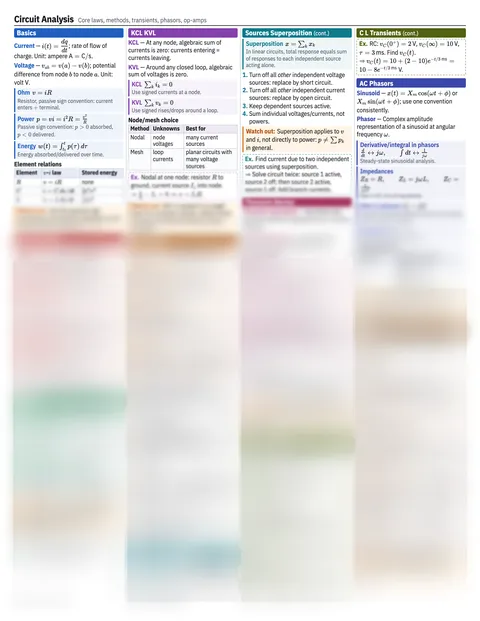
A one-page reference for the whole topic, fact-checked, with the first part free to read. This exam page does not repeat it. Use it to see the material, then make a shorter study sheet from the notes your section actually used.
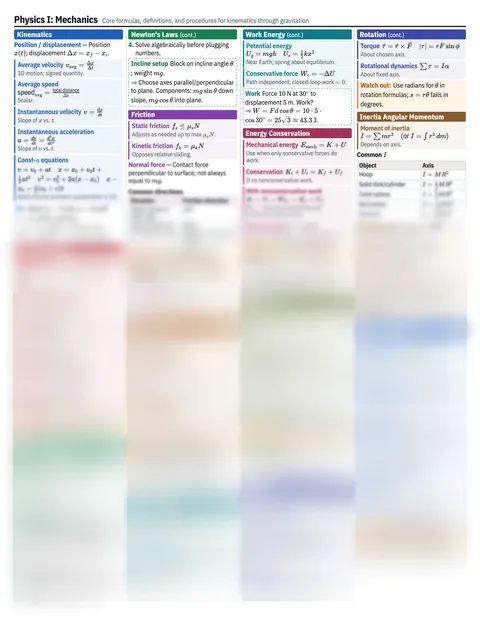
Physics I: Mechanics reference sheet — the free part in text.
Unlock the full reference sheet to edit, print or save it as a PDF.
Make your own for this exam
Upload the kinematics and forces lectures and one solved example of each type, including a lab if the exam pulls data from it. Say “free-body diagram first” in the focus box. Keep units next to each formula. A one-page sheet can hold the equations and the axis convention; it cannot hold a worked projectile from scratch.
FAQ
Questions
- Does Physics I Midterm 1 include energy?
- Often no. Energy and momentum are a common second midterm. Midterm 1 is kinematics, projectiles, Newton’s laws, and friction, plus circular motion if it has been taught.
- Will I get a formula sheet?
- Many physics departments provide one and do not let you add to it. Others allow a handwritten card. The provided sheet will not show how to pick axes or which kinematic equation fits, so practice that separately.
- What is worth putting on a handwritten physics card?
- The kinematic set, the weight components on a ramp, static versus kinetic friction, and centripetal acceleration. Skip derivations. Sign conventions from your own lectures matter more than a generic list.
Keep going
More study pages
All of these sit in the sheet library. Every exam study page.