General Chemistry I Midterm 1 study sheet
General Chemistry I Midterm 1 is the mole exam. You convert grams, moles, and particles, run a stoichiometry problem through a limiting reagent, and use the gas laws. Electron configuration and periodic trends are on this exam if the class has reached atomic structure, and they are the next exam if it has not. Thermochemistry and Lewis structures are usually later.
A formula sheet, an aid sheet or your revision notes, depending on where you study: one page of stoichiometry, units and the conversions that cost points.
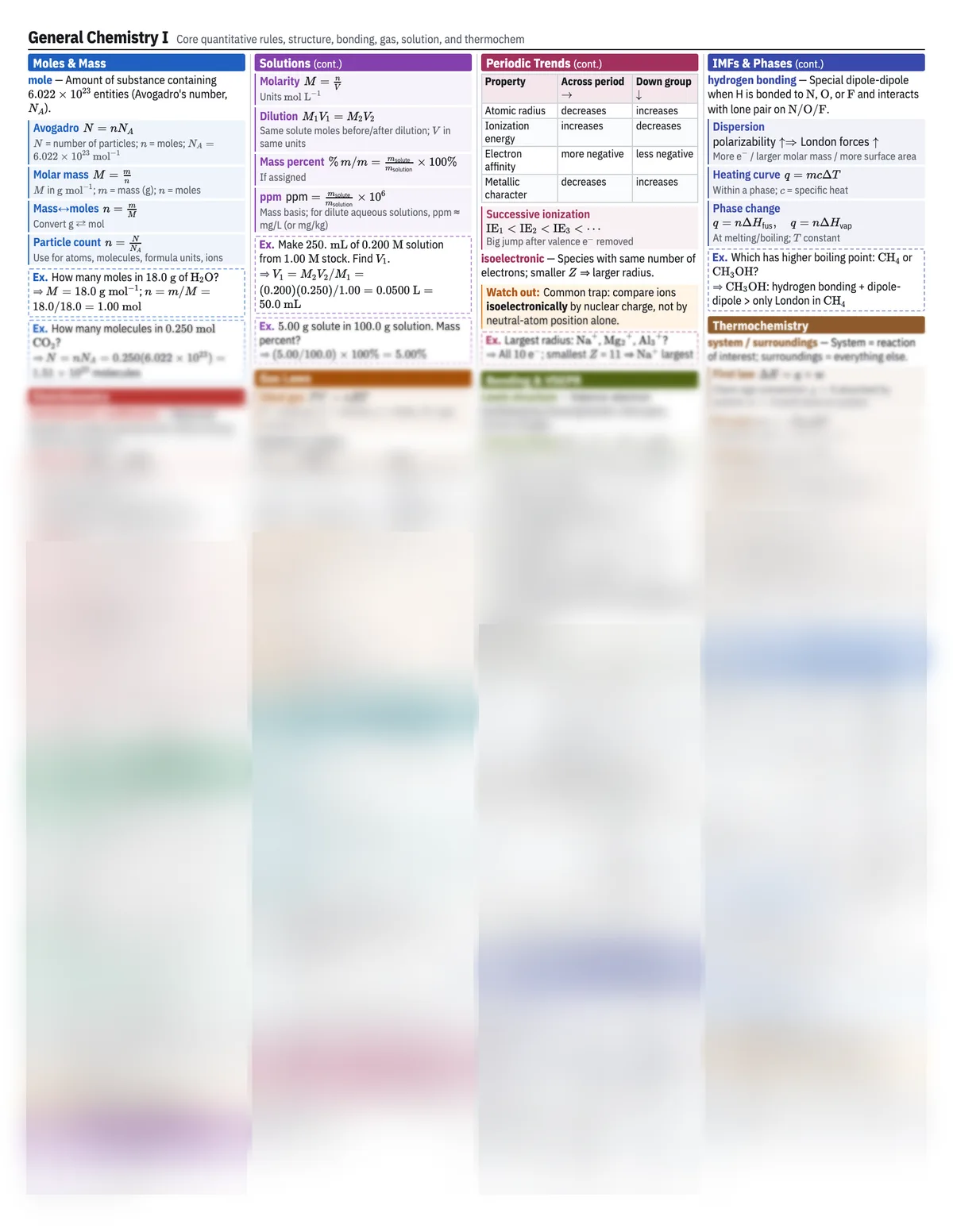 Cheat sheet locked
The scope
What this exam usually covers
Show the unit cancellation. These exams grade the setup, and a bare number with no units is where the points go.
- Moles and molar mass Grams to moles with the molar mass from the periodic table they give you, and moles to particles with Avogadro’s number. Hydrates and percent composition if they were in the homework.
- Stoichiometry Balance first. Convert to moles, use the mole ratio, convert to the asked unit. A mass-to-mass problem that skips the ratio is the standard miss.
- Limiting reagent and percent yield Run the stoichiometry from each reactant. The smaller product amount is the limit. Percent yield is actual over theoretical, times 100.
- Solutions Molarity and dilution, M1 V1 = M2 V2, only if solution stoichiometry was lectured. Titration calculations belong here only in that case.
- Gas laws Combined gas law and PV = nRT, with R in the units your table uses. Dalton’s partial pressures and mole fraction if they appeared in a problem set.
- Atomic structure, if covered Protons, neutrons, electrons, isotopes, electron configuration, and one periodic trend (atomic radius or ionization energy). Skip this block if the lecture has not happened.
Usually later
Lewis structures, VSEPR, intermolecular forces, and thermochemistry (calorimetry, Hess’s law) are the usual second midterm. Equilibrium and acids are General Chemistry II. Do not study orbital hybridization for this exam unless it is on the review sheet.
The rules
What a note sheet is usually allowed to include
check your exam header — it wins
General chemistry midterms almost always provide a periodic table and a constants page (Avogadro’s number, R, and sometimes solubility rules). They almost never allow a student-written process sheet, because the exam is the process. Solubility rules are sometimes on the constants page and sometimes must be memorized; that single difference is worth checking. Calculators are usually allowed and sometimes restricted to non-programmable models. Use a study sheet at home to drill the gram-mole-gram setup. Do not plan to bring it unless the syllabus says a card is permitted, which is uncommon in this course.
The sheet
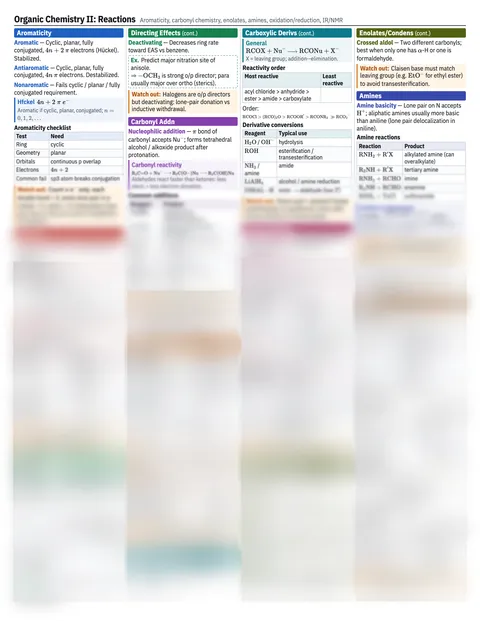
The matching library sheet
A one-page reference for the whole topic, fact-checked, with the first part free to read. This exam page does not repeat it. Use it to see the material, then make a shorter study sheet from the notes your section actually used.
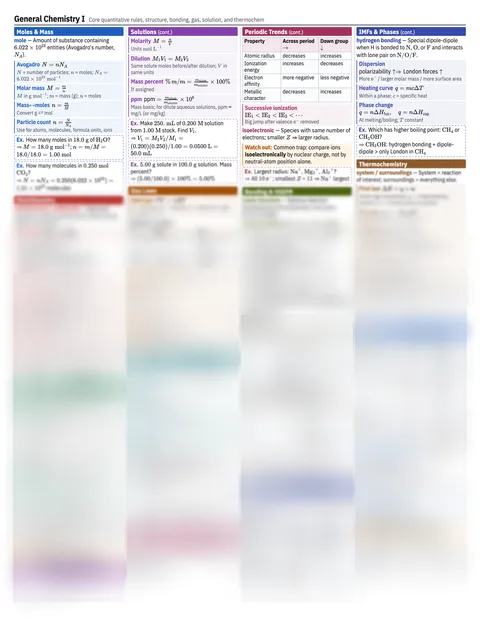
General Chemistry I reference sheet — the free part in text.
Unlock the full reference sheet to edit, print or save it as a PDF.
Make your own for this exam
Upload the stoichiometry and gas-law notes plus one fully worked limiting-reagent problem. Ask for unit labels on every line and the gas-constant units your class uses. Leave thermochemistry files out of this run if they are mixed into the same upload, and say so in the focus box.
FAQ
Questions
- What does General Chemistry I Midterm 1 usually cover?
- Moles, molar mass, balanced stoichiometry, limiting reagent, percent yield, and the ideal gas law. Solution dilution and the start of atomic structure are included only if those lectures already happened.
- Do I get a periodic table?
- Yes, almost always, plus a short constants list. A handwritten note sheet is uncommon. Confirm solubility rules: provided, or not.
- Are Lewis structures on the first midterm?
- Usually they are the next exam, with VSEPR. Check the review topics before you spend the evening on molecular shapes.
Keep going
More study pages
All of these sit in the sheet library. Every exam study page.