General Chemistry I final exam study sheet
The General Chemistry I final is cumulative: the mole and stoichiometry work from the first weeks, gas laws, atomic structure and periodic trends, then Lewis structures, VSEPR, intermolecular forces, and thermochemistry. The later units usually carry more weight because they have been tested least. Stoichiometry still appears everywhere, inside gas, solution, and calorimetry problems.
Some instructors call it a formula sheet, UK students might call it a crib sheet or revision notes, and Canadian courses an aid sheet; here it is one page of the conversions and trends you condense yourself.
 Cheat sheet locked
The scope
What this exam usually covers
These are the problem types a cumulative General Chemistry I final usually grades. The order of units varies between textbooks, so match them to your syllabus.
- Moles, molar mass, and stoichiometry Grams to moles to moles to grams through the balanced equation. Limiting reagent, theoretical and percent yield are on almost every final, and unbalanced equations cost the whole problem.
- Solutions and reactions in water Molarity, dilution, precipitation and net ionic equations, acid-base neutralization, and titration arithmetic. Spectator ions and solubility rules are frequent multiple-choice items.
- Gas laws Ideal gas law with R in matching units, combined gas law, Dalton's partial pressures, and gas stoichiometry. Temperature must be in kelvin; forgetting it is the standard error.
- Atomic structure and periodic trends Electron configurations including the common exceptions your course lists, quantum numbers, and trends in radius, ionization energy, and electronegativity explained by effective nuclear charge.
- Lewis structures and formal charge Valence electron counts, octet exceptions, resonance structures, and formal charge to pick the best structure. Missing lone pairs on the central atom changes the shape answer that follows.
- VSEPR, polarity, and hybridization Electron and molecular geometry from electron domains, bond angles, molecular polarity, and hybridization where your class taught it. Lone pairs count toward electron geometry but are not named in the molecular shape.
- Intermolecular forces and phases Rank boiling points by dispersion, dipole-dipole, and hydrogen bonding, and read a heating curve. Hydrogen bonding needs H attached to N, O, or F.
- Thermochemistry Calorimetry with q equals m c delta T, enthalpy of reaction, Hess's law, and enthalpies of formation. Sign of q for the system versus the surroundings is where points are lost.
Usually later
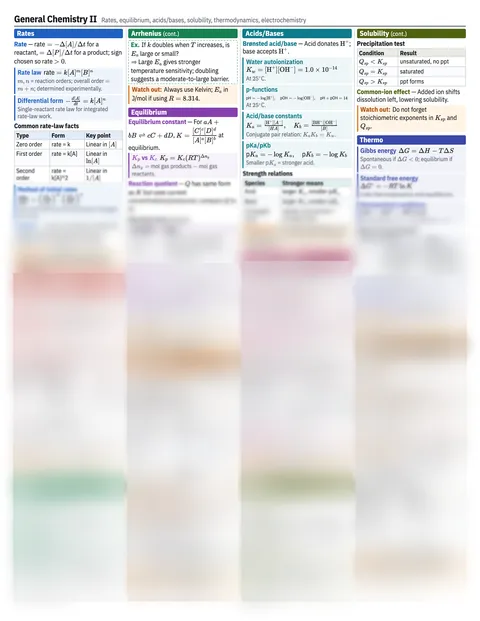
Kinetics, equilibrium, acids and bases beyond neutralization, entropy and free energy, and electrochemistry are General Chemistry II. Some General Chemistry I courses end with solutions and colligative properties, and some with an introduction to equilibrium, so check the review sheet for the last chapter included.
The rules
What a note sheet is usually allowed to include
check your exam header — it wins
General Chemistry I finals are often strict about notes. Many departments give a common final, sometimes a standardized multiple-choice exam, that supplies a periodic table and a constants page and allows no student notes. Other courses allow one handwritten index card or one side of a page. In Canada the exam cover usually states whether an aid sheet is allowed, and in the UK a crib sheet is uncommon for chemistry papers, with data booklets provided instead. Read the syllabus before you plan around a sheet; making one is good revision regardless.
The sheet
The matching library sheet
A one-page reference for the whole topic, fact-checked, with the first part free to read. This exam page does not repeat it. Use it to see the material, then make a shorter study sheet from the notes your section actually used.

General Chemistry I reference sheet — the free part in text.
Unlock the full reference sheet to edit, print or save it as a PDF.
Make your own for this exam
Upload your lecture slides or problem sets for the whole term, and in the focus step name what the review session stressed, such as limiting reagent problems or VSEPR shapes. Pick one page or an index card to match the rule, and keep one fully worked stoichiometry chain with units on every step.
FAQ
Questions
- Is the General Chemistry I final cumulative?
- Almost always. Stoichiometry runs through every later unit, so it shows up even where the final is weighted toward bonding, IMFs, and thermochemistry.
- What goes on a General Chemistry I formula sheet?
- Mole conversions, molarity and dilution, the gas laws with R values, the photon and wavelength relations, periodic trend arrows, the VSEPR table, calorimetry, and Hess's law. Solubility rules are worth a line if your exam does not provide them.
- Can I bring a crib sheet to a General Chemistry I final?
- Sometimes. Many departments give a common or standardized final that supplies a periodic table and allows nothing else. Others allow one index card or one side of a page. The syllabus is the only reliable answer.
- Do I need to memorize the periodic table?
- Rarely. Most chemistry finals provide one. What you need to know is how to read trends from it and how to place an element's electron configuration, which is where the sheet helps.
Keep going
More study pages
All of these sit in the sheet library. Every exam study page.