Intro Statistics final exam study sheet
The intro statistics final is cumulative but leans on inference, the second half of the course. You choose the procedure (one sample or two, paired or independent, proportion or mean), check its conditions, compute the interval or test, and write the conclusion in context. Descriptive statistics, probability and the normal model come back mostly inside those problems rather than as separate questions.
Depending on your school it is a formula sheet, a crib sheet, an aid sheet or revision notes; in statistics it is the page where conditions and procedures sit side by side.
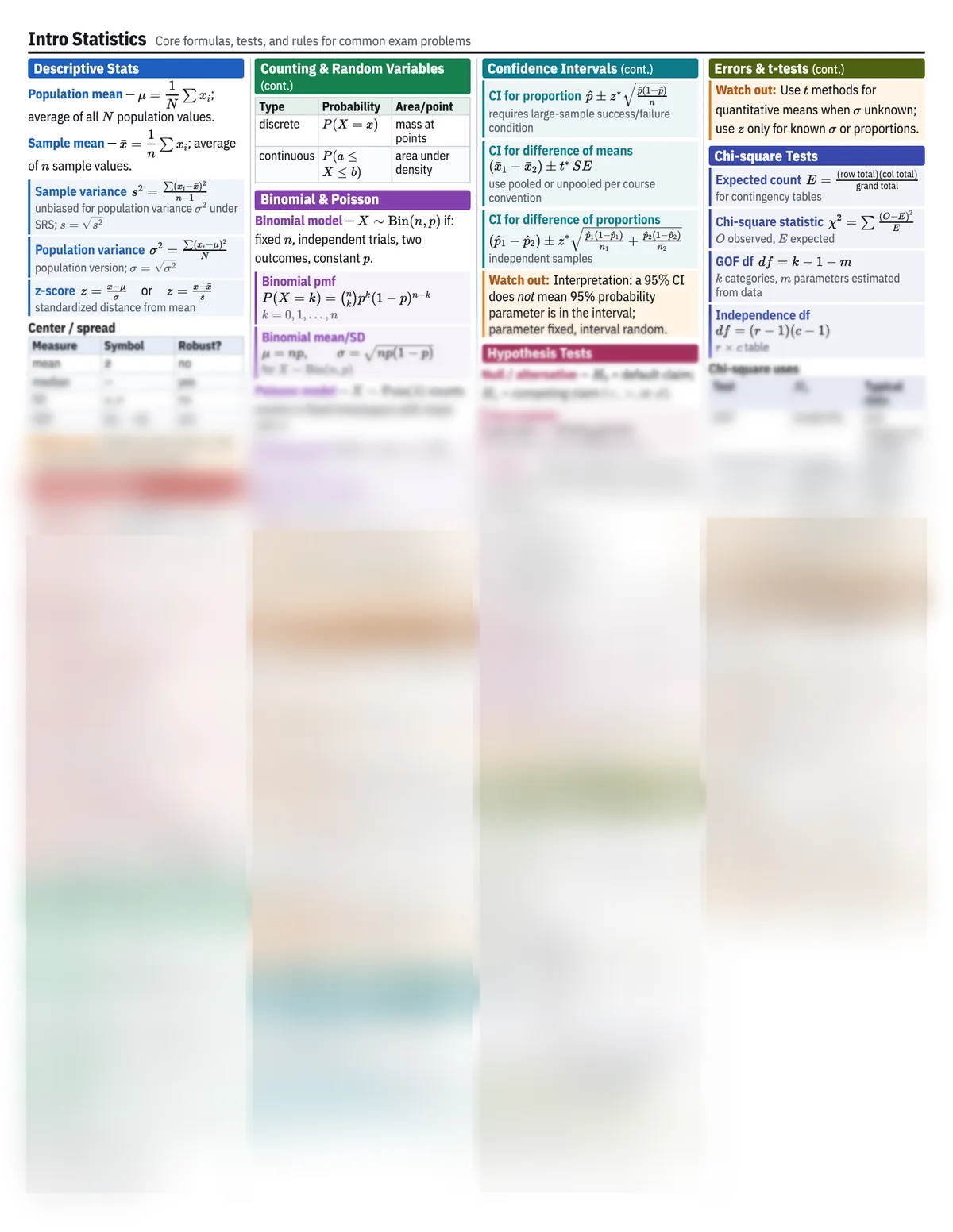 Cheat sheet locked
The scope
What this exam usually covers
Choosing the procedure is most of the grade. Use these as a checklist against your review sheet.
- Choosing the procedure One or two samples, means or proportions, paired or independent data. Treating paired data as two independent samples is one of the most common wrong answers on a stats final.
- Confidence intervals Estimate ± critical value × standard error, for a mean (t with n − 1 df) or a proportion (z). The interpretation is graded: confidence describes the method, not a probability for this one interval.
- Hypothesis tests Hypotheses about the parameter, conditions, test statistic, p-value, and a conclusion in context. Writing “accept H0” instead of “fail to reject H0” costs points in most courses.
- Type I and II errors and power Define both in the context of the problem, and say how α, sample size and effect size change power. Usually a short-answer question worth easy points.
- Two-sample and paired t-procedures The standard error for a difference of means, the paired-differences approach, and the degrees of freedom your course uses (the conservative rule or the calculator’s).
- Chi-square tests Goodness of fit versus independence or homogeneity, expected counts as row total × column total ÷ grand total, the degrees of freedom, and the expected-count condition.
- Regression and correlation Interpreting slope and intercept in context, r and r², residuals, and inference for the slope if your course reached it. Correlation versus causation still gets asked.
- Sampling distributions and the CLT The standard error of a mean or a proportion and when the normal approximation holds. This is the bridge from the midterm material to every inference question.
Usually later
ANOVA, nonparametric tests, multiple regression, and inference for the regression slope are on some intro statistics finals and absent from others. Bayes’ rule and the Poisson model, if they were on the midterm, rarely return as standalone questions. Check the review sheet, and give the space to choosing procedures and checking conditions.
The rules
What a note sheet is usually allowed to include
check your exam header — it wins
Intro statistics finals often come with a provided formula sheet and tables (z, t and chi-square), and the rule for your own notes ranges from one handwritten page to nothing. A provided sheet lists formulas without conditions, interpretation templates or calculator steps, so those are what to study. Canadian courses that allow an aid sheet usually set its size, and UK and Australian courses more often supply a formula booklet and tables than allow a crib sheet. Check the exam rules for your section. Either way, this page is a study sheet: the decision chart is what you need in your head.
The sheet
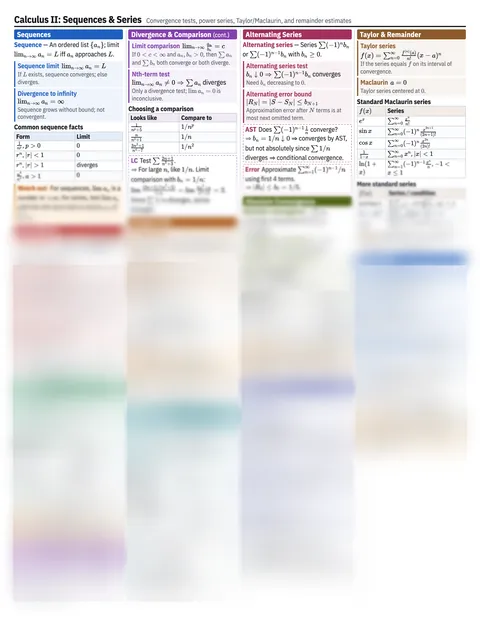
The matching library sheet
A one-page reference for the whole topic, fact-checked, with the first part free to read. This exam page does not repeat it. Use it to see the material, then make a shorter study sheet from the notes your section actually used.
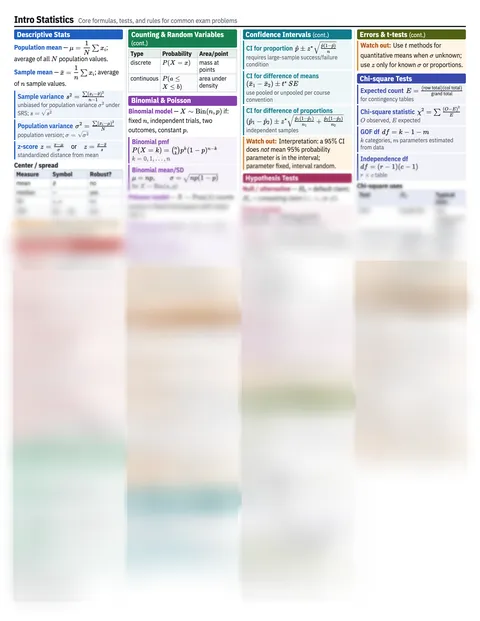
Intro Statistics reference sheet — the free part in text.
Unlock the full reference sheet to edit, print or save it as a PDF.
Make your own for this exam
Upload the inference lectures and problem sets, plus the midterm review if the final is fully cumulative. In the focus step, name what the review session stressed, such as paired tests or chi-square, and the calculator or software your class uses. Pick one page or front and back to match the rule.
FAQ
Questions
- Is the intro statistics final cumulative?
- Usually, but weighted toward inference: intervals, tests, two-sample procedures, chi-square and regression. Probability and the normal model mostly appear inside those problems.
- What goes on a statistics formula sheet for the final?
- A procedure-choosing chart, the conditions for each test, the standard error formulas, the degrees-of-freedom rules, interpretation templates for intervals and p-values, and the chi-square expected-count formula.
- How do I write a hypothesis test conclusion?
- Compare the p-value to α, say whether you reject H0, and state what that means for the parameter in the problem’s context. Never say you proved or accepted the null.
- Can I bring a crib sheet to an intro statistics final?
- Some courses allow one handwritten page on top of the provided formulas and tables; many allow only the provided sheet. Check your syllabus or the exam instructions.
Keep going
More study pages
All of these sit in the sheet library. Every exam study page.