Cell Biology final exam study sheet
The Cell Biology final usually adds the units the midterm did not reach: how cells make ATP, how they divide, and how genes are expressed and controlled. It is normally cumulative, so membranes, sorting and signaling return, but often as part of a larger question, such as how a growth-factor signal pushes a cell past a cell-cycle checkpoint. Expect more diagram interpretation and experimental-design questions than on the midterm.
In the UK and Australia this is a set of revision notes or a crib sheet; in Canada an exam aid sheet; in the US a cheat sheet or study sheet. For cell biology it is mostly processes in order, with where each step happens.
 Cheat sheet locked
The scope
What this exam usually covers
These are the units a cell biology final typically adds or revisits. Use them as a checklist against the review sheet; if your midterm already covered one, it will likely appear again in a combined question.
- Cellular respiration Glycolysis, pyruvate oxidation, the citric acid cycle and the electron transport chain, with where each happens and what each produces. Questions ask what happens to ATP output when oxygen is removed or the proton gradient is collapsed.
- Chemiosmosis and ATP synthase Proton pumping, the gradient across the inner mitochondrial membrane or thylakoid membrane, and ATP synthase as the shared mechanism. Students confuse which side of the membrane the protons accumulate on.
- Photosynthesis Light reactions in the thylakoid make ATP and NADPH and split water; the Calvin cycle in the stroma fixes CO2. Often asked as a comparison with respiration, or as tracing the oxygen atoms in released O2 back to water.
- Mitosis versus meiosis Chromosome number and DNA content at each stage, where homologues pair and cross over, and why meiosis I is the reductional division. A cell with 2n = 4 drawn at metaphase I versus metaphase II is a standard question.
- Cell-cycle control and cancer Cyclins and CDKs, the G1, G2 and spindle checkpoints, p53 and Rb, and proto-oncogenes versus tumour-suppressor genes. Expect a mutation scenario where you predict whether the cell divides.
- Gene expression and regulation Transcription, RNA processing, translation, the genetic code, and regulation at the level of chromatin, transcription factors or operons. Reading a codon table and predicting the effect of a point mutation are common short problems.
- Apoptosis Intrinsic (mitochondrial, cytochrome c) versus extrinsic (death receptor) pathways and caspases. Some courses treat this lightly; others make it the link between signaling and cancer.
Usually later
Detailed enzyme names in glycolysis and the citric acid cycle, C4 and CAM photosynthesis, and stem cells or development are on some cell biology finals and left to other courses in others. Look at your review sheet to see whether the final weights the post-midterm units more heavily, which is common, and whether lab techniques such as microscopy, gel electrophoresis or flow cytometry are examinable.
The rules
What a note sheet is usually allowed to include
check your exam header — it wins
Cell biology finals are often closed-book, especially in large first- or second-year courses with multiple-choice sections. Courses that do allow notes usually limit them to one handwritten page or one side of a page, and a few allow annotated diagrams on it. UK courses may call this a crib sheet; Canadian courses an aid sheet. Where nothing is allowed, condensing the processes into revision notes is still the most efficient review. Check the syllabus; this page is a study sheet either way.
The sheet
The matching library sheet
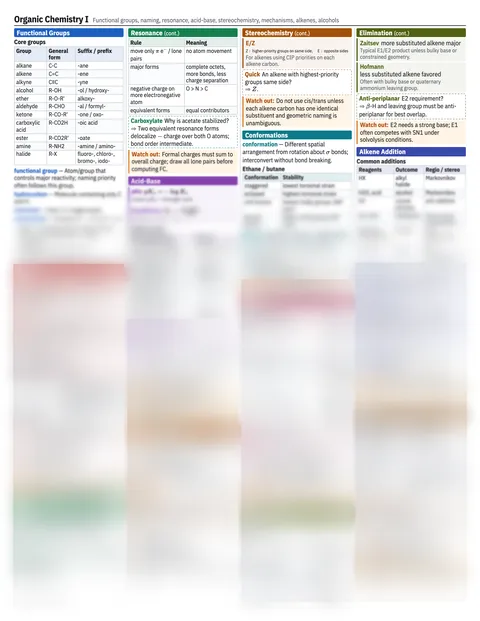
A one-page reference for the whole topic, fact-checked, with the first part free to read. This exam page does not repeat it. Use it to see the material, then make a shorter study sheet from the notes your section actually used.
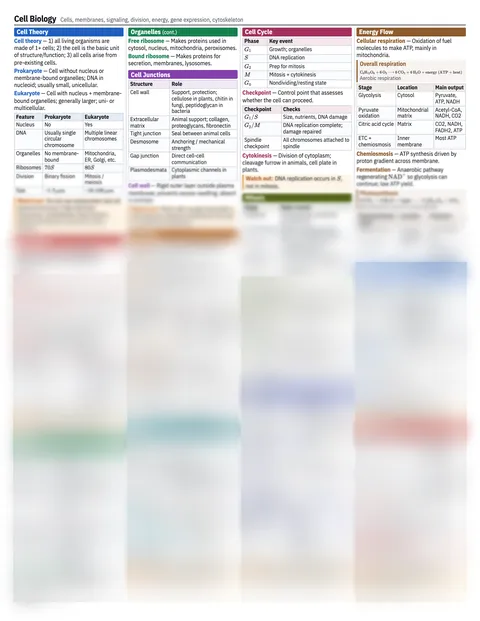
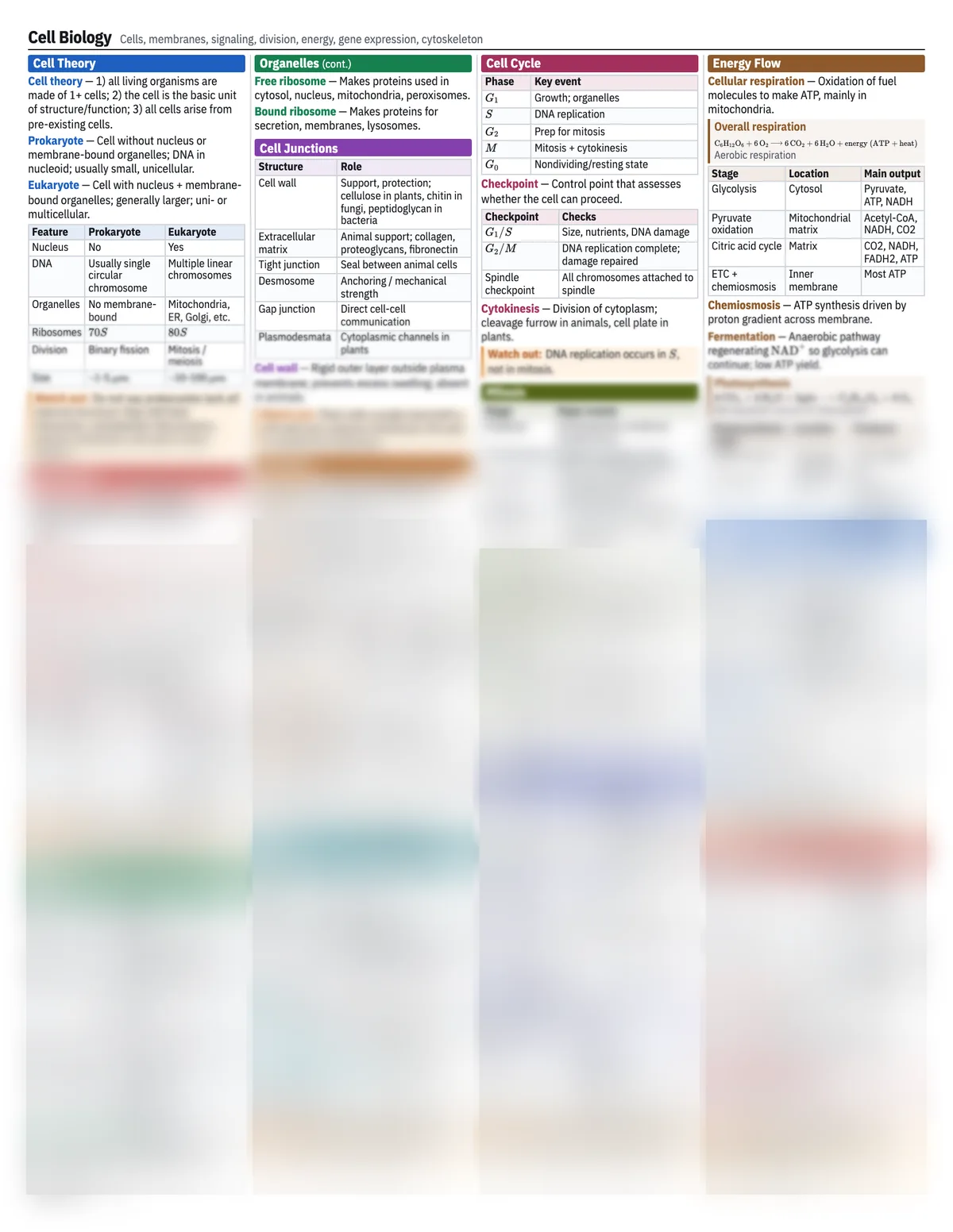
Cell Biology reference sheet — the free part in text.
Unlock the full reference sheet to edit, print or save it as a PDF.
Make your own for this exam
Upload the post-midterm lectures plus the midterm review slides, and leave out any lab manual you will not be examined on. In the focus step, name what the review session stressed, such as checkpoints or chemiosmosis. Choose one page or front and back to match the rule, or the length you want for revision.
FAQ
Questions
- What should I add to my cell biology notes for the final, beyond the midterm sheet?
- Respiration and photosynthesis as processes with locations and products, the mitosis versus meiosis comparison, cell-cycle checkpoints with p53 and Rb, and the steps of gene expression. Keep one line per midterm topic so you can still answer combined questions.
- Is the cell biology final cumulative?
- Usually yes, often weighted toward the material after the midterm. Membranes and signaling tend to reappear inside questions about energy or division rather than on their own.
- How do I condense cell biology into one page of revision notes?
- Write each process as an ordered chain with the location and product of each step, and draw one combined diagram of the mitochondrion and chloroplast. Leave out definitions you already know and keep the steps that trip you up.
- Can I bring a crib sheet to a cell biology final?
- Only if your course says so. Many cell biology finals allow no notes; some allow one handwritten page. Check the syllabus or ask your instructor before the exam.
Keep going
More study pages
All of these sit in the sheet library. Every exam study page.