Cell Biology midterm study sheet
A cell biology midterm is a compare-and-contrast exam. You are asked how two organelles differ, how a protein gets from the rough ER to the plasma membrane, and what changes at each cell-cycle checkpoint. Full respiration and photosynthesis pathways are sometimes this exam and sometimes a later one titled metabolism. Signaling cascades are included at the depth of the lecture, not at the depth of a review book.
For a content-heavy course this is mostly revision notes, or a crib sheet if your exam allows one: the processes and the comparisons examiners ask about.
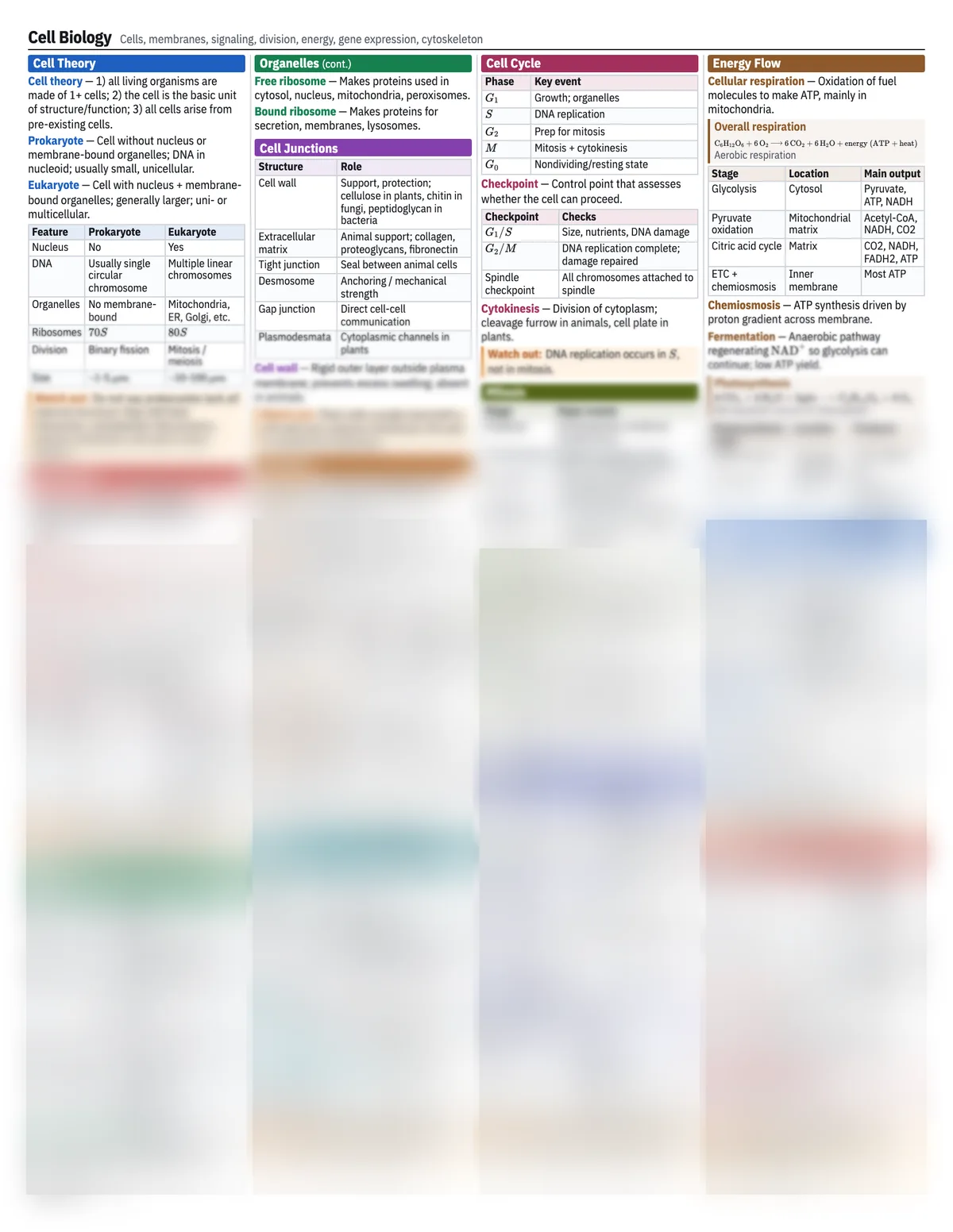 Cheat sheet locked
The scope
What this exam usually covers
Write the comparison in a table on your study sheet. Prose paragraphs do not survive a timed short answer.
- Organelles and jobs Nucleus, ribosome, rough and smooth ER, Golgi, lysosome, mitochondrion, chloroplast if your course includes plants, and the cytoskeleton’s three filaments. One function each, plus one thing it does not do.
- Protein sorting Signal sequences, the secretory pathway, and what happens to a protein with no signal. Vesicle transport only to the level of SNARE or coat proteins if those names were used in class.
- Membranes and transport Phospholipid bilayer, fluidity, channels versus carriers versus pumps, and primary versus secondary active transport. Osmosis as water following solute, with the tonic words your instructor uses.
- Signaling Reception, transduction, response. One GPCR or receptor-tyrosine-kinase path drawn as your lecture drew it, including the second messenger they emphasized.
- Cell cycle G1, S, G2, M, and the checkpoints. What cyclin-CDK actually checks, mitosis stages only if the learning goals list them, and how meiosis differs if that lecture happened.
- Cytoskeleton Microtubules, microfilaments, intermediate filaments: subunit, one motor or one job, and which one the spindle uses.
Usually later
A detailed glycolysis and citric-acid-cycle sheet, the light reactions, and apoptosis pathways are often the second midterm. Histology-style tissue identification is a different course. If your syllabus splits “cell” and “metabolism,” do not memorize enzyme names for this sitting.
The rules
What a note sheet is usually allowed to include
check your exam header — it wins
Cell biology exams are usually closed-note. A few lab-linked courses allow a handwritten page of pathway sketches and ban typed pages. Diagrams you drew yourself are the kind of sheet that gets allowed when anything does; a printed textbook figure usually does not. This page is for studying the comparisons. Assume you cannot bring it unless the exam header says otherwise, and do not walk in with a copied pathway poster.
The sheet
The matching library sheet
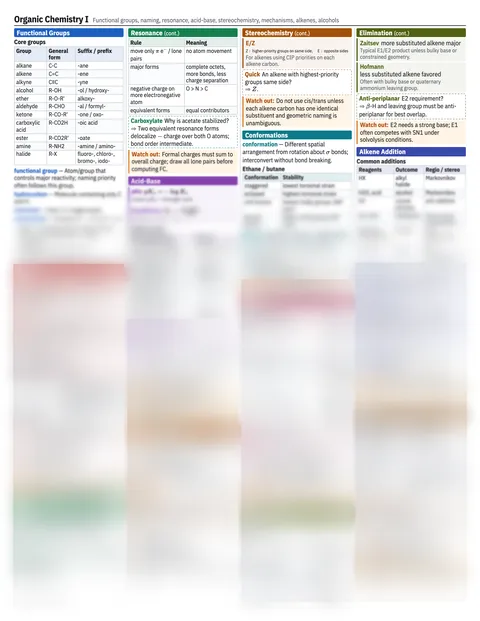
A one-page reference for the whole topic, fact-checked, with the first part free to read. This exam page does not repeat it. Use it to see the material, then make a shorter study sheet from the notes your section actually used.
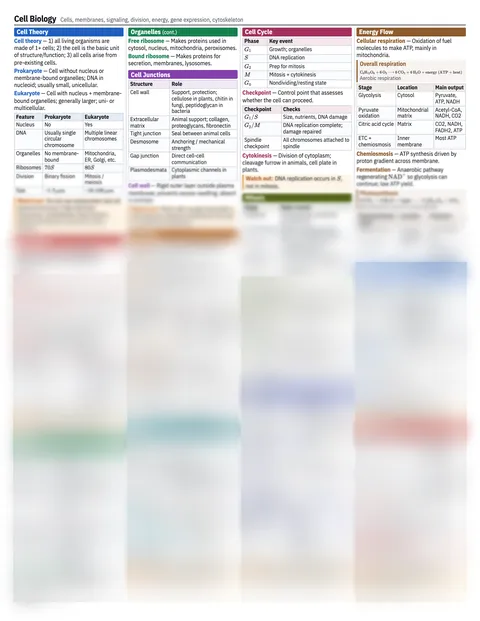
Cell Biology reference sheet — the free part in text.
Unlock the full reference sheet to edit, print or save it as a PDF.
Make your own for this exam
Upload the organelle, membrane, and cell-cycle lectures. Ask for two-column comparisons and one signaling sketch in your course’s notation (the second-messenger name they used, not every possible cascade). Leave metabolism lectures out if the announcement splits the exams.
FAQ
Questions
- What does a cell biology midterm usually ask?
- Compare organelles, trace the secretory pathway, explain a membrane transport example, outline one signaling path from lecture, and name the cell-cycle checkpoints. Short answers and diagrams, more than multiple choice, at many schools.
- Should I memorize the citric acid cycle for this midterm?
- Only if metabolism is on the review list. Many courses give organelles and the cell cycle first and pathways second.
- Are notes allowed?
- Usually no. When a page is allowed, it is handwritten diagrams, not a printed chapter summary. Check the exam instructions.
Keep going
More study pages
All of these sit in the sheet library. Every exam study page.