Physics I final exam study sheet
The Physics I final is cumulative: kinematics and Newton's laws from the first weeks, then energy, momentum, and rotation. Most courses weight it toward the units students have not yet been tested on, which is usually rotation and, where it was taught, simple harmonic motion or gravitation. The hard final problems combine two tools, such as energy conservation into a collision, or a rolling object where translation and rotation share one energy equation.
Your instructor may call it an equation sheet, students in the UK and Australia a crib sheet, and Canadian departments an aid sheet; in every case it is one page of the mechanics you condense yourself.
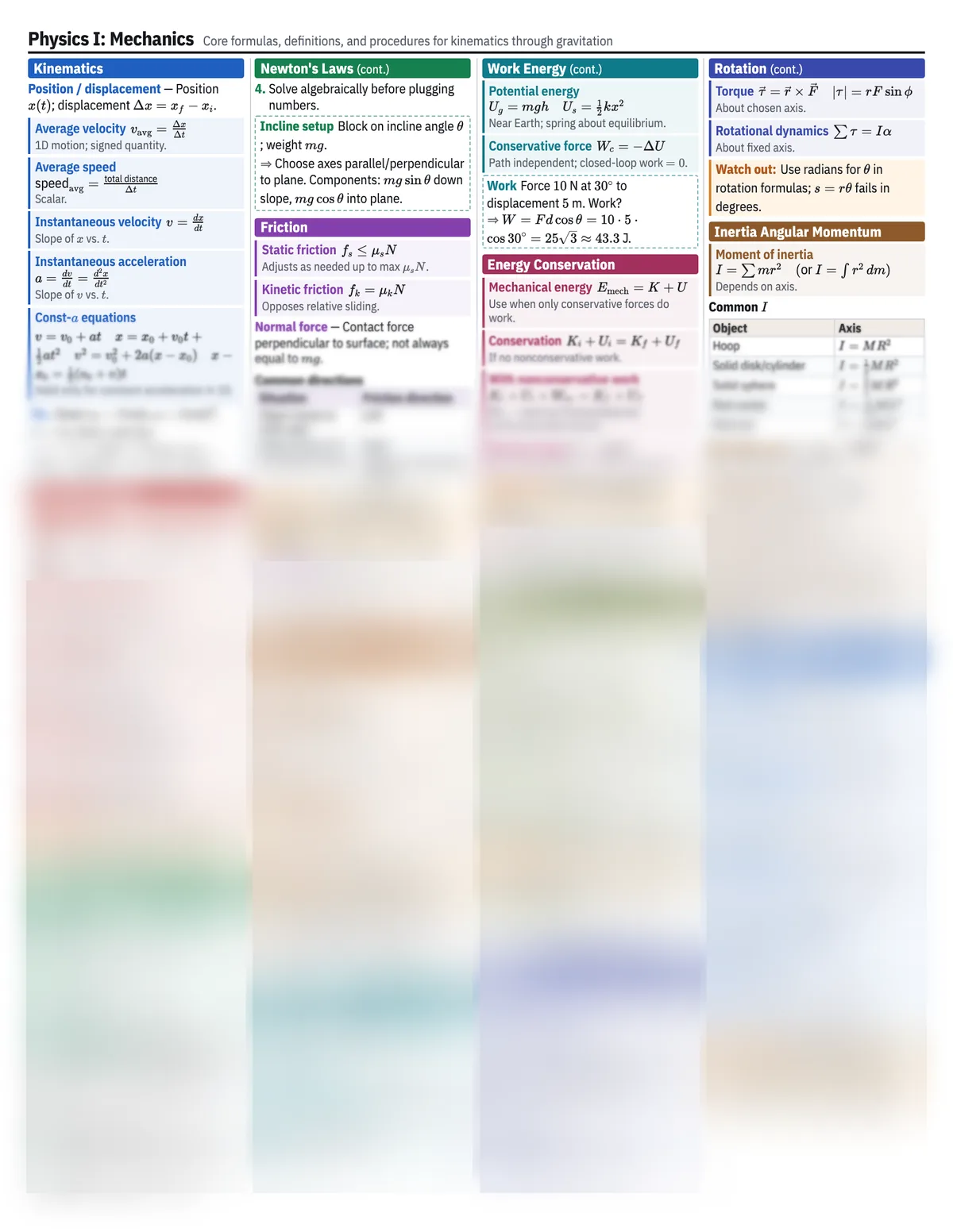 Cheat sheet locked
The scope
What this exam usually covers
These are the problem types a cumulative mechanics final usually grades. Check them against the review sheet, because the last unit varies the most between courses.
- Kinematics and projectiles Constant-acceleration equations, split into x and y for projectiles. Points are lost on sign conventions and on using the range formula when launch and landing heights differ.
- Newton's second law with free-body diagrams Inclines, pulleys, connected blocks, and friction. The grader looks for the diagram and the axis choice before the algebra; static friction is an inequality, not a fixed value.
- Circular motion Net inward force equals m v squared over r. Vertical loops and banked curves are the standard final problems; centripetal force is never a separate force on the diagram.
- Work, energy, and power Work-energy theorem, gravitational and spring potential energy, and work done by friction as the loss term. Choosing energy over forces is often half the credit.
- Momentum and collisions Impulse, conservation in isolated systems, perfectly inelastic collisions, and 1D elastic collisions. Kinetic energy is not conserved unless the problem says elastic.
- Rotation and torque Torque, moment of inertia including the parallel-axis theorem, rotational second law, and rolling without slipping, where v equals omega r ties the two motions together.
- Angular momentum Conservation for a spinning skater or a collision with a rod about a pivot. Students lose points by conserving linear momentum when the pivot exerts a force.
- Oscillations and gravitation Mass-spring and pendulum periods, SHM energy, Newton's gravitation, and circular orbits. On the final only where these were lectured, so check the syllabus.
Usually later
Fluids, waves, sound, and thermodynamics close out Physics I at some schools and belong to Physics II or a separate course at others; they are de-emphasised on most mechanics finals. Static equilibrium and gravitation are each covered by some courses and skipped by others. The review sheet tells you which chapters count; trust it over the textbook's table of contents.
The rules
What a note sheet is usually allowed to include
check your exam header — it wins
Physics finals are more generous with notes than many science finals, because the grading is on setup rather than memory. Common rules are one handwritten page front and back, one side of a US Letter or A4 page, or a department equation sheet printed into the exam booklet with nothing of your own. Some UK and Australian departments permit a crib sheet only for certain papers, and Canadian courses usually state the aid-sheet size on the exam cover. A smaller number allow no notes at all. The syllabus decides, and this page is a study sheet either way: the act of fitting a semester onto one page is the revision.
The sheet
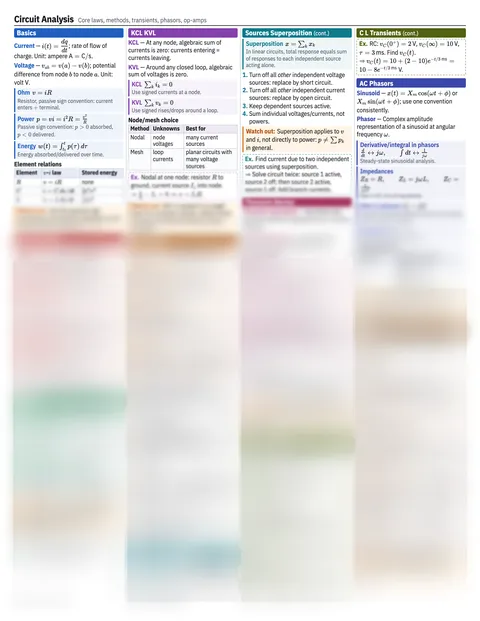
The matching library sheet
A one-page reference for the whole topic, fact-checked, with the first part free to read. This exam page does not repeat it. Use it to see the material, then make a shorter study sheet from the notes your section actually used.
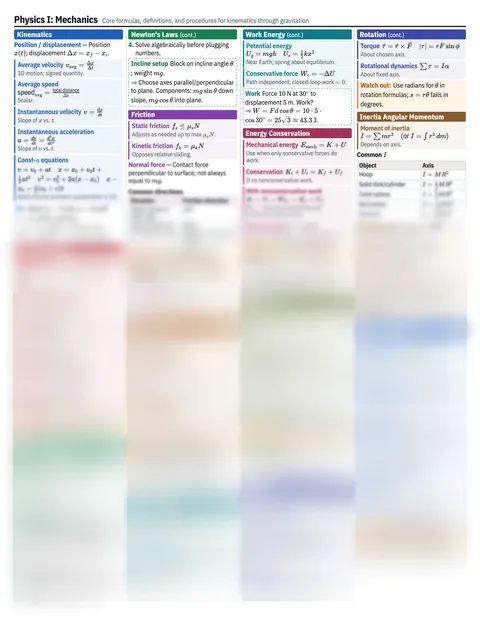
Physics I: Mechanics reference sheet — the free part in text.
Unlock the full reference sheet to edit, print or save it as a PDF.
Make your own for this exam
Upload your lecture slides or problem sets for the whole term, then in the focus step name the units the review session stressed, often rotation and energy. Pick one page or front and back to match your course's rule, and keep the worked examples that combine two topics.
FAQ
Questions
- Is the Physics I final cumulative?
- Usually yes, but weighted toward the material after the last midterm. Rotation and angular momentum often get more problems than kinematics. The review sheet or past finals show the actual split.
- What goes on a Physics I formula sheet for the final?
- The constant-acceleration equations, Newton's second law with friction, circular motion, the energy and momentum equations, the rotational analogues, and a short moment of inertia table. Add one worked example for each problem type that mixes two tools.
- Can I bring a crib sheet to a Physics I final?
- Many courses allow one, often one handwritten page or one side, and some print their own equation sheet into the exam and allow nothing else. Policies differ by department and even by instructor, so read the syllabus or the exam announcement.
- Should I put derivations on the sheet?
- Rarely. The space is better spent on the conditions each equation needs, such as constant acceleration, no slipping, or an isolated system, because applying an equation outside its conditions is where most final-exam points are lost.
Keep going
More study pages
All of these sit in the sheet library. Every exam study page.