Thermodynamics final exam study sheet
A thermodynamics final usually asks you to follow a gas through a process or a cycle and account for heat, work, and internal energy at every step, then apply the second law through entropy or an efficiency limit. It is normally cumulative, with the later material, entropy, Carnot limits, and free energy, carrying the long problems. Engineering thermodynamics courses grade the same laws through property tables and control volumes, so check which version you are in.
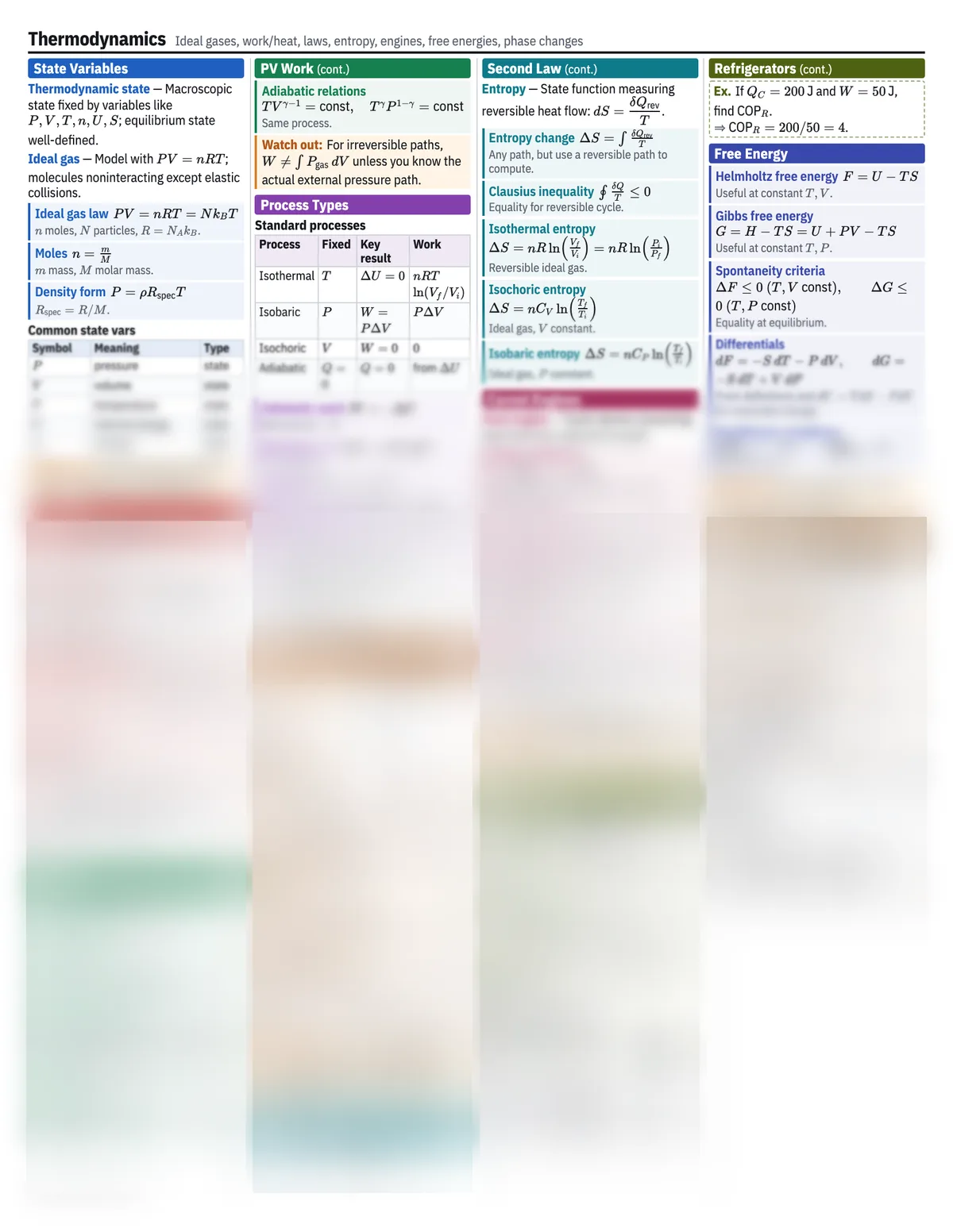
It goes by formula sheet in most US courses, crib sheet or revision notes in the UK, and aid sheet in Canada: a single page of the laws, process relations, and sign conventions you rely on.
 Cheat sheet locked
The scope
What this exam usually covers
These are the problem types a thermodynamics final commonly grades. The physics and engineering versions of the course share the laws but differ in the tools.
- Ideal gas and state variables PV equals nRT in the units your course uses, moles versus mass, and which variables fix the state. Unit slips with kelvin, liters, and kilopascals cost easy points.
- First law and sign convention Delta U equals Q minus W, or Q plus W in courses that count work done on the gas. Pick your course's convention, write it on the sheet, and do not switch mid-problem.
- Work in isothermal, isobaric, isochoric, adiabatic processes Area under the PV curve, the nRT ln ratio for isothermal work, and PV to the gamma constant for reversible adiabatic steps. Cycle tables of Q, W, and delta U are a standard final question.
- Heat capacity and gamma Cv and Cp for monatomic and diatomic ideal gases, Cp minus Cv equals R, and gamma. Using Cp for a constant-volume step is a common mistake.
- Entropy and the second law Entropy change for reversible paths in each process, entropy of the universe for irreversible ones, and why it cannot decrease for an isolated system. Free expansion questions test this.
- Heat engines, refrigerators, and Carnot limits Efficiency as work out over heat in, coefficient of performance for refrigerators and heat pumps, and the Carnot bounds in kelvin. Claims that beat Carnot are trick questions.
- Free energy and phase changes Helmholtz and Gibbs free energy as spontaneity tests, latent heat, and the Clausius-Clapeyron relation. These appear in physics and chemistry-flavoured courses more than engineering ones.
Usually later
Engineering courses may test steam-table interpolation, nozzles, turbines, compressors, and Rankine or refrigeration cycles, which this reference does not cover. Physics courses sometimes end with statistical mechanics, Maxwell relations, or the Boltzmann factor, and those vary widely in weight on the final. Read the review list to see which side your course leans toward.
The rules
What a note sheet is usually allowed to include
check your exam header — it wins
Thermodynamics finals often allow more paper than other courses, because property tables are part of the problem. Engineering versions commonly provide steam and refrigerant tables and permit one page of student notes, front and back. Physics versions more often allow a single handwritten sheet or print the key relations on the exam. Canadian programs usually name the aid sheet on the cover, and UK departments that allow a crib sheet tend to say exactly which papers. Some instructors allow nothing beyond the provided tables. Follow the syllabus; either way, this page is for study.
The sheet
The matching library sheet
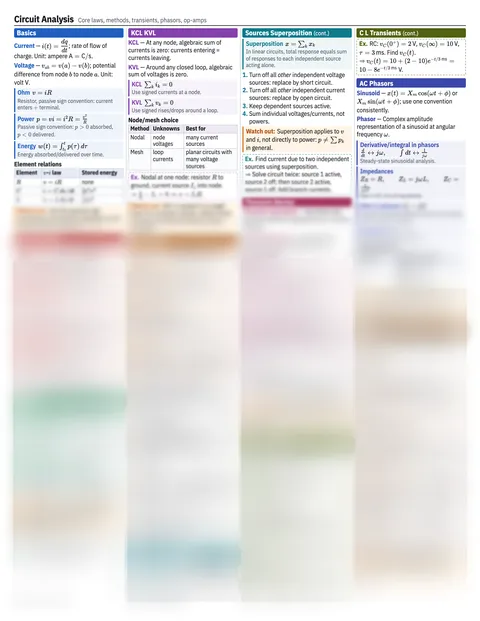
A one-page reference for the whole topic, fact-checked, with the first part free to read. This exam page does not repeat it. Use it to see the material, then make a shorter study sheet from the notes your section actually used.
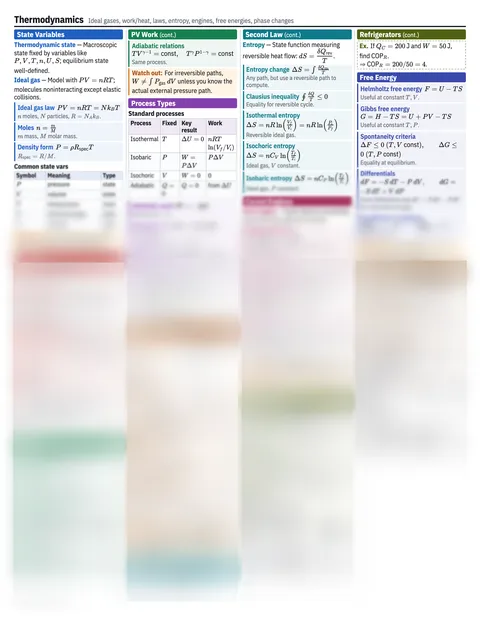
Thermodynamics reference sheet — the free part in text.
Unlock the full reference sheet to edit, print or save it as a PDF.
Make your own for this exam
Upload the lecture notes and problem sets for the full term, and in the focus step say which version of the course you take and what the review session stressed, for example cycle analysis or entropy of mixing. Choose one page or front and back to fit the rule, and keep a filled-in Q, W, delta U table for one cycle as your worked example.
FAQ
Questions
- Is the thermodynamics final cumulative?
- Usually, with more weight on the second law, entropy, and cycles than on the first-law material from early in the term. The exact balance is on the review sheet or in past exams.
- What goes on a thermodynamics formula sheet?
- The ideal gas law, the first law with your sign convention, work for each process type, Cv, Cp, and gamma, entropy change for each process, efficiency and COP with the Carnot limits, and Gibbs and Helmholtz free energy if your course covered them.
- Can I bring a crib sheet into a thermodynamics exam?
- Often yes, but the size varies. Many courses allow one page and provide property tables; some print the equations on the exam and permit nothing else. Check the course outline before you plan around one.
- Does this help with an engineering thermodynamics final?
- Partly. The first and second laws, ideal-gas processes, and Carnot limits carry over. Control-volume energy balances and table lookups for steam and refrigerants are not on this reference, so add them from your own notes.
Keep going
More study pages
All of these sit in the sheet library. Every exam study page.