Anatomy & Physiology I final exam study sheet
The Anatomy & Physiology I final is usually cumulative, but most of the new points come from the second half of the term: muscle tissue and contraction, nervous tissue, the spinal cord and brain, and often the special senses. Early material returns as short questions, so terminology, tissues and bone need a quick refresh rather than a full relearn. Expect at least one multi-step physiology question, such as the events at the neuromuscular junction.
Call it a study sheet, revision notes, a crib sheet or an aid sheet: for an A&P final it is the one page where you fit the processes in order and the structures by name.
 Cheat sheet locked
The scope
What this exam usually covers
Use this as a checklist against your course schedule. A&P I and II split the body systems differently at different schools.
- Early-term review Terminology, homeostasis, membrane transport, tissue types, skin and bone come back as quick questions. Tonicity and feedback-loop labelling are the ones still worth practising.
- Muscle tissue and contraction Sarcomere structure, the sliding filament model, excitation-contraction coupling, the role of calcium and ATP, and motor units. The order of events at the neuromuscular junction is a common long-answer question.
- Major skeletal muscles Name, location and main action for the muscles on your lab list. Origin and insertion only if your course asked for them; many intro courses do not.
- Nervous tissue and action potentials Neurons and glia, resting membrane potential, depolarization and repolarization, the refractory period, and synaptic transmission. Points are lost on which ion channels open in which phase.
- Spinal cord, brain and reflexes Gray and white matter, the reflex arc, brain regions with their main functions, the meninges and cerebrospinal fluid, and cranial nerves if your instructor assigned them.
- Autonomic nervous system Sympathetic versus parasympathetic: origin, neurotransmitters, receptors and effects on the major organs. Usually a comparison table question.
- Special senses Often the last unit: eye structure and the path of light, ear structure for hearing and balance, taste and smell. Some courses move this to A&P II, so check the schedule.
Usually later
Endocrine, cardiovascular, respiratory, digestive, urinary and reproductive systems are usually A&P II, though some programs teach endocrine at the end of A&P I. Detailed muscle origins and insertions are only on finals where the lab required them. Check the final review sheet for exactly which systems are in and whether the lab practical is separate.
The rules
What a note sheet is usually allowed to include
check your exam header — it wins
A&P finals are usually closed-book, and the lab practical final almost never allows notes. Where a lecture final does allow something, it is typically one handwritten index card or one side of a page, sometimes an instructor-provided list of terms; in Canada that is an aid sheet and in the UK a crib sheet. Nursing prerequisite courses tend to be the strictest. Read the syllabus and the final exam announcement. This page is a study sheet either way: building the muscle contraction sequence and the nervous system tables yourself is good revision.
The sheet
The matching library sheet
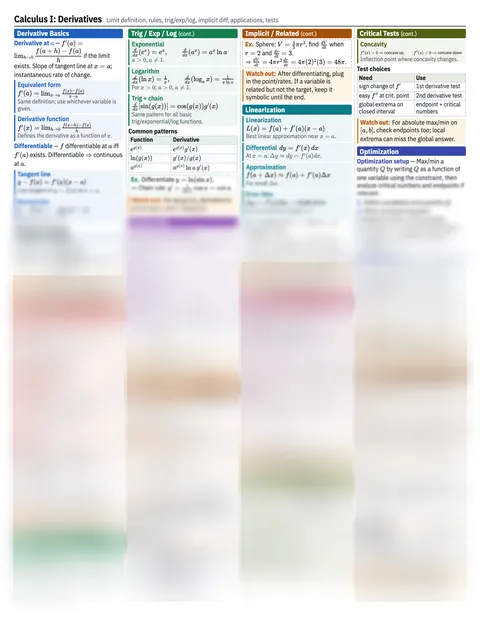
A one-page reference for the whole topic, fact-checked, with the first part free to read. This exam page does not repeat it. Use it to see the material, then make a shorter study sheet from the notes your section actually used.
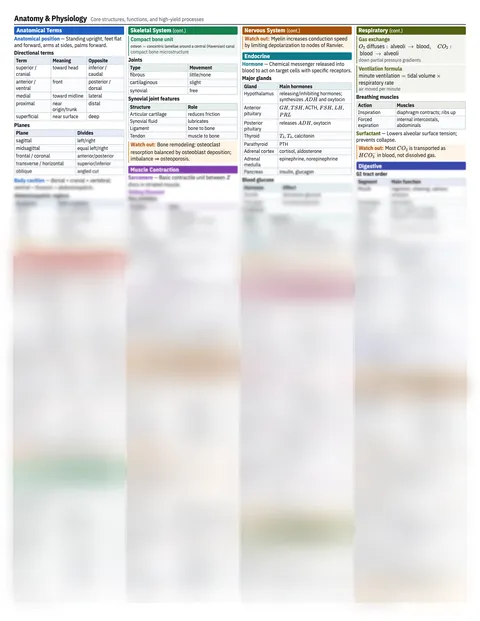
Anatomy & Physiology reference sheet — the free part in text.
Unlock the full reference sheet to edit, print or save it as a PDF.
Make your own for this exam
Upload the slides and lab handouts for the whole term, and in the focus step weight them toward muscle, nervous system and whatever the final review emphasized. Ask for sequences (neuromuscular junction, action potential) as numbered steps. Choose one page for revision, front and back if you want room for the early material, or an index card if that is the rule.
FAQ
Questions
- Is the A&P I final cumulative?
- Usually yes, but weighted toward the material since the last midterm: muscle and the nervous system. Early topics return as shorter questions. Your final review sheet says how the points are split.
- Is an aid sheet allowed on an A&P final?
- Usually not. Most A&P finals are closed-book and the lab practical never allows notes. A few lecture finals permit one handwritten index card. Follow the syllabus; when it says nothing, assume no notes.
- What should go on my A&P I final revision notes?
- The sliding filament and neuromuscular junction sequence, action potential phases with the ion movements, a sympathetic versus parasympathetic table, brain regions with functions, and short reminders for tissues, skin and bone.
- Do I need to know muscle origins and insertions?
- Only if your lab or lecture required them. Many intro A&P courses ask for name, location and action only. Check the lab list.
Keep going
More study pages
All of these sit in the sheet library. Every exam study page.