Organic Chemistry I Midterm 1 study sheet
Organic Chemistry I Midterm 1 is a structure exam at most schools. You draw functional groups, push resonance arrows, rank acids with a pKa trend, assign R/S and E/Z, and compare chair conformations. The substitution and elimination mechanisms (SN1, SN2, E1, E2) are the usual Midterm 2, after the class has a week of curved-arrow practice.
In the UK and Australia it is a crib sheet, in Canada often an aid sheet, and for many students just their revision notes: one page of structures, conventions and trends.
 Cheat sheet locked
The scope
What this exam usually covers
Draw everything. These exams lose points on missing formal charges and wedges, not on paragraphs.
- Functional groups and names Recognize and name the groups your chapter covered: alkane, alkene, alkyne, alkyl halide, alcohol, ether, amine, aldehyde, ketone, carboxylic acid, and simple derivatives if they were lectured.
- Resonance and formal charge Legal arrow pushes only: a lone pair becomes a bond, or a bond becomes a lone pair on the adjacent atom. The major contributor has full octets and fewer charges.
- Acid-base and pKa The stronger acid has the lower pKa. Rank by the atom bearing the charge, resonance of the conjugate base, induction, and the orbital the lone pair sits in. Equilibrium lies toward the weaker acid.
- Stereochemistry Chiral centers, R/S with the lowest priority in the back, enantiomers versus diastereomers, meso compounds, and E/Z on alkenes. Fischer projections only if your class used them.
- Conformations Newman projections: staggered beats eclipsed, anti beats gauche when the groups are large. Chair flips: the larger substituent prefers equatorial.
- Hybridization and geometry sp3 tetrahedral, sp2 trigonal planar, sp linear, and how that shows up in a bond-line drawing. Not a molecular-orbital essay.
Usually later
SN1 versus SN2, E1 versus E2, alkene additions, and alcohol reactions are the usual next unit. If your Midterm 1 review does not list a mechanism, do not fill the study sheet with reaction arrows. Spectroscopy (IR, NMR) is often a quiz of its own or part of Organic Chemistry II.
The rules
What a note sheet is usually allowed to include
check your exam header — it wins
Organic exams rarely allow a free-written cheat sheet of reactions, and Midterm 1 often allows nothing because the content is structure rather than a reagent table. Some sections hand out a pKa table or a periodic table and forbid any other paper. A few allow a single handwritten card of functional groups and the R/S steps. Printed copies, old exams, and model kits are commonly banned even when a card is allowed; model kits are sometimes explicitly allowed, which is the opposite rule from the card. Read the exam announcement. Use this study sheet to practice drawings at your desk.
The sheet
The matching library sheet
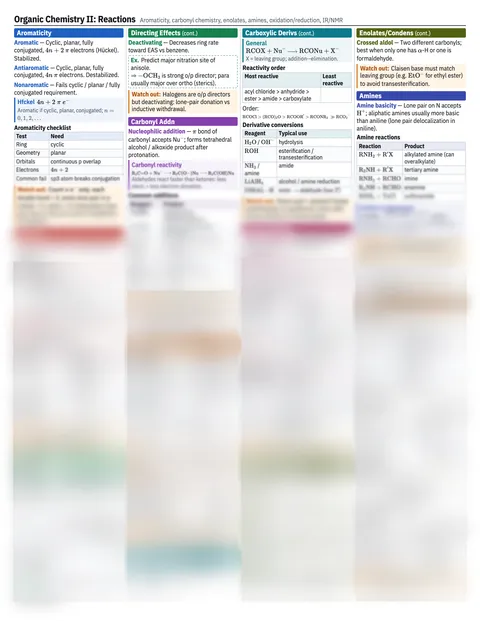
A one-page reference for the whole topic, fact-checked, with the first part free to read. This exam page does not repeat it. Use it to see the material, then make a shorter study sheet from the notes your section actually used.
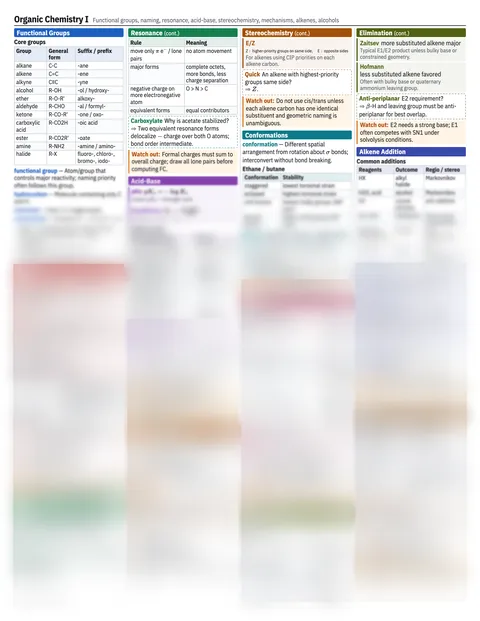
Organic Chemistry I reference sheet — the free part in text.
Unlock the full reference sheet to edit, print or save it as a PDF.
Make your own for this exam
Upload your chapter 1 through 4 notes, or whichever packet your instructor called the first exam. Ask for bond-line drawings, formal charges, and one comparison (R versus S, axial versus equatorial), not a paragraph per term. Your course’s abbreviation for a tert-butyl group or a phenyl ring should come from your notes, not from a generic sheet.
FAQ
Questions
- Does Organic Chemistry I Midterm 1 include SN1 and SN2?
- Usually no. Those mechanisms are the typical second midterm. Midterm 1 is structure, resonance, acidity, stereochemistry, and conformations, unless your review list says otherwise.
- Can I bring a pKa table?
- Only if it is printed on the exam or your syllabus allows it. Many sections provide the table and ban student notes. Do not assume a card is allowed because another section had one.
- What drawings should the study sheet actually contain?
- A functional-group line, a legal resonance example, the Cahn-Ingold-Prelog steps, an E/Z pair, and one chair with equatorial versus axial. Mechanisms can wait.
Keep going
More study pages
All of these sit in the sheet library. Every exam study page.