Calculus II midterm study sheet
The first Calculus II midterm is usually a methods exam. You are graded on choosing u-substitution, integration by parts, a trig identity, a trig substitution, or partial fractions, and on knowing when an improper integral converges. Area and volume applications are sometimes on this exam and sometimes on the next one, depending on whether your class finished techniques before the test date.
Some courses say formula sheet, some say aid sheet or crib sheet; either way it is one page of integration methods and when to reach for each.
 Cheat sheet locked
The scope
What this exam usually covers
Work the decision, not just the algebra. The point most students miss is naming the method before they compute.
- Basic antiderivatives The short table: power rule including the 1/x case, exponentials, the six trig functions you are expected to know, and inverse trig only if your class has introduced them.
- u-substitution The inside function whose derivative is sitting in the integrand, up to a constant. Definite integrals need the limits changed, or the antiderivative evaluated back in x.
- Integration by parts LIATE is a hint, not a proof. The exam wants u and dv chosen so that the new integral is simpler, and a second round of parts when the original integrand comes back.
- Trig integrals Odd power of sine or cosine: peel one off and substitute. Even powers: half-angle identities. Products of secant and tangent follow the same even/odd split.
- Partial fractions Distinct linear factors, repeated linear factors, and irreducible quadratics. Long division first when the numerator’s degree is not smaller.
- Improper integrals Rewrite the infinite limit or the discontinuity as a limit, then say whether it converges. A comparison or limit-comparison sentence is enough when you cannot find an antiderivative.
Usually later
Sequences, series tests, radius of convergence, and Taylor series are the usual second midterm or the final, not this one. If your calendar still lists “chapter 11” after the test, do not study the ratio test tonight. Disk, washer, and shell volumes belong here only if they have already been lectured.
The rules
What a note sheet is usually allowed to include
check your exam header — it wins
Calculus II note-sheet rules are stricter than Calculus I at many schools, because the antiderivative table is the whole exam. Common versions: no notes, with a short integral table printed on the cover; one handwritten index card that may include the table and the parts formula; or a department formula sheet you cannot annotate. Photocopies and typed cards are a frequent explicit ban. Treat this page as a way to practice the method checklist. Carry a physical sheet only when the written policy for your section allows it.
The sheet
The matching library sheet
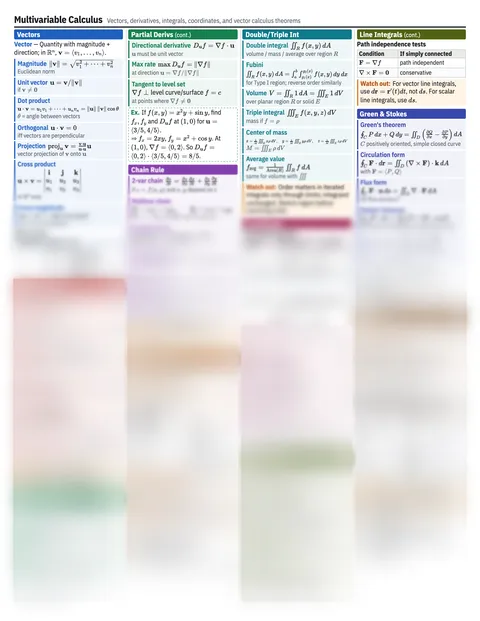
A one-page reference for the whole topic, fact-checked, with the first part free to read. This exam page does not repeat it. Use it to see the material, then make a shorter study sheet from the notes your section actually used.
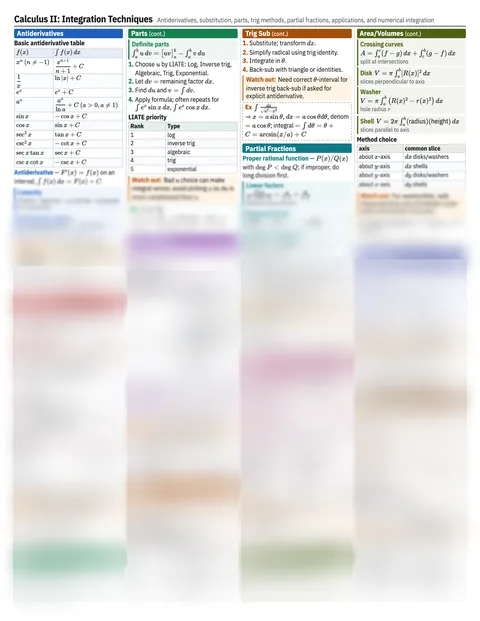
Calculus II: Integration Techniques reference sheet — the free part in text.
Unlock the full reference sheet to edit, print or save it as a PDF.
Make your own for this exam
Upload the technique lectures and the homework that asked you to choose a method, and say so in the focus box: “name the technique first, then the integral.” Skip series notes if they are in the same folder. One page fits a method menu plus the half-angle identities; it will not fit every example.
FAQ
Questions
- Which integration methods does the Calculus II midterm usually test?
- Substitution, parts, trig integrals that need an identity, trig substitution, partial fractions, and improper integrals as limits. The question is usually “which method,” with the algebra second.
- Should I put series tests on a Calculus II midterm study sheet?
- Not unless your instructor already taught them before this exam. Series convergence is typically the next exam. Check the review list rather than the table of contents.
- Are volumes on the techniques midterm?
- Only if disk, washer, or shell has been covered. Many calendars finish techniques, give the midterm, and do applications the following week.
Keep going
More study pages
All of these sit in the sheet library. Every exam study page.